2018 Summer Weather Forecast for Contractors Nationwide
Contractors in the West, prepare for heat; Eastern U.S. to see near-normal temps, rain
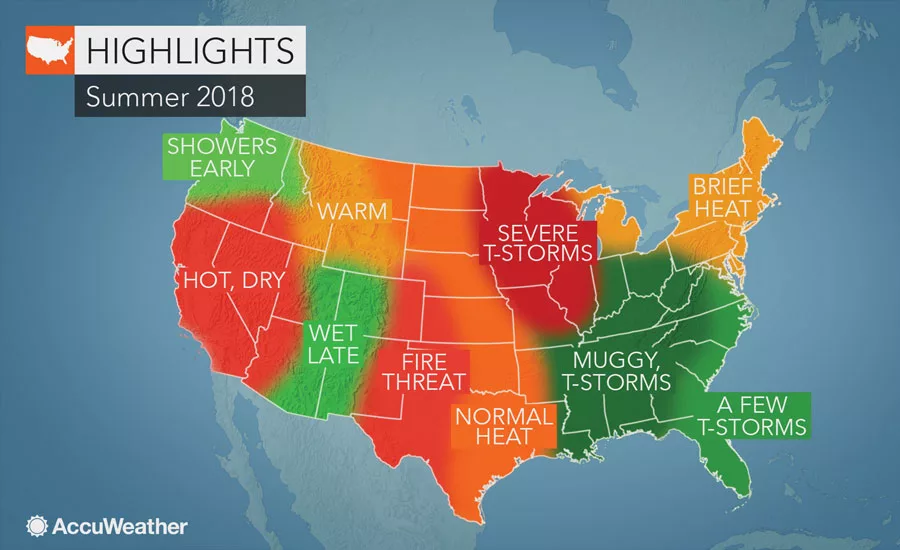
SUMMER 2018 FORECAST: Summer 2018 is forecasted to be hot in the West and rainy with near-normal temps in the East. PHOTO COURTESY OF ACCUWEATHER.
As folks across the U.S. start cranking up their air conditioning to beat the summer heat, HVAC contractors are gearing up for what meteorologists predict will be a hotter-than-normal summer — at least, for a large part of the country. According to forecasts from sources like AccuWeather and NOAA, demand for a/c will be strong in areas west of the Mississippi, with potential for increased HVAC sales in the East despite overall normal-level temperatures. A hot or muggy summer means that contractors will likely have their work cut out for them in the coming months.
ACCUWEATHER
“One of the big themes of this summer is the hottest regions — where we see the extended hot periods — are going to be over the western part of the country, especially the interior West and southern Plains: El Paso, Amarillo, [Texas],” said Max Vido, a long-range meteorologist at AccuWeather.
Driving that pattern is a higher-than-normal jetstream, allowing heat to build up across California, Nevada, and extending northwest into Oregon.
“Seattle, Portland might end up a little closer [to normal temperatures], with a little flow coming off the ocean,” Vido said. “But definitely across the interior, it’s going to be pretty hot. I think some of those areas don’t have as much air conditioning up through there, so perhaps a hot summer could help drive some sales through those areas.”
The high Plains, already in extreme drought, are in for a hotter-than-normal summer, while the central and northern Plains (Kansas, Nebraska, Dakotas, and into Minnesota) will see warmer and drier weather as well. Further west in the Four Corners region (Phoenix; Albuquerque, New Mexico; Salt Lake City; and Denver), the hottest months will be June and July, followed by near-normal temperatures for August.
East of the Mississippi, there won’t be as many of the long heat waves that bring a spike in cooling demand, Vido said. Temperatures from the Gulf Coast to the Southeast to Appalachia will be near normal, with above-average rainfall.
On the flip side, all the humidity in the air will mean it’s muggier than normal.
Looking for quick answers on air conditioning, heating and refrigeration topics? Try Ask ACHR NEWS, our new smart AI search tool. Ask ACHR NEWS
“Despite temperatures not getting into the 90s, the RealFeel® temperatures will be pretty high, so it should drive at least normal cooling demand in these areas,” Vido added, “especially in the more northern regions: Tennessee toward Kentucky and the Ohio Valley, even into Pennsylvania … if it’s warm and sticky, there’s not really that motivation to turn off those air conditioners.”
In terms of the hurricane season, AccuWeather is predicting a near-average number of storms without highlighting any specific coastal areas that might be more prone to a hit than others.
“It’s looking like there should be fewer impacts than last year, which was a very active and destructive hurricane season,” Vido said. “With early season activity (late May, June, July), we’re already seeing very active tropical connections down there, so there’s definitely potential for something to spin up early in the season.”
NOAA
The National Oceanic and Atmospheric Administration (NOAA) offers a long-range forecast through the National Weather Service.
“It looks like this summer, overall as a country, is more of a map that’s red and darker red, so warmer overall than last year, according to countrywide statistics,” said Matthew Rosencrans, meteorologist at the National Weather Service and Climate Prediction Center. “Obviously, there are huge nuances as we go across the country.”
June, July, and August have the highest odds for above-normal temperatures in the area stretching from Washington State down across the Four Corners region to Rio Grande, he said: likely 1 to 1.5°F higher than average.
“When you’re talking about difference from normal, it’s a pretty large deviation and a pretty high demand for energy for cooling,” Rosencrans said.
Compared to last year, NOAA forecasts a summer that’s significantly warmer out West and cooler in the East. From the northern Rockies to the western Great Lakes and down to the central Mississippi Valley, Rosencrans says there’s not a clear shift from a 30-year-normal. The eastern Great Lakes, down through the northern parts of the Southeast, will trend a light tilt toward above-normal.
“That doesn’t mean there wouldn’t be a two-week period over the three months, but the odds of multiple heat events are shifted a bit lower,” he said.
In terms of precipitation, NOAA puts it at drier than normal in the Pacific Northwest, wetter than normal in Utah and Colorado due to a slight northern shift in monsoon patterns, and above normal in the eastern U.S. from the Great Lakes down to Georgia and the Florida Gulf Coast: potentially more cold fronts, creating thunderstorms and rain.
AN INDEPENDENT PERSPECTIVE
To compare summer 2018 to last year’s weather, Chris Orr, certified consulting meteorologist, divided the country into three main sections.
“The eastern part of the country is going to be very similar to last year,” he said. “The central part, hotter than last year. And most of the West will be just a hair cooler than last year.”
In June, New England (from New York up through Maine) will start out on the warm side, about 2° above normal. The Ohio Valley into the central Great Plains will be about 1° warmer than normal, and the whole West from the Rocky Mountains to the Pacific will be above normal by about 2° to 3°. The Denver area might be a little cooler than normal.
Most of the country will have higher-than-normal rainfall in June: 1 to 3 inches above average from Florida across the Great Plains and down into New Mexico. By contrast, the Pacific Northwest will be an inch or two below normal rainfall (which is a big deal for them, according to Orr), and New England will be about half an inch below normal.
July will be cooler in the Front Range from eastern Wyoming through Denver and down through Albuquerque by about 1 to 1.5°, Orr forecasted. That’s the only place, though; in the rest of the central and western U.S., temps remain hot.
“The central part of the country — that’s Oklahoma up through Kansas City to St. Louis and down to northern Louisiana — will be 1° to 2° above normal,” Orr predicted.
So will the area west of the Rockies, he added. Missouri, North Dakota, Minnesota, and Texas will all be about 2 inches below normal rainfall, while the Southeast (Virginia to Mississippi down to Florida) plus most of the Rockies will be 1 to 2 inches above.
It’ll be above-normal temperatures through Missouri, most of Kansas and Texas, Louisiana, and the Tulsa, Oklahoma, area in August as well.
“It’s gonna be hot, running 2° to 3° above normal,” Orr continued. “It’ll be warmer than normal and also more humid: good for air conditioning.”
West of the Rockies will be 1° to 2° above normal, while eastern Wyoming and Nebraska are forecasted to be 1° to 2° below normal in August.
“Wet areas would be eastern Wyoming and South Dakota, about 2 inches above normal, and what we call the Midwest — Ohio, Pennsylvania, out to New York state — are looking at about an inch above normal rainfall,” said Orr.
In terms of the hurricane season, Orr predicted an above-average year, with the main threat being to the Florida panhandle, Georgia, Alabama, and the Carolinas.
PLANNING THE SUMMER
West of the Mississippi, the summer’s hot forecast looks bright for HVAC business, said Don Prather, technical services manager at ACCA.
“HVAC contractors thrive when the weather’s extreme, because people want their heating and cooling,” he said. “It sounds like a great year for contractors: start hiring.”
For contractors busy with a/c installs in hot areas this summer, he’s got some advice: don’t over calculate the load as temperatures spike.
“There’s a common misconception among contractors that because the weather is hot, you need to change the load calculation,” Prather said. “If the weather is 100°, it’s just for a couple hours. And the same with the heating — it never goes to minus 40° and stays there for three days straight.
“Our tables and load calculations have already taken all that into consideration,” he added.
So if a technician tries to factor it in as well, they’ll end up charging the customer for oversized equipment that short-cycles constantly.
Rick True, general manager, Batchelor’s Service, Mobile, Alabama, is already benefitting from a warm late spring.
“Usually we go from slower in March and then April starts moving up, but what we call spring never happened,” he said. “This year, we had 70° every day and 60s at night all through April. Around May 1, it went from 70s to 90s. We went from dead to wide open — we had to adjust on the fly. Service techs had been barely getting hours … now everybody is already working too much.”
How is Batchelors adjusting to all the extra work?
“With a big smile on our face,” he said.
As temperatures rise, heat safety should be among a contractor’s priorities.
“We keep our people very aware of the need to keep hydrated,” said True. “We have a big ice machine and ice chests with a cooler [in each truck] that they fill up and keep water in.”
True tries to have his techs go to work earlier, too, before the attics have a chance to heat up to a blazing 130° at the height of the afternoon.
Contractors in the Midwest or out East, where temperatures are forecasted to be more normal, don’t need to worry; just be proactive.
“Normal conditions are still excellent,” said Prather. “Every year, they’re building new houses, the market’s expanding … they’ll have the regular business.”
In the absence of a spike in service demand, the most important thing a company can do is to prepare for the next big weather event by training and acquiring technicians, Prather added.
“Anytime there’s extreme weather, there’s going to be more calls than they can handle,” he said. “You want to have well-trained people who can do the work when you need them.”
Taking a proactive approach is a conscious choice on the part of contractors, said Mike Treas, HVAC sales coach and an EGIA Contractor University faculty member.
“We have the choice to let the weather affect our business, or we drive our business to effectively deal with and handle customer needs based on age and condition of equipment,” he said.
Mark Matteson, an EGIA Contractor University faculty member and president of Sparking Success consulting, agreed that building a strong service base will help keep business steady for contractors, despite the whims of the weather.
“Overall, you’re seeing a dramatic change in weather patterns: the unpredictability is one of the strangest things,” he said. “I think climate change is here to stay, and it will only get more unique and unpredictable as time goes on. When you have a large service agreement base, you have a steady relationship with the client. A lot of times, the customer will just say ‘do it’ and won’t look for other bids.
“It’s kind of like a restaurant,” he added. “Friday night, you have X amount of waiters and waitresses on staff, and it either gets really busy or not at all. You have to be flexible. You have to be ready to step up.”
Publication date: 6/11/2018
Want more HVAC industry news and information? Join The NEWS on Facebook, Twitter, and LinkedIn today!
Looking for a reprint of this article?
From high-res PDFs to custom plaques, order your copy today!