ACHR News
search
Ask ACHR NEWS AI
cart
facebook twitter instagram linkedin youtube
  • Sign In
  • Subscribe
  • Sign Out
  • My Account
ACHR News
  • NEWS
    • Breaking News
    • New HVAC Products
    • Featured Products
    • Manufacturer Reports
    • HVAC Data
    • Legislation
    • ACHR NEWS Centennial
  • RESIDENTIAL
    • Air Conditioners
    • Furnaces
    • Residential Heat Pumps
    • Ductless
    • Residential IAQ
    • Testing, Monitoring, Tools
    • Components & Accessories
  • COMMERCIAL
    • Air Handlers
    • Rooftop Units
    • Chillers and Cooling Towers
    • Commercial Heat Pumps
    • Boilers and Hydronics
    • VRF/Ductless
    • Commercial IAQ
  • REFRIGERATION
    • Refrigerants
    • Refrigerant Regulations
    • Leak Management
  • CONTRACTOR PRO
    • Geothermal
    • Homeowner Study
    • VRF and VRV Ductless
    • Unitary Trends
  • EDUCATION
    • Training and Education
    • Business Management
    • Service and Maintenance
    • Continuing Education
    • Market Research >
      • HVAC Brand Awareness Report
      • VRV, VRF, VRVZ Report
      • Unitary Trends Report
      • Water Heat Professionals Report
    • Webinars
    • Sponsor Insights
    • eProducts Info
    • White Papers
  • EVENTS
    • HVAC Contractor Forum
    • Industry Events and Webinars
  • MEDIA
    • Videos
    • AHR Expo 2025 Videos
    • Podcasts >
      • ACHR News Podcast
      • HARDI Podcasts
      • AHR Expo Podcasts
      • ACCA Podcasts
    • Interactive Spotlights
    • Quizzes
    • eBooks
    • HVAC Talkback
  • HVAC GROUP
    • ACHR NEWS >
      • Current Issue
      • Digital Edition
      • Subscribe
    • Distribution Trends
    • SNIPS NEWS >
      • Join SNIPS NEWS
    • Engineered Systems News >
      • Join ES News
    • HVACR Directory
    • Contests
    • Newsletters
    • Contact
    • Advertise
    • My Account
HVAC ContractingTechnical

Diagnosing and Finding a Refrigerant Restriction
By Bryan Orr
kecko
(Photo courtesy of Kecko: http://bit.ly/2ovPXIt)
December 18, 2017

Refrigerant circuit restrictions can be common things like a plugged filter drier or a restricted metering device. They can also be more difficult to diagnose and exotic issues like a kinked liquid line, blocked evaporator feeder tube, or a compressor connected improperly with a discharge line full of solder (I’ve seen it).

To start with, let’s talk about the symptoms.

When an undesigned restriction occurs, refrigerant will “back up” against the restriction, resulting in more refrigerant being present before the restriction and less afterwards than designed. Think of it like a refrigerant traffic jam with the refrigerant “road” being congested before the restriction and free and clear afterwards. This restriction will result in a pressure drop across the restriction with higher pressure being on the inlet side and lower pressure on the outlet side of the “traffic jam”.

First we must be aware that a restriction exists in the first place. In the case of the most common liquid line restrictions on HVAC equipment (with no receiver) we will see low suction pressure, high superheat, and normal to high subcooling. In cases like this we know it is not simply “low on charge” because of the subcooling reading, and we also know it isn’t just a an evaporator airflow issue because of the high superheat. This leaves us in the realm of restriction.  Like anything else, some common sense, a look at the system history and a visual inspection can find many restrictions without any fancy diagnosis, but sometimes you have to put on your thinking cap, grab a pipe or a cigar, and go to work.

In a perfect world we could just connect a gauge anywhere in the system and we could find the pressure drop, in the real world we only have two or maybe three points on connection and they are not sufficient for us to pinpoint a restriction. Luckily we have temperature drop as a proxy for pressure drop, whenever the pressure drops there will also be a temperature drop. The trouble is, by the time the temperature drops enough for us to reliably measure it with a thermometer it is usually pretty bad, making minor restrictions hard to find.  It can also be challenging when the metering device itself is a suspect (and it often is), because the metering device is a designed restriction. This means that a pressure drop is it’s very purpose, but is it restricting too much?

So to actually find a restriction you are left with a few tools in your arsenal.

Common Sense

Get acquainted with the history of the system. How old is it? What has been done on it recently? Has the refrigerant circuit been open to atmosphere?  If you recently had a burnout compressor then it is very likely that suction and liquid line driers could be restricted. If the system has been running just fine for 7 years it is more likely that that TXV element tube rubbed out and now the TXV is slammed down. If the distributor just a leak repaired on it, it is very possible that they accidentally filled one of the feeder tubes with solder when they made the repair. A little common sense can save a lot of random hypothesis. Any experienced technician will agree with the problem solving principle called Occam’s Razor that states: “With all things being equal, simpler explanations are generally better than more complex ones.” This certainly hold true when looking for restrictions.

Looking for quick answers on air conditioning, heating and refrigeration topics? Try Ask ACHR NEWS, our new smart AI search tool. Ask ACHR NEWS →

Temperature Drop 

Grab your most accurate line temperature clamp and start making measurements across possible restrictions like line filter driers and the liquid line itself. If you find any confirmable temperature drop across a line drier than you can knows it’s restricted, just make sure to double check. Across a typical liquid line you will generally only see a few degrees of temperature drop but it does depend on the ambient temperature, condensing temperature and the line length.

Freeze Test

Sometimes the exact point of temperature change can be tough to locate. In these cases when the metering device, distributor, feeder tubes, inlet screen or evaporator are all suspects you can do the freeze test. Disconnect the blower and watch the frost patterns. On a properly functioning system the ice will start right at the outlet of the metering device and extend forward though the feeder tubes and work its way fairly evenly through the coil on the coil piping route. Look for inconsistencies in the pattern and you can often find a restriction.

If for example, you see that the frost is starting before the metering device instead of after, you can bet the restriction is an inlet screen. This test is finicky and requires a trained eye to track the tubing patterns, otherwise you might think a coil is restricted when it’s just the way it’s piped. Also be aware that the designed pressure drop of metering devices that also contain a distributor and feeder tubes is cumulative across all of those restriction points. This means that in some cases you may get more frost after the distributor than you do between the metering device and the distributor, this is to be expected.

Thermal Imaging 

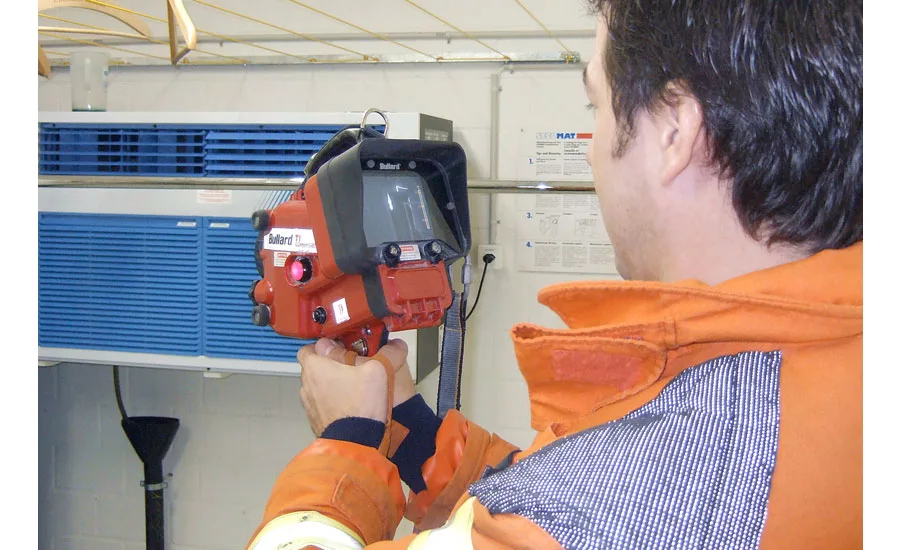
The holy grail of finding restrictions is the thermal imaging camera. You are able to see restrictions in real time and pinpoint the exact location where the temperature change begins. Thermal imaging can even be used to find illusive restrictions like discharge line restrictions caused by poor brazing practices, condenser feeding issues, evaporator restriction etc…

So the process for finding restrictions is –

  1. Prove you have one by looking carefully at your readings
  2. Use some common sense and perform a visual inspection
  3. Take lots of temperature measurements until you find it
  4. Whip out the fancy pants thermal imaging camera and spot that sucker in no time flat and be the hero with throngs of adoring fans

Keep in mind it get’s even trickier to diagnose when you are working on a system with a receiver, because the receiver can usually hold a lot of excess refrigerant, often making a liquid line restriction appear more like a low charge in the readings. Also, minor suction line restrictions like a kinked suction line can be very difficult to find because the temperature drop will usually be unmeasurably low.

This is why taking all the system readings in conjunction with some common sense and knowledge of the systems history are your best allies. And when in doubt… get a thermal imager from TruTech tools .

I told you it wasn’t easy.

Publication date: 12/18/2017

Want more HVAC industry news and information? Join The NEWS on Facebook, Twitter, and LinkedIn today!

KEYWORDS: thermal imaging

Share This Story

Looking for a reprint of this article?
From high-res PDFs to custom plaques, order your copy today!


Podcast studio

Bryan Orr is the vice president at Kalos Services Inc. and founder of the HVAC School. 

Recommended Content

JOIN TODAY
To unlock your recommendations.

Already have an account? Sign In

  • HVAC-enrollment

    The Trades Are Back: HVACR Programs See Nearly 30% Enrollment Spike

    A new wave of future technicians is entering the pipeline.  
    Training and Education
    By: Matt Jachman
  • 2025 Top 40 Under 40

    2025 Top 40 Under 40 HVACR Professionals List

    The 11th annual Top 40 Under 40 list highlights those...
    HVAC Residential Market
    By: Hannah Belloli-Oster
  • LG Ductless Mini-Split Systems

    The 9 Types of Heat Pumps

    As the U.S. moves toward electrification, heat pumps are...
    Heat Pumps
    By: Joanna R. Turpin
Subscription Center
  • Create an Account
  • Start a Subscription
  • Manage My Account
  • Sign Up for Newsletters
  • Visit Customer Service
  • Update Preferences

More Videos

Sponsored Content

Sponsored Content is a special paid section where industry companies provide high quality, objective, non-commercial content around topics of interest to The News audience. All Sponsored Content is supplied by the advertising company and any opinions expressed in this article are those of the author and not necessarily reflect the views of The News or its parent company, BNP Media. Interested in participating in our Sponsored Content section? Contact your local rep!

close
  • Piggy Bank
    Sponsored byWatercress Financial

    Energy Prices, Inflation, and HVAC: What Today’s Homeowners Care About

  • Refrigerated Food
    Sponsored bySolstice Advanced Materials

    R-455A Refrigeration: A Cold Storage Solution for the Future

  • Airex Rooftop Units
    Sponsored byAirex Manufacturing Inc

    Consolidating Roof Penetrations: A Growing Trend in Multifamily HVAC Design

Popular Stories

Outdoor-condensing-units.jpg

EPA Removes R-410A Installation Deadline

HVAC-Price-Increase-graphic

HVAC Price Increase List: June 2026

Trump-Section-232.jpg

Trump Reduces Section 232 Tariffs on HVAC Equipment to 15%

cooling-habits.jpg

50 Percent of Americans Have Skipped HVAC Maintenance

ACHR NEWS Editor Chris Gray Presenting HVAC Minute 5-18-2026

HVAC Manufacturers Fight Pricing Lawsuits

View The ACHR NEWS
Centennial Anniversary Timeline

The ACHR News Timeline Chart
Submit a Letter
Submit a letter to our editors.

Events

November 6, 2025

Next-Gen Data Center Cooling: HVAC Innovation and Real-World Solutions

On Demand As AI workloads and high-density computing push traditional cooling methods to their limits, the data center industry is accelerating the adoption of next-generation HVAC technologies.

June 9, 2026

Before You Go All In on AI: Set Up Your Business to Actually Win

In this webinar, we'll walk you through exactly what to get in place before you add AI to your business. You'll leave with a clear picture of where you stand today and a practical action plan to set yourself up for real results.

View All Submit An Event

Poll

EPA Decision

Are you happy the EPA decided contractors can continue to install R-410A equipment?
View Results Poll Archive

Products

BNI Mechanical/Electrical Square Foot Costbook, 2026 Edition

BNI Mechanical/Electrical Square Foot Costbook, 2026 Edition

See More Products
A2L Refrigerants - Free Webinar - May 21, 2026

Related Articles

  • commercial geothermal market

    Commercial Geothermal Still Finding a Receptive Audience

    See More
  • Solar Applications Finding a Home in Residential HVAC

    See More
  • High Bay Facilities

    Finding a Better Solution for Heating High Bay Facilities

    See More

Related Products

See More Products
  • low grade.png

    Low GWP Refrigerant Safety: Flammable & Mildly Flammable Refrigerants Manual

  • Lessons Learned in a Boiler Room: A common sense approach to servicing and installing commercial boilers

See More Products

Related Directories

  • A-Gas

    A global leader in the supply and lifecycle management of refrigerants, offering a range of products and services, including recovery, buyback, reclamation, separation, and destruction.
  • A-Gas Rapid Recovery

    We provide refrigerant recovery services for HVAC, refrigeration, demolition, and marine industries. We are dedicated to delivering high-speed EPA-compliant recoveries to our customers.
  • Refrigerant Services Inc.

    Replacement refrigerants.
×

Sign Up. Stay Informed.

The #1 trusted source for the HVACR industry since 1926

SUBSCRIBE
  • RESOURCES
    • Advertise
    • Contact Us
    • Advisory Board
    • Classifieds
    • Submit a Letter
    • Directories
    • Store
  • ACCOUNT CENTER
    • Create an Account
    • Start a Subscription
    • Manage My Account
    • Sign Up for Newsletters
    • Visit Customer Service
    • Update Preferences
  • SERVICES
    • Marketing Services
    • Reprints
    • Market Research
    • List Rental
    • Survey/Respondent Access
  • STAY CONNECTED
    • LinkedIn
    • Facebook
    • Instagram
    • YouTube
    • X (Twitter)
  • PRIVACY
    • PRIVACY POLICY
    • TERMS & CONDITIONS
    • DO NOT SELL MY PERSONAL INFORMATION
    • PRIVACY REQUEST
    • ACCESSIBILITY

Copyright ©2026. All Rights Reserved BNP Media, Inc. and BNP Media II, LLC.

Design, CMS, Hosting & Web Development :: ePublishing