High-performance Buildings Need a BAS
Comfort-based data collection is necessary to achieve optimal facility management
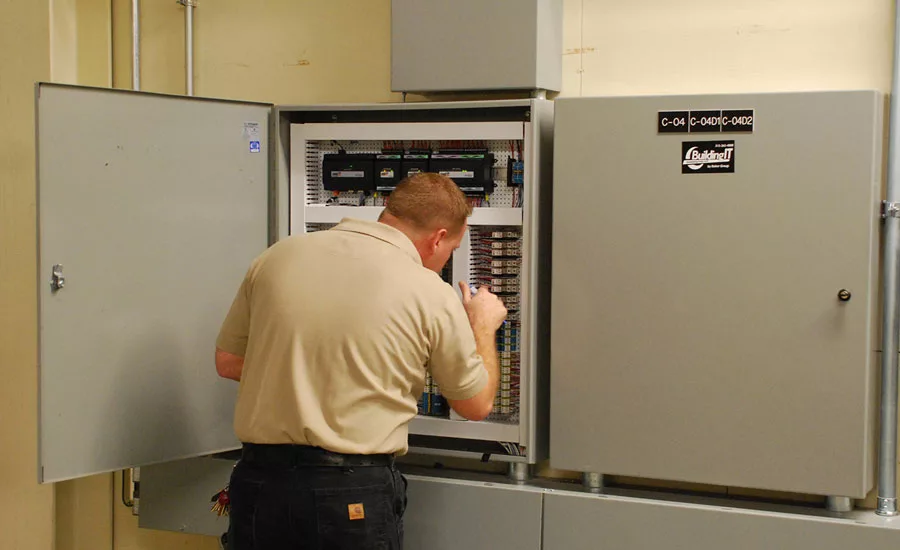
MULTIPLE CHOICES: There are many cost-effective building automation system (BAS) applications available. Here, a direct digital control (DDC) technician with The Baker Group in Ankeny, Iowa, inspects a panel.
High-performance buildings are designed to efficiently use energy, water, and other resources in order to create healthy and productive work spaces. While modeling software is often used for the initial design of such buildings, the ongoing benchmarking, commissioning, and monitoring of these structures are usually the purview of building automation systems (BAS).
Indeed, these functions are critical in high-performance buildings for several reasons, noted Danfoss in a recent report, “High Performance: Making the Buildings-Energy Equation Sustainable,” which stated: “The need to accurately model, benchmark, monitor, and maintain or improve building performance is decisive not only to ensuring building performance but to enabling the system of finance required to make a new world of high-performance buildings possible.”
GATHERING DATA
According to the report that Danfoss developed with Dr. James Freihaut, a professor of architectural engineering at Pennsylvania State University, “Finance requires that investment be linked to real value, which means the actual performance of a building needs to be very near — or better than — the projected building performance.”
In many cases, that data is lacking, notes the paper, which is why there is currently lax demand for the financing of high-performance buildings.
One reason that data may be lacking is that many buildings do not even have a BAS to monitor performance, which is a big mistake.
“Most buildings have nothing other than a teacher or janitor feeling cold and changing the thermostat,” said Dave Bohlmann, vice president of technology, KMC Controls. “A building automation system reduces the pitfalls of manual operation, which mainly includes not configuring set points properly to allow the system to react to actual occupant needs, fault detection, preventive maintenance, etc.”
A BAS is a first step not just to monitor and control equipment but to better understand building performance. Once that performance is better understood, more energy-efficient equipment and techniques can be implemented, noted Bohlmann.
Looking for quick answers on air conditioning, heating and refrigeration topics? Try Ask ACHR NEWS, our new smart AI search tool. Ask ACHR NEWS
Leroy Walden, president, Highrose Consultants LLC in Marietta, Georgia, agrees that a BAS is the base starting point for a high-performing building when it comes to operations.
“Any nonresidential building built today must include some type of automated control capabilities for coordinated comfort, lighting, access, and security,” he said. “Building owners today typically manage multi-building portfolios, and without some sort of automated control strategy, occupant comfort, energy management, and facility/occupant protection, they become overly burdensome and often neglected.”
And because there are many cost-effective BAS applications and integrations available that can make a workplace more efficient and productive, there is no reason for a building owner to skip investing in a BAS, said Daryld Karloff, executive vice president of building services, Baker Group, Ankeny, Iowa. “When it comes to building automation systems, we believe there are two real high-performance value propositions to building owners. The first is the benefit of energy savings and sustainability, and the second is driving improved productivity for the business in the building.”
The first benefit is rather obvious, but in order to drive improvement in productivity, it is necessary to thoroughly understand the functions occurring within the building.
“We know that careful HVAC design and zoning based on the functional use of the building improves thermal comfort and therefore productivity, but we want to go deeper than that,” said Karloff.
For example, conference spaces in a building can utilize parts of a BAS, such as sensors that count people, in order to improve productivity.
“Counters allow us to not only reset the ventilation for the room to match the number of people, but they allow us to call an elevator to the floor as people start to leave. If there is a waiting elevator, we just eliminated wait time and improved productivity,” said Karloff. “You can see how a BAS suddenly becomes an extremely valuable tool in this quest to reduce friction in the workplace.”
In addition, counting people entering and leaving conference spaces provides great insight into which rooms are used the most.
“Smart facility managers replicate spaces that are desired and used and repurpose rooms/areas that are used less,” noted Karloff. “This improved space utilization helps drive savings in the building’s operating costs.”
Of course, creating this type of strategy involves the skill of an experienced contractor who can help guide the building owner toward the ultimate goal of reducing energy usage and increasing productivity.
“BAS contractors develop unique, trust-based relationships with their clients over the years due to the special nature of the BAS installation,” said Walden. “It forms the central nervous system of the building from an operational standpoint and is an indispensable facet of the owner's ability to serve and satisfy their customers’ [tenants, occupants] needs.”
In order to keep that unique relationship strong, BAS contractors must be advocates for their clients, keeping them informed of emerging industry trends and directing them to independent and reliable information sources that will help them evaluate their own needs and those of their customers, added Walden. “Contractors should then consult with them on specific business outcomes and custom-tailor technology implementations to help them achieve their goals.”
EMPLOYING A STRATEGY
Helping building owners reach their energy and productivity goals first requires that a BAS be in place. For standard buildings that already have a BAS in place, the good news is that most systems installed in the last 10-15 years offer a suitable starting point to begin the process of becoming high-performance buildings, said Walden.
“A key criteria is that the BAS be IP-based and be compatible with BACnet or LON protocols that allow interoperability and data sharing between comfort controls, lighting, power monitoring, security, and access control systems,” he said. “Most building automation systems of this generation can be supplemented by the addition of more modern data query and visualization software, such as dashboarding and data analytics, which form the cornerstones of smart, high-performing building operations.”
Unfortunately, many building automation systems installed prior to the year 2000 are proprietary systems, and it may not be cost-effective to try to update the legacy systems in support of a high-performing building strategy, noted Walden.
“However, through protocol interpreters and field bus integrations, many of the existing field controllers can be reused,” he said. “Connection of these existing field controllers to a modern wide area network controller provides the requisite IP-based networking capability and supports most modern, open-data-sharing protocols.”
Building owners trying to decide whether to replace their existing automation systems with new ones will obviously want a detailed cost analysis to ensure the upgrade is worthwhile.
“Some solutions are more advanced than others, so simply changing out a BAS can give a user more access to features, analytics, and logic to more efficiently run the existing mechanical systems,” said Bohlmann. “Dashboards, for example, can allow owners to easily compare their building with their own building’s past performance or comparable buildings in their portfolios.”
Whether upgrading an existing system or buying a new one, the BAS of today must be capable of integrating with many building systems as well as providing control functions, said Karloff.
“Most mainstream automation manufacturers have a box that will do this; however, the key ingredient for success is the skill of the automation technicians,” he added. “The technician team needs to have the skills to see deeply into an organization and implement control sequences and systems integrations that improve productivity and control energy costs.”
For this reason, Karloff suggests that building owners select their BAS partners based on the experience and skills of their technical staff.
“All too often, owners start with a focus on the marketing material of the box manufacturer and then later discover the local representative’s name,” he said. “The right BAS contractor with the right skill set is in the best position to help a building owner determine the best strategies to reduce energy, improve comfort, and improve productivity.”
Publication date: 7/17/2017
Want more HVAC industry news and information? Join The NEWS on Facebook, Twitter, and LinkedIn today!
Looking for a reprint of this article?
From high-res PDFs to custom plaques, order your copy today!