ACHR News
search
Ask ACHR NEWS AI
cart
facebook twitter instagram linkedin youtube
  • Sign In
  • Subscribe
  • Sign Out
  • My Account
ACHR News
  • NEWS
    • Breaking News
    • New HVAC Products
    • Featured Products
    • Manufacturer Reports
    • HVAC Data
    • Legislation
    • ACHR NEWS Centennial
  • RESIDENTIAL
    • Air Conditioners
    • Furnaces
    • Residential Heat Pumps
    • Ductless
    • Residential IAQ
    • Testing, Monitoring, Tools
    • Components & Accessories
  • COMMERCIAL
    • Air Handlers
    • Rooftop Units
    • Chillers and Cooling Towers
    • Commercial Heat Pumps
    • Boilers and Hydronics
    • VRF/Ductless
    • Commercial IAQ
  • REFRIGERATION
    • Refrigerants
    • Refrigerant Regulations
    • Leak Management
  • CONTRACTOR PRO
    • Geothermal
    • Homeowner Study
    • VRF and VRV Ductless
    • Unitary Trends
  • EDUCATION
    • Training and Education
    • Business Management
    • Service and Maintenance
    • Continuing Education
    • Market Research >
      • HVAC Brand Awareness Report
      • VRV, VRF, VRVZ Report
      • Unitary Trends Report
      • Water Heat Professionals Report
    • Webinars
    • Sponsor Insights
    • eProducts Info
    • White Papers
  • EVENTS
    • HVAC Contractor Forum
    • Industry Events and Webinars
  • MEDIA
    • Videos
    • AHR Expo 2025 Videos
    • Podcasts >
      • ACHR News Podcast
      • HARDI Podcasts
      • AHR Expo Podcasts
      • ACCA Podcasts
    • Interactive Spotlights
    • Quizzes
    • eBooks
    • HVAC Talkback
  • HVAC GROUP
    • ACHR NEWS >
      • Current Issue
      • Digital Edition
      • Subscribe
    • Distribution Trends
    • SNIPS NEWS >
      • Join SNIPS NEWS
    • Engineered Systems News >
      • Join ES News
    • HVACR Directory
    • Contests
    • Newsletters
    • Contact
    • Advertise
    • My Account
HVAC ContractingTechnical

Determining Proper Cooling Tower Size

To maximize cooling tower benefits, the appropriate tower size must be selected
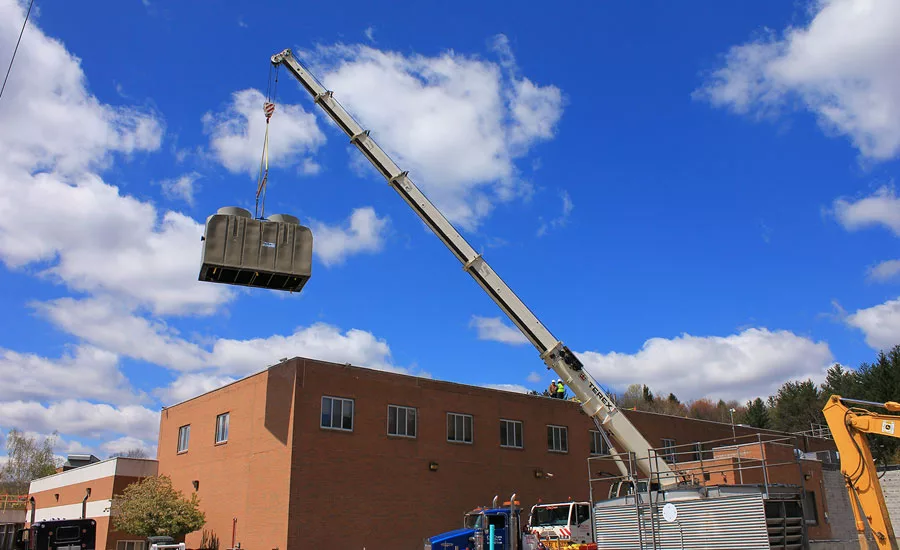
cooling tower being raised onto roof
October 24, 2016

Cooling towers are a relatively inexpensive and reliable way of expelling heat from a number of industrial and commercial processes, including nuclear & thermal power plants, petroleum refineries, petrochemical plants, food processing plants, as well as commercial HVAC systems.

As the worldwide market for these applications continues to grow, so does the need to address the issue: How large should a cooling tower be to efficiently handle a specific application.

“There are a lot of different applications where you certainly don’t want an undersized cooling tower,” said John Flaherty, president of Delta Cooling Towers. Delta manufactures a line of high-density polyethylene (HDPE) engineered plastic tower models.

“For example, if an undersized cooling tower is not producing cold enough water to cool the condenser loop of an office building’s HVAC chiller, then the chiller could shut down. That would probably mean some expensive repairs plus a lot of angry tenants.”

On the industrial side, Flaherty advises that insufficient tower cooling capacity can cause breakdowns or even severe damage to costly process equipment, resulting in extensive losses in productivity. In fact, determining the minimum size for most any application is critical.

Cooling towers are known, generally, for their ability to expel waste heat from an industrial process or the condenser in a comfort cooling application. Wet cooling towers achieve this function through evaporating a small portion of the recirculating water, resulting in significant cooling of the returning water to the process.

COOLING TOWER SIZING

For most wet cooling tower applications, said Flaherty, optimum cooling tower size may be determined by a combination of four different metrics: heat load, range, approach, and wet bulb temperature. In order to understand how these factors influence cooling tower size, it is first necessary to give the terms some context.

Looking for quick answers on air conditioning, heating and refrigeration topics? Try Ask ACHR NEWS, our new smart AI search tool. Ask ACHR NEWS →

The wet bulb temperature (WBT) of the air entering the cooling tower is an independent variable that is a fundamental factor in dictating the appropriate size of a cooling tower.  It is both the theoretical limit to the exiting cooled water temperature and the only specific air parameter necessary in cooling tower selection. In sizing a cooling tower, the highest WBT expected temperature is used for very hot, humid climates.

The thermal performance of mechanical draft towers is barely affected by relative humidity or by the dry bulb temperature (true thermodynamic temperature) of the entering air. For mechanical draft towers, the amount of mass airflow (generated by fans) constitutes much of the hot-water-cooling capacity of the tower.

Dry bulb temperature and relative humidity do have a major effect on the performance of natural draft towers, those without fans.

The difference between the WBT and the cooled water temperature is called the approach temperature (or simply, approach). Approach temperatures generally fall between 4° and 20°F. As the approach temperature drops, the required cooling tower size increases exponentially. However, many cooling tower manufacturers do not guarantee tower performance when approach temperature is less than 5°F.

The difference between the tower’s hot water temperature (water leaving the hot machinery) and the cold water temperature is called the range. Along with WBT and approach, the range also affects cooling tower size requirements. The heat load varies directly with range and gallons per minute (gpm) flow rate.

“When three of four sizing factors are held constant, the requirement for cooling tower size varies directly with heat load, but inversely with range, approach, and wet bulb temperature,” Flaherty explained. “So, there can be several design decisions to make that will impact the ultimate size of the required cooling tower.”

EFFICIENCY MATTERS

Flaherty noted that maintaining cooling tower efficiency is important to most applications.

An efficiency-related advantage of HDPE cooling towers is they are impervious to corrosion. The corrosives present in salt water air or the caustic atmosphere of many industrial sites are not a problem for these towers. Because HDPE towers are unaffected by corrosives, maintenance is minimized and service life increased.

Cooling tower efficiency can also be affected by tower footprint. “Some companies choose a tower with a smaller footprint to conserve on space,” Flaherty said. “But that may require using more power to drive the tower, and energy savings is high on a lot of companies’ priorities. So, in those cases, a cooling tower with a bigger footprint may consume much less energy, and therefore would be the more efficient choice.”

Flaherty added that for most industrial and commercial applications, it is highly beneficial to consult with an experienced cooling tower engineer before finalizing plans to purchase a tower for a facility.

For more information, visit www.deltacooling.com.

Publication date: 10/24/2016

Want more HVAC industry news and information? Join The NEWS on Facebook, Twitter, and LinkedIn today!

KEYWORDS: cooling towers sizing for HVACR

Share This Story

Looking for a reprint of this article?
From high-res PDFs to custom plaques, order your copy today!


Recommended Content

JOIN TODAY
To unlock your recommendations.

Already have an account? Sign In

  • HVAC-enrollment

    The Trades Are Back: HVACR Programs See Nearly 30% Enrollment Spike

    A new wave of future technicians is entering the pipeline.  
    Training and Education
    By: Matt Jachman
  • 2025 Top 40 Under 40

    2025 Top 40 Under 40 HVACR Professionals List

    The 11th annual Top 40 Under 40 list highlights those...
    HVAC Contracting
    By: Hannah Belloli-Oster
  • LG Ductless Mini-Split Systems

    The 9 Types of Heat Pumps

    As the U.S. moves toward electrification, heat pumps are...
    HVAC Residential Market
    By: Joanna R. Turpin
Subscription Center
  • Create an Account
  • Start a Subscription
  • Manage My Account
  • Sign Up for Newsletters
  • Visit Customer Service
  • Update Preferences

More Videos

Sponsored Content

Sponsored Content is a special paid section where industry companies provide high quality, objective, non-commercial content around topics of interest to The News audience. All Sponsored Content is supplied by the advertising company and any opinions expressed in this article are those of the author and not necessarily reflect the views of The News or its parent company, BNP Media. Interested in participating in our Sponsored Content section? Contact your local rep!

close
  • An illustration shows a house with a geothermal heating system. Pipes are depicted running underground.
    Sponsored byClimateMaster

    Residential Tax Credits Are Ending, But Demand Continues

  • Piggy Bank
    Sponsored byWatercress Financial

    Energy Prices, Inflation, and HVAC: What Today’s Homeowners Care About

  • Refrigerated Food
    Sponsored bySolstice Advanced Materials

    R-455A Refrigeration: A Cold Storage Solution for the Future

Popular Stories

price-raising-practices.jpg

Rising Costs Force Contractors to Take a Harder Look at Pricing

DOE-sign.jpg

HVAC Groups Support DOE’s Rulemaking to Cut Energy Efficiency Mandates

HARDI lolgo navy

HARDI Distributors' Sales Down Nearly 5% in May

Data-Center-Inspection.jpg

Can HVAC Train Enough Technicians for the Data Center Boom?

New-HVAC-Equipment.jpg

Amended Complaint Filed in HVAC Price-Fixing Lawsuit

View The ACHR NEWS
Centennial Anniversary Timeline

The ACHR News Timeline Chart
Submit a Letter
Submit a letter to our editors.

Events

November 6, 2025

Next-Gen Data Center Cooling: HVAC Innovation and Real-World Solutions

On Demand As AI workloads and high-density computing push traditional cooling methods to their limits, the data center industry is accelerating the adoption of next-generation HVAC technologies.

July 22, 2026

Designing VRF Systems Using A2L Refrigerant

In this session, we will cover how to design VRF systems for the U.S. market using new A2L refrigerants. These systems provide an advanced zoning solution by using inverter technology to deliver precise heating and cooling control across multiple zones and spaces.

View All Submit An Event

Poll

Summer Staff

Are you fully staffed for the summer season?
View Results Poll Archive

Products

BNI Mechanical/Electrical Square Foot Costbook, 2026 Edition

BNI Mechanical/Electrical Square Foot Costbook, 2026 Edition

See More Products
Designing Systems Using A2L Refrigerant - Free Webinar - 7/22/2026

Related Articles

  • Delta Cooling Tower: Cooling Tower

    See More
  • The Marley Cooling Tower Co.: FIBERGLASS COOLING TOWER

    See More
  • Marley Cooling Tower, a United Dominion Co.: COOLING TOWER LINE

    See More

Related Products

See More Products
  • comfortcoolingdvd.jpg

    COMFORT COOLING REFRIGERATION SYSTEM TROUBLESHOOTING

See More Products

Related Directories

  • Rakshan Cooling Towers

    Rakshan Cooling Towers is a leading manufacturer in India, delivering energy-efficient, durable, and customized cooling tower solutions for industrial, commercial, and HVAC applications.
  • World Cooling Towers

    World CoolingTowers is a leading cooling tower manufacturer in India. We manufacture and Supply highly durable cooling towers at a reasonable price.
  • REYMSA Cooling Towers

    REYMSA Cooling Towers has been in the cooling tower business for more than 55 years and offers the best Non-Corrosive Cooling Tower on the market.
×

Sign Up. Stay Informed.

The #1 trusted source for the HVACR industry since 1926

SUBSCRIBE
  • RESOURCES
    • Advertise
    • Contact Us
    • Advisory Board
    • Classifieds
    • Submit a Letter
    • Directories
    • Store
  • ACCOUNT CENTER
    • Create an Account
    • Start a Subscription
    • Manage My Account
    • Sign Up for Newsletters
    • Visit Customer Service
    • Update Preferences
  • SERVICES
    • Marketing Services
    • Reprints
    • Market Research
    • List Rental
    • Survey/Respondent Access
  • STAY CONNECTED
    • LinkedIn
    • Facebook
    • Instagram
    • YouTube
    • X (Twitter)
  • PRIVACY
    • PRIVACY POLICY
    • TERMS & CONDITIONS
    • DO NOT SELL MY PERSONAL INFORMATION
    • PRIVACY REQUEST
    • ACCESSIBILITY

Copyright ©2026. All Rights Reserved BNP Media, Inc. and BNP Media II, LLC.

Design, CMS, Hosting & Web Development :: ePublishing