The Case for a Natural Refrigerant Incentive Program
Natural refrigerants in the US need a kick-start, and it could happen in California
Most supermarkets that do business in California are familiar with the state’s greenhouse gas cap-and-trade program. Through this program, California collects a significant amount of money each year from the state’s greenhouse gas emitters. The money collected must, by law, be invested by the state in programs that help fight climate change.
To that end, the North American Sustainable Refrigeration Council (NASRC), an environmental nonprofit that seeks to expand the use of natural refrigerants in commercial refrigeration, has been working with California’s government to create an incentive program that would give environmentally friendlier refrigeration technologies a financial kick-start. If approved by the California legislature, the Refrigerant Incentive Program would go a long way toward ending supermarkets’ struggles with refrigerant phaseouts, regulations, and government refrigerant dictates.
The pot of money that California collects is allocated to climate change programs in three-year increments. The first investment plan started in 2013 and will end in June. California is currently considering which projects will receive money from the investment fund for the next three-year period (July 2016 to June 2019).
RATIONALIZING REFRIGERANT INCENTIVES
The supermarket industry realized a long time ago that it is impossible to solve environmental problems related to refrigerant leaks using a repair-based approach (i.e., with policies that focus on leak repair and record-keeping). Yet, the U.S. Environmental Protection Agency’s (EPA’s) main regulatory program to address harmful refrigerant emissions reflects a repair-based policy. A repair-based policy will never result in zero emissions, because in order for the policy to kick in, one must first leak refrigerant.
To achieve zero harmful refrigerant emissions requires a preventive approach — one that focuses on refrigerants that don’t harm the environment. For the first time in recent history, there are multiple refrigerant choices — naturals and hydrofluoroolefins (HFOs) — that cause zero harm to the ozone layer and zero (or close to zero) global warming impact. While the chemical manufacturing companies are concentrating on developing pure HFO refrigerants suitable for use in commercial refrigeration systems, the NASRC is focusing on natural refrigerant solutions. Natural refrigerants are very new to the U.S. and are more expensive than standard supermarket systems. This price gap particularly impacts small grocers. While they realize that refrigerant leaks cost them money and present environmental concerns, and many would no doubt love to replace their old systems, they often have trouble coming up with the $1 million to $1.5 million in capital to purchase a new advanced refrigeration system.
Even larger grocers who might have the capital to invest in refrigeration technology that eliminates their direct greenhouse gas emissions face a problem. As for-profit entities, they find it difficult to justify a price premium of 20-100 percent for an advanced system when industry profit margins are as low as 1 percent and new technology is often perceived as risky.
A KICK-START FOR NATURALS
Why are prices so high for environmentally friendlier technology choices? Systems manufacturers say the additional expense is a matter of scale. Because these technologies are new to the U.S., manufacturers have not yet achieved the sales volumes that allow for economies of scale. Some components must be imported from Europe and Japan because foreign companies don’t see a large enough market in the U.S. to justify opening manufacturing facilities here. Installation and maintenance costs are high in the U.S. because contractors have little experience with these new systems. And contractors dealing with new technology may struggle to estimate how much a contract is going to cost them to fulfill, so they do the wise thing from their point of view and estimate high.
Looking for quick answers on air conditioning, heating and refrigeration topics? Try Ask ACHR NEWS, our new smart AI search tool. Ask ACHR NEWS
If California’s proposal is successful, it will create enough volume to allow manufacturers to achieve economies of scale and encourage them to set up shop in the U.S. Equipment prices will come down, and service contractors will have more opportunities to bid on projects and gain experience with these types of systems. Organizations, such as the NASRC, can gather data on system performance and share information across companies. This leads other supermarket companies to invest in these technologies, ultimately creating a self-sustaining cycle. The effects of this cycle will be nationwide — not just in California.
THE ENVIRONMENTAL BENEFIT
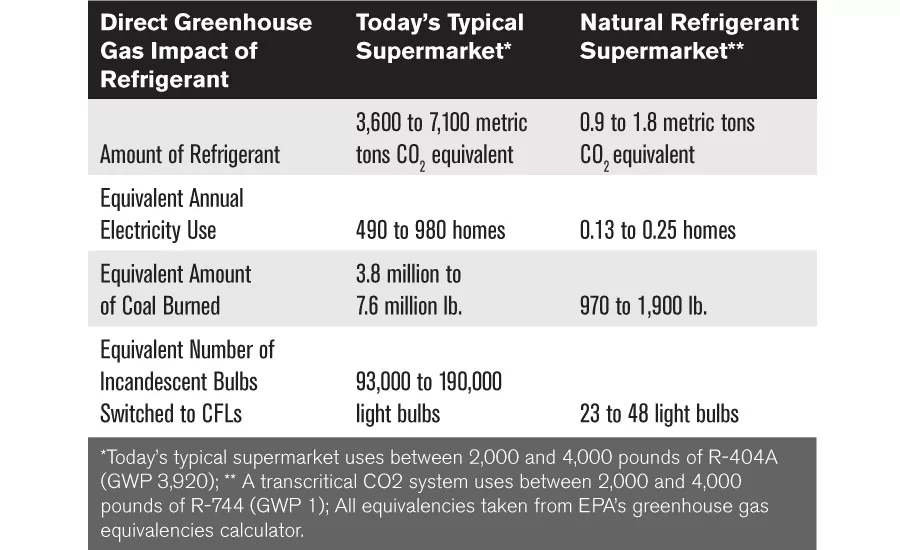
Table 1 shows the direct greenhouse gas emissions reductions for a carbon dioxide transcritical natural refrigerant system. Although the exact calculations depend on the specifics of each store, as well as the specifics of the baseline used, it is possible to do basic estimates using numbers provided by the EPA for typical stores.
The table also shows the scale of the improvements that can be achieved when compared to other environmental initiatives. Is it easier to get one supermarket to use a natural refrigerant system or to persuade about 7,500 homes to reduce their electricity use by 10 percent? And the direct greenhouse gas emissions reductions are permanent and consistent as opposed to residential energy use reductions that can, and do, vary from year to year.
THE TIME FOR ACTION IS NOW
So, where does the proposal stand now? The governor of California has submitted his proposal to the legislature, along with a number of other proposals on how to spend the money in the investment fund. As you can imagine, every organization and special interest in California that can claim to fight climate change is angling for a piece of the fund. If the legislature doesn’t feel like food retailers want the money, they’ll be happy to give it to someone else.
If you support this program, as we at the NASRC do, send a message to the California legislature. If you do not know who your representatives are, visit http://findyourrep.legislature.ca.gov. The NASRC can provide you with bullet points to help facilitate your conversation. For more information, call (650) 867-7533 or email the NASRC at liz.whiteley@nasrc.org.
SIDEBAR
By Ron Rajecki
The NEWS Staff
Refrigerant manufacturers say they would welcome attention to and investment in the refrigeration industry from low-GWP (global warming potential) incentive programs such as the one proposed in California.
George Koutsaftes, global business director, heat transfer, fluorine products, Honeywell Refrigerants, said California’s incentive plan could serve as a model for the nation to fast track the adoption of low-GWP refrigerants that are commercially available and capable of significantly reducing greenhouse gas emissions.
Koutsaftes noted that there are now a variety of low-GWP refrigerant options available to customers, including next-generation hydrofluoroolefin (HFO) technology, and industrial gas solutions, such as CO2 and hydrocarbons (HCs). With multiple options available to support the goal of reducing greenhouse gas emissions, customers have the opportunity to thoughtfully select the right solutions to fit their needs.
According to Koutsaftes, Honeywell, which offers HFO refrigerants through its Solstice® line, works closely with air conditioning and refrigeration equipment manufacturers to advise them on emissions, performance, and safety to select the right match of new low-GWP refrigerants with new equipment designs to support the transition from hydrofluorocarbons (HFCs) to low-GWP products.
“For example, in supermarket systems, Honeywell has developed near drop-in replacements that provide a cost-effective low-GWP solution, but might still require up to $30,000 in retrofit costs — primarily in contractor time — to manage refrigerant changeouts and to make slight adjustments to existing equipment to meet low-GWP targets,” he said. “The California Air Resources Board’s [CARB’s] proposal to provide financial incentives would provide businesses and their customers with a cost-effective way to implement the use of the whole array of low-GWP refrigerants available today and help California more rapidly achieve its ambitious climate goals.
“Through the proposed incentive program, California can serve as a model for how to drive the adoption of all viable low-GWP solutions available today and take a significant step forward in achieving a lower carbon future,” Koutsaftes said.
Chemours also believes the program’s incentives will likely be applied more broadly than just driving the use of natural refrigerants as there are other greenhouse gas-impacting considerations in play, especially with respect to energy efficiency. As such, the program has the potential to be very positive for the environment and industry.
“We are aware that in California, the governor’s budget summary proposes to spend $20 million in the 2016-2017 cap-and-trade expenditure plan on refrigerants,” said Stefanie Kopchick, North America marketing manager, refrigerants, Chemours. “We anticipate that CARB will sponsor a workshop to discuss criteria for determining qualifications for access to incentive funding. Through this workshop, we expect that the decision will be made to use the incentives to encourage leak reduction and transition to lower GWP fluorinated and non-fluorinated solutions. This would include hybrid systems that provide both direct benefits in GWP reduction and indirect benefits through maintaining or improving energy efficiency.”
Overall system efficiency considerations are especially critical in the high ambient temperatures experienced in much of California and provide the maximum reduction in greenhouse gas emissions for the state, Kopchick added.
This criteria, she explained, is especially important in the context of the recent California legislation SB 350 – The Clean Energy and Pollution Reduction Act of 2015. SB 350, which was approved in late 2015, includes requirements to double the energy savings in electricity and natural gas final end uses of retail customers through energy efficiency and conservation by Jan. 1, 2030, with new targets every two years.
“A hybrid approach of a CO2-HFO blend cascade system can be used effectively and provides an opportunity to significantly reduce energy consumption compared to the non-hybrid approach, allowing California to meet its multiple environmental goals around SLCPs [short-lived climate pollutants] and energy efficiency,” Kopchick said.
Matt Ritter, director of government affairs at Arkema, said the company understands that California intends to spend the money from its cap-and-trade program one way or another. As such, spending it on refrigerant-related programs is fine.
“We would hope they would choose a technology-neutral position rather than trying to steer it in one direction,” he said.
Ritter added he thinks the state must look beyond low-GWP ratings and be sure to analyze the energy-efficiency impacts of the choices it makes.
“[The state] certainly provides incentives to go to a certain technology, but I don’t know that energy efficiency in years two, three, four, and beyond is always clearly evaluated,” he said. “Life cycle costs of any alternative must be fully evaluated before providing incentives.”
Publication date: 5/9/2016
Want more HVAC industry news and information? Join The NEWS on Facebook, Twitter, and LinkedIn today!
Looking for a reprint of this article?
From high-res PDFs to custom plaques, order your copy today!