HVACR Contractors Share Chiller Maintenance Best Practices
Regular maintenance is an absolute must, though plans and best practices can differ
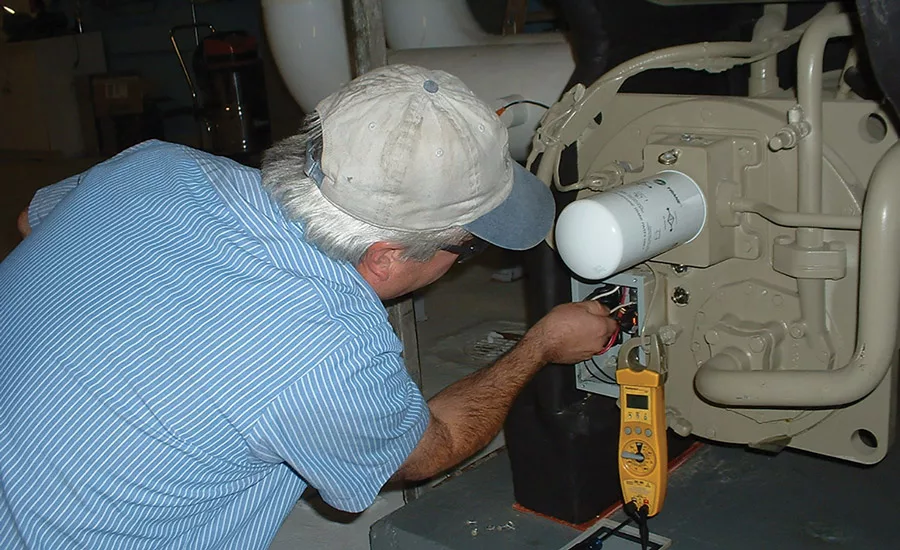
PREVENTING DOWNTIME: “Being proactive is always in the customer’s interest,” said Ann Kahn, president of Kahn Mechanical Contractors in Dallas. “A comprehensive, regular maintenance program goes a long way in preventing failures and catching them before they happen.” Photo courtesy of Kahn Mechanical Contractors
Performing regular maintenance on chillers ensures they will operate as efficiently, and for as long, as possible. And while maintenance plans and practices can vary from region to region, manufacturer to manufacturer, and even client to client, HVACR contractors agree that minimal maintenance is better than no maintenance.
WHY CHILLERS FAIL
Ray Humphries, area service manager for Capstone Mechanical in Waco, Texas, said the most common chiller failures he sees are not catastrophic. “They are usually very minor component failures, such as thermistors, pressure transducers, and flow switches,” he said. “These are all relatively minor parts that are both inexpensive and easy to replace, if you have them on hand. Most of these are specific to a particular chiller.”
Greg Crumpton, president and founder of AirTight FaciliTech in Charlotte, North Carolina, grouped chiller failures into two categories: electrical and mechanical.
“Electrical failures typically begin with an electrical issue, perhaps incoming power issues or motor overheating,” Crumpton explained. “This will generally be the cause of the first failure of an electrical type. If a second failure occurs — which often happens — it will be electrical in nature, as well. The system, after the first failure, really has to be addressed with dieters, ‘clean-up kits,’ etc. to ensure the system’s pH level will be in check at the startup of the second replacement compressor. If not, the failures will continue to cascade and become worse each time.”
Mechanical failures, Crumpton added, are just that — something metallic broke. “It could be a crank shaft, valves, a scroll disc, bearings, etc. — if the system has operated for years with no issues, it could simply be a failure due to run hours exceeding component life or just a metallurgic fracture,” he said. “If the system is suffering from poor operating conditions, refrigerant charge issues, or underload/overloaded, these failures typically are a result of lubrication issues, meaning the oil wasn’t present or plentiful enough for proper lubrication. Normally, you will see this in a refrigerant floodback scenario. While these failures tend to be less catastrophic than electrical failures, proper diagnosis and resolution is required to ensure a repeat mechanical failure does not occur.”
PICK A PLAN
Chiller maintenance plans help prevent catastrophic failures by ensuring equipment is properly monitored and serviced on a regular basis. These plans can vary based on a number of factors, including chiller type, manufacturer, geographical region, and client preference, to name a few. But, contractors and customers alike broadly acknowledge that maintenance “saves energy and [prevents] expensive repairs,” said Hank Bloom, owner of Environmental Conditioning Systems in Mentor, Ohio. “Most customers with chillers have service agreements, which save [money and] relationships in the long term.”
Humphries said Capstone’s maintenance plans are customized based on the type of chiller — whether they’re air-cooled or water-cooled, centrifugal, or screw. “[We follow] manufacturers’ recommended schedules and tasks,” he said.
Looking for quick answers on air conditioning, heating and refrigeration topics? Try Ask ACHR NEWS, our new smart AI search tool. Ask ACHR NEWS
Matching customers’ expectations with their budgets also dictates the type of maintenance plan that is implemented, he added. “Their expectations and budgets usually don’t match very well. This is where we have the opportunity to educate customers. We can base our recommendations on the type of application and whether the system’s comfort or process cooling. Do they have redundant capacity that they are not even aware of? Can equipment or modifications be made that provide effective redundancy?”
Crumpton also said chiller maintenance plans vary slightly among manufacturers. “The nuances may be software-driven or contractor- or starter-driven,” he said. “The bulk of the work is the same regardless of brand. Oil, oil filters, and clean heat exchange surfaces are a must. We recommend the OEM’s recommended plan and then add any site-specific requirements. It could be an industrial plant that has a byproduct that causes issues or a geographic region that requires additional services, as well.”
Maintenance plans are then based upon their requirements, expectations, and willingness to properly plan and budget, Crumpton continued. “A research-and-development facility that doesn’t lose money if they miss an eight-hour shift without a chiller available is a lot different than a high-density data center. It really comes down to what the customers [want to pay] to ‘insure.’ Uptime isn’t cheap, but sometimes downtime can be devastating.”
Ann Kahn, president of Kahn Mechanical Contractors in Dallas, also said her company does not have a set of plan options and instead tailors plans to each individual client based on specific equipment and requirements.
Bloom said Environmental Conditioning Systems “always follows manufacturers’ recommendations because there are so many different types of chillers. We also have our own [plans], and we sit down with customers and go over budgets and explain what chiller service actually dictates.”
MAINTENANCE BEST PRACTICES
When it comes to performing routine maintenance on chillers, many contractors’ best practices proved similar.
“Our maintenance tasks are performed by qualified techs who are trained to recognize small issues that, if left unchecked, can potentially lead to major repairs,” Humphries said. “Even if we have tasking being done by less experienced techs, we have our senior techs on-site, as well; they are there to teach and mentor these less experienced techs. We are fortunate to have men who are willing to pour into one another and discipline eachother.
“Obviously, the typical things are verifying the temperature, pressures, and flow readings, as these are the most common ‘failures,’” Humphries continued. “With that in mind, if the control systems are receiving false information, they will not control the chiller in a safe state of operation. Continued operation in these circumstances can lead to catastrophic failure and require major down time and costs to repair.”
Kahn said their technicians “check refrigerant charge, oil levels, electrical connections, controls, cooling tower, pumps, and motors” during maintenance visits. “We [also] perform an annual stop inspection that includes Eddy-current testing and an oil analysis, among others things,” Kahn said.
Crumpton said AirTight’s maintenance best practices depend on the type of chiller, whether air-cooled or water-cooled, open drive, hermetic, screw compressor, etc. “Many options are treated specifically per type of chiller, but again, going back to basics, in general, you want to ensure refrigerant charge levels and lubrication,” he said. “If [it’s] not an oil-free model, clean the heat exchanging surfaces and/or tubes within the vessels and [perform] an adequate electrical check to ensure the voltage and current flow are within the normal parameters.”
PERKS OF BEING PROACTIVE
Preventive chiller maintenance does just what the name implies, and most customers recognize the value of maintenance plans.
“Being proactive is always in the customer’s interest,” Kahn said. “Centrifugal chillers often fail to transfer heat properly, and air-cooled chillers suffer failed controls, though both [are] due to poor maintenance. A comprehensive, regular maintenance program goes a long way in preventing failures and catching them before they happen.”
For customers who wish to be even more proactive, Humphries said they offer oil analysis and refrigerant analysis. “Predictive testing has dropped in price and is much more commonplace because of this,” he said. “Both manufacturers and end users of chillers have come to realize the value of predictive testing.”
It used to be that a chiller would be completely torn down and overhauled based solely on the hours it had run, Humphries added. “It made no difference how the chiller was performing — this was the accepted norm of having a chiller. I have had to tear down chillers that have been running flawlessly for 10 years — or sometimes more — to only have a chiller that now does not perform as well as it did before the rebuild, even though it’s within normal parameters. Now, to be honest, there were a lot of chillers that needed to be rebuilt before they hit that magical run-hour number. They were overhauled and ran within normal parameters, as well. But, doesn’t it stand to reason that you perform a major overhaul unless there is some measurable reason to do so other than run hours.”
Providing proactive preventive maintenance also builds trust, Crumpton said, adding that AirTight offers oil analyses and tube analyses that allow them to look at the internal wear conditions of the machine or compressor.
“With proper reporting after these services, we can sit with and engage the owner in what the aluminum content or the copper content of the oils shows,” he said. “Having a preventive and predictive plan in place can mitigate that financial exposure as well reinforce that they hired the right folks.”
Publication date: 5/9/2016
Want more HVAC industry news and information? Join The NEWS on Facebook, Twitter, and LinkedIn today!
Looking for a reprint of this article?
From high-res PDFs to custom plaques, order your copy today!


