Advances in Boiler Construction and Design
The boiler market has been slowly shifting to more efficient condensing units
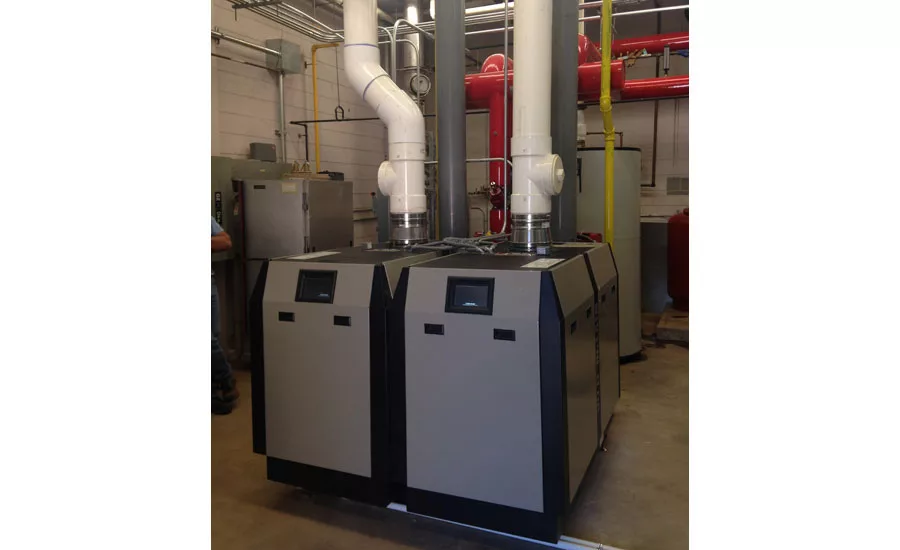
CONDENSING BOILERS: A middle school in North Carolina installed two Weil-McLain SlimFit 1500 condensing boilers to improve heating efficiency at the facility.
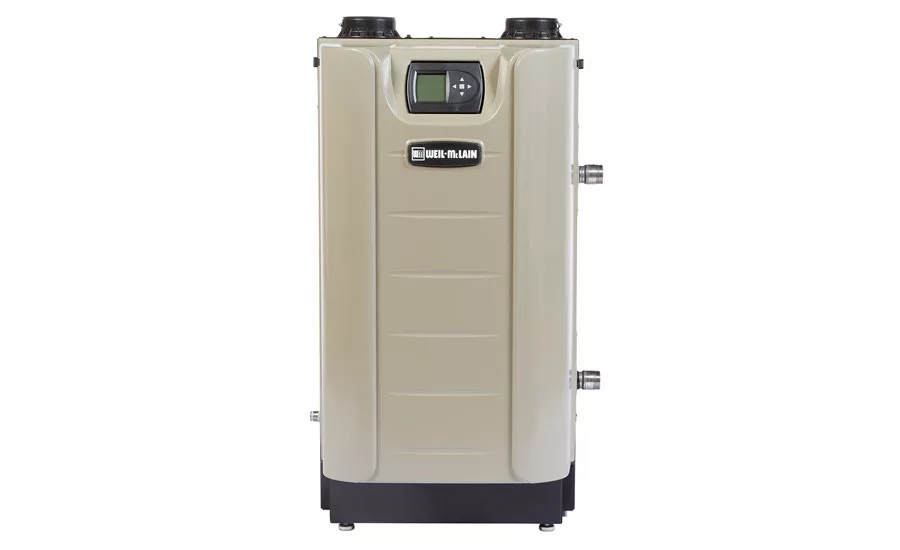
HIGH EFFICIENCY: The new high-efficiency Evergreen condensing boiler from Weil-McLain.

REPLACEMENT BOILER: A new high-efficiency Weil-McLain Evergreen 399 unit is installed in an automotive plant to replace a 20-year-old copper fin boiler.
Contractors, architects, engineers, and others who specify commercial and industrial boilers continually seek systems that are more cost effective, energy efficient, and environmentally friendly. The boiler industry has responded by making significant advances in both construction and design, with new systems offering greater efficiencies, cutting-edge technologies, advanced controls, and the ability to integrate with renewable energy.
CONDENSING BOILERS GAINING MOMENTUM
The boiler market has been slowly shifting from standard, non-condensing boilers to more efficient condensing units over the last couple of decades. Reasons for the switch to condensing technology include a desire for operating efficiencies that result in lower operating costs, increased awareness of energy efficient products, and the growing number of governmental policies and incentive programs.
Energy-efficient condensing boilers first appeared in the U.S. market in the late 1990s and their sales have grown exponentially. The movement accelerated when the energy crisis several years ago spiked fuel costs. The shift toward green building design and Leadership in Energy and Environmental Design (LEED) certifications for installing high-efficiency equipment has also driven the trend
Many predicted that condensing boilers would make up half of the market by 2016, but the trend has been slower than anticipated. This delay is attributed to a couple of factors. For one, North American economies are not growing as quickly as anticipated, making it more difficult for some businesses and homeowners to approve an investment in more advanced, pricier boiler technology.
Additionally, federal rebates, which play a major role in encouraging installation of condensing technology, are no longer available. Some state and local municipalities offer rebates to help offset first boiler installation costs, but the lack of federal incentives has slowed growth.
Though the market today is still dominated by cast iron non-condensing boilers — which make up about 60 percent of installations — it’s likely that condensing boilers will continue to experience growth and play an even larger role in the hydronic heating industry by 2017.
GREATER EFFICIENCIES KEY DRIVER
With an operating life measured in decades, purchasing a new or replacement condensing or non-condensing boiler is a significant decision. Most specifying engineers today seek the most energy efficient heating design.
Looking for quick answers on air conditioning, heating and refrigeration topics? Try Ask ACHR NEWS, our new smart AI search tool. Ask ACHR NEWS
Since September 2012, the minimum boiler efficiency requirement in the United States is 82 percent for gas hot water boilers and 84 percent for oil hot water boilers. Some jurisdictions in the U.S. have building or energy codes that require the reporting of the efficiency ratings of boilers and other heating products.
Standard efficiency is anything below 90 percent annual fuel utilization efficiency (AFUE) while more than 90 percent is considered high efficiency. To reach levels above 90 percent, specifiers should consider installing a condensing boiler, as these units offer the greatest thermal efficiencies. Typical aluminum or stainless steel condensing models offer efficiencies greater than 90 percent AFUE.
A condensing boiler extracts additional heat from the exhaust gases by condensing its hot water vapor to liquid water, thus recovering its latent heat of vaporization. By capturing some of the waste heat, the condensing boiler heat exchanger can be up to 10 percent more efficient than a conventional boiler operating in the proper conditions.
Some boiler manufacturers currently add a secondary heat exchanger or recuperator to improve the efficiency of conventional, non-condensing boilers. In this case, a secondary heat exchanger recovers the latent exhaust heat from the flue gases, condensing water vapor in the process. In theory, you can increase the efficiency of a standard cast iron boiler by up to 10 percent to achieve higher efficiencies, lower energy costs, and qualify for utility rebates.
Maintaining optimum boiler efficiency is critically important to minimizing carbon dioxide emissions, conserving fuel resources, and lowering building operating costs.
ADVANCED CONTROLS DRIVING GROWTH
Boiler manufacturers are regaining HVAC market shares by offering systems with more powerful and advanced controls. Condensing boilers feature significant advancements in ease of installation and controls when compared to traditional non-condensing boilers.
Setup wizards offer simple, intuitive controls that help walk the contractor through menus during the installation process. All Weil-McLain condensing boilers, for example, including the new Evergreen™ and SlimFit™ boilers, include this convenient setup feature.
Multiple preset systems are another popular new boiler control feature. These units feature pre-set heating systems for typical operating conditions that are built into the controller so installers don’t have to enter specific supply or return temperatures during installation. The contractor only inputs the specific application — such as radiant heat, snow removal, or domestic hot water — which reduces installation costs and time while increasing reliability.
In addition to ease of installation, condensing boilers feature significant advancements in boiler control that include remote control and diagnostics, boiler-to-boiler communications, modulating from maximum input to minimum input, rotating lead lag, and integration with building automation systems (BAS).
Facility managers want immediate access and control of a mechanical room no matter the location. Boilers today can be controlled through an iPhone and Android smartphone, computers and tablets, and other devices, allowing an operator to change and optimize settings, review alarms, and adjust parameters to changes in weather.
Many institutional buildings, such as schools, churches, or hospitals, have multiple boiler setups for redundancy and reliability. Other facilities have installed or retrofitted to multiple, modular boilers for various reasons like cost or space restrictions. In this case, installation of an intelligent boiler sequence control can provide significant energy savings.
Weil-McLain’s SmartSequencing™, for instance, maximizes energy across all boilers on a system, reducing energy costs. SmartSequencing controls an algorithm that runs as many boilers as possible at the minimum input, therefore maximizing efficiency. With this advanced control feature, boilers maintain optimal efficiency through lead-lag rotation and balanced heat loading.
Modern condensing boilers also have the ability to communicate with building automation systems. The benefits of building automation are improved occupant comfort, efficient operation of building HVAC systems, and reduction in energy consumption and operating costs.
Another advancement is 0-10 VDC output signal. This feature provides easy integration with older boilers, such as cast iron, that don’t have sophisticated controls, and is especially valuable if a boiler fails in a facility with multiple boilers.
With 0-10 VDC, instead of replacing all boilers, a facility can install one condensing boiler to improve efficiency and run that unit as the primary boiler. If more heat is needed, the output signal turns on an older boiler — which is most efficient at full capacity anyway — and then modulates the condensing boiler. This hybrid system improves the overall efficiency of the system and requires less initial investment for the customer.
Programmable zone options also have advanced in design. In the past, boiler manufacturers offered zone pump or zone valve controllers for maintaining separate conditions in different areas of a facility. This feature would activate either the pump or valve that controls the flow of water through the radiator. Today, Weil-McLain offers equipment with ZoneStacking™, allowing for up to 24 different programmable zones that don’t require additional external panels.
IMPROVEMENTS IN BOILER MAINTENANCE
The ease of cleaning and maintenance of condensing boilers varies based on the type of technology and material design. Stainless steel condensing boilers feature either a water tube or fire tube heat exchanger. The water tube stainless steel heat exchanger consists of water inside a spiral tube with the flue gases on the outside. These units can be more difficult to clean due to the spiral design.
The fire tube, on the other hand, features the flue gases on the inside and water on the outside. These are typically straight tubes and a facility manager can easily access them by opening the lid and cleaning them. As a result, fire tubes are becoming more popular in stainless steel condensing technology than water tubes.
Aluminum condensing heat exchangers feature separate sections bolted together and include a clean out plate. Inside the heat exchanger are pins to increase the heat transfer area. Maintenance personnel simply remove the front plate to access the inside of the heat exchanger. The areas between the pins can be then easily cleaned and flushed with water.
When HVAC equipment fails, it can be a building owner’s and facility manager’s worse nightmare. Heating units are typically down when they are running and needed the most. Also, there often isn’t a repair budget in place because the failure wasn’t anticipated. Therefore, facility managers today seek preventative maintenance options to avoid an expensive critical failure.
One new trend in boiler maintenance that meets this demand is predictive maintenance. With this new advancement, maintenance personnel can receive a predictive analysis of what may happen to a boiler over a specific length of time such as the next six to 12 months.
Manufacturers have developed this technology by factoring a certain set of parameters and based on changes in those factors can predict when specific maintenance procedures — such as cleaning tubes or a heat exchanger — should occur to prevent catastrophic failure.
BOILER DESIGN DURABILITY
Condensing is a fairly new technology, so it’s difficult to prove the durability of these units. With proper maintenance, it’s likely that these units can last anywhere from 15 to 20 years.
Annual efficiency monitoring of the heat transfer fluid in condensing boilers with aluminum or stainless steel heat exchangers is recommended. Depending on the results, action can be taken to improve boiler efficiencies, resulting in lower annual operating costs.
Standard cast iron boilers, on the other hand, can have a longevity advantage. It’s not uncommon for a cast iron boiler to have a useful life between 30 and 50 years. These conventional boilers are also designed to access tight spaces such as narrow hallways and small elevators, often a key factor in retrofit applications — which make up 90 percent of boiler installations. The installer can bring one cast iron section at a time where a complete boiler assembly is too large for the available entryway.
Weil-McLain’s SlimFit condensing boiler was specifically designed to fit into narrow spaces. The larger units can be disassembled into two separate pieces for ease of access into tight areas.
Another advancement in improving the life of condensing heat exchangers is the development of a non-metallic condensate base, which greatly reduces heat exchanger corrosion.
While highly durable composite bases are not affected by acidic condensate, aluminum or stainless steel bottoms are affected. A non-metallic heat exchanger base protects against corrosion due to aggressive condensate resulting in long-lasting service.
THE FUTURE OF BOILER DESIGN
The future of boiler design is integration with renewable heating sources such as solar energy, geothermal, wind, and biomass.
Solar energy, for example, is popular in western U.S. states to pre-heat water tanks. A solar water heater typically will not provide enough heated water by itself, but it can increase the energy efficiency of the system and work in tandem with a boiler. When water temperature drops below a certain level the boiler is activated to provide supplemental heat.
In mild climates, such as on the East Coast or in the South, geothermal energy is becoming more prevalent. This application uses ground source heat pumps for heating and for cooling. Geothermal heat pumps use the natural warmth of the ground several feet below the soil to pre-heat water.
A geothermal heating method can reduce the amount of natural gas, electricity, or oil that a boiler uses to save energy. When more heat is needed, an electric or a conventional hydronic boiler is activated.
The use of boilers installed in combination with renewable technologies and eco-friendly heating systems to improve efficiencies is on the rise.
IN CONCLUSION
Modern boilers have come a long way in design and technology. Today’s boilers feature advanced controls, efficient heating, and are easily integrated into existing boiler systems to provide lower energy costs for facility managers and building owners.
Publication date: 1/4/2016
Want more HVAC industry news and information? Join The NEWS on Facebook, Twitter, and LinkedIn today!
Looking for a reprint of this article?
From high-res PDFs to custom plaques, order your copy today!