Duct Dynasty: Btu Formula Basics
The Mathematics Behind Measuring and Verifying Performance
Last month’s article left off looking at how to verify designs through the field measurement of delivered Btu. In order to accomplish this, you’ll need to understand the basics of the Btu formulas. There are two commonly used formulas used to accomplish this task.
Calculating Btu
|
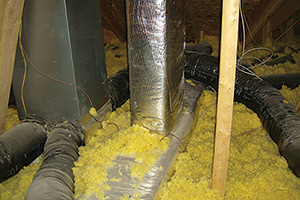
| HVAC equipment doesn’t stand a chance of delivering the proper Btu when it’s attached to a poorly operating duct system. |
There is a formula for calculating heating Btu and a formula for calculating cooling Btu. Both of these formulas have three components necessary to complete the calculations. Two of the Btu formula components are field measured while the third is a multiplier that is added at the end of the formula.
The heating Btu formula, which is also referred to as the “Sensible Heat” formula, is:
CFM x ΔT x 1.08 = Heating Btu
The cooling Btu formula, which is also referred to as the “Total Heat” formula, is:
CFM x ΔH x 4.5 = Cooling Btu
Let’s look at the individual components of these formulas and how you can utilize them on a daily basis.
Btu Formula Component No. 1: Airflow
The first measurement that is needed in the Btu formulas is cfm. A measurement of airflow is needed to fill in this portion of the formula. The airflow measurement can be obtained at the equipment, the total supply air delivered into a building, or the amount of airflow delivered into an individual room where a customer is experiencing comfort issues.
To obtain fan airflow at the equipment, determine the fan-speed setting the equipment is operating on and measure the equipment’s total external static pressure. With this information, fan airflow can be plotted on the manufacturer’s fan performance data. To do this, intersect where the fan speed setting and the measured total external static pressure lineup for the equipment you’re testing, the result will be fan airflow. Most fan data is typically found in the installation instructions.
Looking for quick answers on air conditioning, heating and refrigeration topics? Try Ask ACHR NEWS, our new smart AI search tool. Ask ACHR NEWS
To determine a system’s delivered airflow, measure the airflow from each supply register of the system and add all of the supply airflow readings together to determine the total delivered airflow into the building. Be careful not to overlook any supply registers, or your total airflow will be inaccurate.
Btu Formula Component No. 2: Temperature Change
The second measurement that is needed in the Btu formulas is a temperature change across the equipment or system. For the best results, be sure to record your temperature readings to the nearest tenth of a degree. In the heating mode of operation, the temperature change is measured in dry bulb temperature with a typical thermometer. This is commonly referred to as delta T or ΔT.
In the cooling mode of operation, this temperature change is measured in wet bulb. You’ll need an instrument capable of obtaining these readings inside the duct system. A sling psychrometer won’t work for this type of testing. The wet bulb readings aren’t directly used in the cooling Btu formula, though they have to be converted to an enthalpy measurement.
This conversion takes place by means of an enthalpy chart or psychrometric calculator. Once the enthalpy readings are obtained, they are subtracted from one another to determine the delta H or ΔH. Since the wet bulb temperature change has an additional step in converting it to enthalpy, it can be a tricky one to master at first. Fight the temptation to directly subtract your wet bulb readings and use that as your delta H.
When obtaining any temperature readings, be careful when reading the discharge temperature at the equipment. Make sure the thermometer probe does not see the hot or cold surfaces of the equipment. If it does, the temperature reading will likely be inaccurate due to radiant heating or cooling of the temperature probe. This is one of the most common issues when it comes to test results that don’t make sense.
Btu Formula Component No. 3: The Btu Multiplier
Each formula has a multiplier to finish the calculation. The multiplier for the heating Btu formula is 1.08. One of the most frequently asked questions we get in training classes is: “Where did the 1.08 multiplier come from?”
The 1.08 multiplier is based on the weight of standard air (0.075 pounds of air per cfm) x the specific heat of air (0.24 Btu per pound) x minutes in an hour (60). For best accuracy, this 1.08 multiplier does need to be adjusted for higher elevations and extreme temperatures above or below 70°F. There are a lot of programs and apps that can do this for you so your head doesn’t explode.
The multiplier for the cooling Btu formula is 4.5. The 4.5 multiplier is based on the weight of standard air (0.075 pounds of air per cfm) x minutes in an hour (60). Notice, the specific heat portion of the formula is missing.
Heating Btu Formula Application
Let’s say you have a customer who is unhappy with a furnace install you did for them. The complaint might be that the furnace runs all the time and doesn’t seem to warm the house very well. Ever heard this one before?
Let’s measure the Btu the gas furnace is delivering to see if there are any clues that might lead to an answer. The fan airflow is plotted at 670 cfm, the return air temperature entering the furnace is 70.1°, and the air temperature leaving the furnace is 127.1°. Subtract these two temperatures to find the temperature change of the furnace is 57°. The BTU multiplier you would use for heating is 1.08. Put the measurements into the heating Btu formula and you come up with:
670 cfm x 57°ΔT x 1.08 = 41,245 Btu
Next, compare the delivered Btu of 41,245 you just calculated the furnace to be delivering to the furnace’s rated Btu output of 57,000. Divide 41,245 Btu by 57,000 to find the furnace is only delivering 72 percent of its rated Btu output.
Do you think you might be one step closer to solving this customer’s problem? He paid for 57,000 Btu of furnace output, yet he is only getting 41,245 worth. Which of the three formula components is off? That’s where you would need to begin your investigation in solving this issue.
Cooling Btu Formula Application
Let’s take a look at the application of the cooling Btu formula in a similar scenario. Your customer has a 3-ton cooling system that has never worked quite right. The entire situation seemed to get worse when they had their duct system sealed through a rebate program.
Fan airflow is plotted and the fan in the air handler is moving 890 cfm. The wet bulb temperature entering the air handler is measured at 68.4°. Using an enthalpy chart, the 68.4° wet bulb temperature is converted to an enthalpy value of 32.76 Btu per pound of air.
The supply wet bulb temperature leaving the air handler is calculated at 62.9°. Convert this measurement to enthalpy to find 28.5 Btu per pound of air. Subtract the supply enthalpy of 28.5 from the return enthalpy of 32.76 to find an enthalpy change (ΔH) of 4.26. The cooling Btu multiplier you’ll be using is 4.5. Put the measurements into the cooling Btu formula:
890 cfm x 4.26ΔH x 4.5 = 17,061 Btu
By looking at the delivered cooling Btu calculated at 17,061 Btu, the 3-ton rated system is operating much closer to a 1.5-ton system. Do you think a larger piece of equipment will solve this customer’s problem? The flexibility of these formulas helps determine both equipment and system delivered Btu by gathering some key pieces of information and filling in some blanks.
Don’t be surprised if you see a difference in the amount of Btu the equipment is moving compared to the amount the system is truly delivering into the home. As you learn the basics of these formulas, you’ll learn new variations for how to apply them for solving issues you encounter daily.
Publication date: 3/9/2015
Want more HVAC industry news and information? Join The NEWS on Facebook, Twitter, and LinkedIn today!
Looking for a reprint of this article?
From high-res PDFs to custom plaques, order your copy today!


