Tips for Testing and Diagnosing Faulty Compressor Motors
Best Practices for Diagnosing and Solving Compressor Problems
|
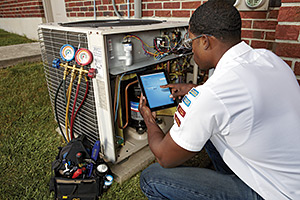
| When troubleshooting a compressor, apps like the HVACR Fault Finder app and Copeland™ mobile app from Emerson Climate Technologies can help service technicians determine the possible causes of the compressor failure. (Photo courtesy of Emerson Climate Technologies) |
The compressor is often considered the heart of the refrigeration system as well as one of the major electrical energy users, and the compressor’s motor is a key part of that equipment. Keeping the compressor running efficiently ensures the entire system will be more productive. But, should a compressor fail, the entire system will fail, and knowing how to properly test, diagnose, troubleshoot, and maintain that equipment will ensure minimal downtime while preventing future failures.
Why Test?
In order to determine the exact cause of a compressor malfunction, manufacturers say thorough and accurate diagnostics are a must.
“Testing is important to confirm proper operation of all three system prime movers — the compressor, the fan, and the blower,” said Jerry Edwards, manager, electric engineering and motor technology, Bristol Compressors Intl. Inc.
“This will help avoid operational issues generated by improperly performing equipment and achieve the maximum lifespan of each component and the system itself.”
In hermetic compressors, which are the most common type of compressor today, the motor itself cannot be accessed easily for testing, said Patrick Pride, field system engineer, Danfoss. “However, several electrical checks and tests can be routinely performed if a problem is suspected.”
Using a multimeter to check amp draw and line voltage helps to ensure the compressor is able to meet the expectations for the required application, said Scott Lanzer, marketing manager of digital services, Emerson Climate Technologies Inc.’s air conditioning business. “For example, if the line voltage is below the recommended minimum for a particular compressor’s motor, this could then raise the motor amp draw and potentially cause the internal motor overload to open. This could be seen as ‘nuisance trips’ until the proper voltage is restored to the compressor.”
Testing the oil can also help uncover an issue and potentially prevent catastrophic failure, said Joe Sanchez, application engineering department manager, Bitzer. “For example, oil that is brown and overheated may indicate the compressor is overheating. This may lead the technician to inspect the valve plates for damage, desuperheating devices, or evaporator/expansion valve function to possibly thwart an inevitable failure.”
Looking for quick answers on air conditioning, heating and refrigeration topics? Try Ask ACHR NEWS, our new smart AI search tool. Ask ACHR NEWS
Testing Best Practices
Since a number of things can cause a compressor motor to fail, manufacturers recommend performing several tests to determine the exact cause.
“When a contractor is investigating potential electrical problems with the compressor, the usual methods of checking amp draw and line voltage at specific conditions is one of the best ways to determine if the compressor and system are operating properly,” Lanzer said.
John Lattuca, technical specialist for Tecumseh Products Co., said it is prudent for the technician to check the cleanliness of the condenser coil, the cleanliness of the fan blade, and the condition and alignment of the fan shroud once a year. “These checks could also occur more frequently, depending on the condensing unit environment,” he added.
“It is important to keep the condenser coil clean and have proper airflow through the coil,” Lattuca added. “Without this, discharge pressure will increase, which could possibly overload the compressor and cause it to fail prematurely.”
Sanchez said the level of testing and diagnostics depends greatly on the type of compressor, system, and application.
“From an extremely general statement, we recommend yearly analyses of the oil from any compressor or system,” he said. “The oil can tell a lot about what is going on mechanically that often leads to compressor failures. Acid tests are very common and are easy to use and may help prevent a motor burnout. However, a comprehensive oil analysis will reveal metal particles as well as indicate wear in the running gear or bearings. In addition, a very simple diagnostic is to input real live conditions into our software and compare the measured amp draw and discharge gas temperature to expected values. High amp draw may indicate a valve plate is broken. Low discharge gas temperature may indicate refrigerant flooding.”
Sanchez continued: “Most commercial-sized hermetic and semi-hermetic compressors not only have windings, but also thermistors for signaling that the motor is overheating. By using a multimeter, the resistance of the windings and thermistors can be checked with known motor data. Insulation tests between the winding(s), thermistors, and ground can be done to find existing shorts. A multimeter can be used to prove insulation is bad, but rarely guarantees a motor is good, due to its lower voltage output. By applying a high potential voltage (HI POT) test, the electrical insulation can be verified more thoroughly.”
Service technicians should check run capacitors and start capacitors and relays, if specified, said Edwards. “Check that each is as specified by the manufacturer and operating at the correct capacitance values. Check system operating pressures. Refrigerant charge should be correct for optimum compressor performance. Ensure filter dryers, all heat exchangers, and air filters in the system are clean and/or working as specified. Improper refrigerant/airflows and heat exchanger cleanliness can cause compressors to run hotter and at higher pressures. At minimum, this limits the performance and life of the unit, but, in severe cases, it can create frequent loss of compressor operation requiring additional service trips that lead to unhappy customers.”
Edwards also recommended taking the following steps when diagnosing compressor problems:
• Always wear the proper personal protective equipment (PPE), and only test within the limits of individual training/expertise to avoid serious injury;
• Always ensure the motor thermal protector has not opened. This will appear as an open circuit condition across the motor winding. Before diagnosing the problem as a failed compressor, always allow the motor protector time to reset, usually until the upper housing is within 5°F of ambient temperature (this can vary by unit);
• Check to ensure the resistance to the compressor shell is very high, which will make certain the compressor motor is not electrically grounded to the compressor mechanical;
• Ensure the compressor is connected to a power supply that delivers a good nominal (+/- 5 percent) voltage at the compressor power terminals;
• If troubleshooting a more advanced system, identify any conditions that are being reported by the built-in diagnostics system, and always follow manufacturer guidelines; and
• Confirm all input, output, and grounding wiring is present, and that all required components are present and operational.
“We recommend technicians perform motor resistance checks,” Edwards added. “Values should be +/- 5 percent of winding resistance specified on the compressor model specification sheets provided by the manufacturer.”
Common Problems and Solutions
As the heart of the refrigeration system, the compressor must run efficiently in order for the system to perform properly. Often, compressor problems are a result of stress on the compressor motor that can be caused by “a blocked fan or when a unit is overloaded, which can cause the compressor motor to draw high amperage,” Pride said. “Shorts in the windings and the presence of liquid refrigerant in the compressor due to an improperly operating system can ultimately lead to compressor bearing failure,” he added.
Sanchez said the compressor is rarely the original culprit of system failure but is instead at the end of a chain of events within the system.
“For example, a compressor motor may fail but only because the crankshaft was locked up,” he said. “The locked crankshaft may be due to a lack of lubrication. The lack of lubrication may have been caused by flooding of liquid refrigerant into the compressor which washed the oil away. The liquid refrigerant could have been caused by an overfeeding expansion valve at the evaporator. The overfeeding expansion valve may have been due to poor bulb placement. … By performing preventive maintenance, the motor may have its efficiency preserved for a longer time.”
“Most compressor problems are electrically related,” Lattuca said. “The compressor does not start, and the overload protector may be tripping. These problems are resolved by checking the voltage going to the compressor, the electrical components, wiring to the components, and the resistance of the compressor motor windings.”
The most common compressor problems typically stem from a system component failure, said Lanzer. “If a system component is no longer functioning properly, the result can be detrimental to the compressor’s health,” he said. “Compressor failure modes — such as flooded start, floodback, overheat, and loss of oil — can all be traced back to a system-related problem. These problems will not be resolved by simply replacing the compressor; they can only be resolved by finding the root cause of the problem in the system and then addressing that issue. By understanding the compressor’s operating pressures, amps, and voltages, these can then be used to determine if the compressor is operating properly by baselining these against the compressor performance guidelines. Using free software, such as the Copeland™ mobile app, a technician can simply input these system conditions into the compressor ‘diagnostics’ menu screen and use ‘troubleshoot’ to determine a possible cause.”
Edwards said miswiring, where the compressor or electrical component has been changed and the reconnection of wiring is not correct, is often the root cause of compressor motor issues.
“To avoid this issue, always make sure to determine the requirements for wiring,” he said. “This is also a perfect time to check the run capacitor and, where applicable, the start-assist gear. These components may have contributed to the initial failure. The power terminal can also be damaged during service and installation, if the compressor and control wires are not removed and installed improperly. To avoid this issue, always follow the manufacturer’s instructions when removing or installing equipment.”
Compressor issues are often the result of a fault somewhere else in the system, added Edwards.
“If the internal overload protector [OLP] has been tripped by an overheating compressor motor, it can be misdiagnosed as a failed compressor,” he said. “To avoid this issue, always allow the motor protector time to reset, usually until the upper housing is within 5 degrees of ambient temperature; however, this can vary by unit.”
Edwards also offered several other tips for diagnosing and troubleshooting compressors and compressor motor issues. “Failure to start against excessive system pressure differential can often be misdiagnosed as a poor-starting compressor. Always ensure minimum off times are being enforced by the system master controller, and the system pressures are dropping to acceptable levels during the off cycle. Always maintain clean systems. Check heat exchanger coils and filter dryers. Ensure all capacitors are tested to the correct, specified values provided by the manufacturer. Check for proper system charge and pressure operation, which will allow the compressor to run at optimum conditions.”
In the end, Edwards said, even “small changes in operating condition can lead to real improvements in operational efficiency.”
Publication date: 12/8/2014
Want more HVAC industry news and information? Join The NEWS on Facebook, Twitter, and LinkedIn today!
Looking for a reprint of this article?
From high-res PDFs to custom plaques, order your copy today!