ACHR News
search
Ask ACHR NEWS AI
cart
facebook twitter instagram linkedin youtube
  • Sign In
  • Subscribe
  • Sign Out
  • My Account
ACHR News
  • NEWS
    • Breaking News
    • New HVAC Products
    • Featured Products
    • Manufacturer Reports
    • HVAC Data
    • Legislation
    • ACHR NEWS Centennial
  • RESIDENTIAL
    • Air Conditioners
    • Furnaces
    • Residential Heat Pumps
    • Ductless
    • Residential IAQ
    • Testing, Monitoring, Tools
    • Components & Accessories
  • COMMERCIAL
    • Air Handlers
    • Rooftop Units
    • Chillers and Cooling Towers
    • Commercial Heat Pumps
    • Boilers and Hydronics
    • VRF/Ductless
    • Commercial IAQ
  • REFRIGERATION
    • Refrigerants
    • Refrigerant Regulations
    • Leak Management
  • CONTRACTOR PRO
    • Geothermal
    • Homeowner Study
    • VRF and VRV Ductless
    • Unitary Trends
  • EDUCATION
    • Training and Education
    • Business Management
    • Service and Maintenance
    • Continuing Education
    • Market Research >
      • HVAC Brand Awareness Report
      • VRV, VRF, VRVZ Report
      • Unitary Trends Report
      • Water Heat Professionals Report
    • Webinars
    • Sponsor Insights
    • eProducts Info
    • White Papers
  • EVENTS
    • HVAC Contractor Forum
    • Industry Events and Webinars
  • MEDIA
    • Videos
    • AHR Expo 2025 Videos
    • Podcasts >
      • ACHR News Podcast
      • HARDI Podcasts
      • AHR Expo Podcasts
      • ACCA Podcasts
    • Interactive Spotlights
    • Quizzes
    • eBooks
    • HVAC Talkback
  • HVAC GROUP
    • ACHR NEWS >
      • Current Issue
      • Digital Edition
      • Subscribe
    • Distribution Trends
    • SNIPS NEWS >
      • Join SNIPS NEWS
    • Engineered Systems News >
      • Join ES News
    • HVACR Directory
    • Contests
    • Newsletters
    • Contact
    • Advertise
    • My Account
HVAC Residential MarketHVAC Light Commercial MarketHVAC Commercial Market

How to Minimize HVAC Customer Callbacks

Discipline and New Technology Help HVAC Contractors Prevent Errors

By Jack Sine
August 25, 2014
Jack Sine
Jack Sine

What is a super tech? A super tech is one who eats, sleeps, and breathes HVAC. He may be a contractor, manager, or technician, but, above all, he is a perfectionist. And his greatest enemy is the callback. If that sounds like you, then you may be a super tech, too.

The Cost of Callbacks

Everyone agrees that a callback is a bad thing, but most have not invested the time and effort to discover just how expensive one truly is. Of course, the expense will vary somewhat from contractor to contractor and area to area, but the cost is probably much higher than most HVAC professionals think.

Brian Leech, owner, Service Legends in Des Moines, Iowa, committed himself and his 27 employees to finding out the scope of the average callback. “I knew the cost of callbacks was expensive,” said Leech, “but I never tried to calculate it. I sat down and identified the areas affected by a callback, and the more I worked at it, the more I found that every aspect of the business is affected, all of the overhead and more.”

But he didn’t stop there.

“The term unrealized potential means you don’t only look at the cost of the callback, but also the lost profit you would have earned during the time of the callback.”

Leech didn’t just sit down with a calculator to come up with the number. “I wanted my employees to take ownership of this task,” he said. “So, I prepared materials and we closed shop for a day and took on the cost of callbacks as a team project.”

Leech and his staff figured out the actual cost of a callback for a van, and the total cost of the callback based on the technician level who was assigned the error. The average cost? Give or take $3,000. That’s a lot of incentive for reducing callbacks.

Looking for quick answers on air conditioning, heating and refrigeration topics? Try Ask ACHR NEWS, our new smart AI search tool. Ask ACHR NEWS →

Minimizing Callbacks

Leech insisted service techs must take ownership of their callbacks. He does this with a carrot-and-stick approach. Not only does he grant them ownership of the callback program, he also provides them with incentives. “We instituted more training directly related to the specific problem that caused a specific callback. Next, we gave financial incentives and paid days off for the employees with the fewest callbacks. The ones with the most were placed on probation for two months.”

After six months, his team reduced callbacks by 77 percent.

A Thorough Approach

Leech’s program offered his company great results. There are other contractors and managers out there developing innovative programs to minimize callbacks, as well. One of the major things they are fighting is the propensity of technicians to take shortcuts, perhaps because they feel pressure to get more work done in a day.

Bill Brown, HVAC instructor, Brownson Technical School in Anaheim, California, said: “Some technicians get to the field and start taking shortcuts because the right way is too difficult, too time consuming, or because they feel they are under pressure to get on to the next job. For instance, instead of measuring suction line temperature, a technician will wrap his bare hand around the pipe and judge by feel. We call it the cold-beer test. That kind of shortcut is unacceptable at any time, but especially now with the SEER standards to meet.”

Of course, this kind of work habit leads to callbacks and makes the technicians less productive.

Combustion Checks

Contractors would benefit from requiring technicians to utilize a simple combustion check on heating systems. Adolfo Wurts, engineering manager at Fieldpiece Instruments Inc., said more than 90 percent of a field technician’s work with combustion efficiency occurs during a combustion check.

“The technician is looking to make the heating system run efficiently,” he said. “To do that, he doesn’t need to perform a full, time-consuming combustion analysis. He needs to make sure the system is running within the manufacturer’s specs, and those include targets for three or four measurements, depending on the manufacturer.

“The process doesn’t require a lot of time and it doesn’t need the expensive instrumentation that combustion analysis does. Unfortunately, many techs just wing it, and that leads to loss of performance and efficiency and creates more callbacks. A good, dedicated combustion-check meter should switch between natural gas, No. 2 fuel oil, and propane and include a pump and a high-temperature thermocouple for insertion into the flue. Calculate the percentages of oxygen, carbon dioxide, and excess air. More importantly, they cost much less than combustion analyzers and are easier to use.”

A/C Analysis

To assure an air conditioning system is running at top efficiency, a technician needs to perform superheat/subcooling and evaporator airflow analyses. Brian Arthun is another super tech who hates callbacks. He is a service technician for Select Heating and Air Conditioning in Orange, California.

“We recently won a contract on a six-story office building,” he said. “They had not been happy with their previous contractor, and for good reason. They had 65 condensing units in the building — mostly split systems and a couple of packaged systems. Using the Fieldpiece Guide Analyzer, I did due diligence on all of them to see how they were running. Of the 65 units, only three were close to spec. The rest, except for one, were badly undercharged. A couple of them needed 10 pounds of refrigerant. The one that wasn’t undercharged, was overcharged by 15 pounds. We had to weigh the excess refrigerant out.”

Sometimes a super tech must rely on his instinct and experience as well as his tools to avoid a callback. Mike Christensen is a service manager for Weatherite, a Walnut, California-based commercial HVAC service and maintenance company. Recently, Mike and one of his technicians had just completed a repair on a 5-ton cap tube system and had evacuated the system before weighing in the charge per the panel weight on the front of the unit. After they weighed in the charge and waited for the system to stabilize, their instinct and experience told them that the system was running below its 5-ton capacity because there was a small delta T of approximately 13?F. Much to his surprise, he had to add 3 pounds, 4 ounces of refrigerant to the package system. He had never heard of a 5-ton package system needing that much extra refrigerant over what was stamped on the nameplate. To verify his work, he checked the charge again, measured the temperature split, and used the Target Evaporator Exit Temperature test on his Fieldpiece Guide Analyzer to make sure the system was running optimally. So by combining a well-thought-out team-oriented approach, it might just be possible to tame the costly callback and assure customer loyalty.

Publication date: 8/25/2014

Want more HVAC industry news and information? Join The NEWS on Facebook, Twitter, and LinkedIn today!

KEYWORDS: callback superheat and subcooling

Share This Story

Looking for a reprint of this article?
From high-res PDFs to custom plaques, order your copy today!


Jack Sine is a freelance writer specializing in HVAC, green building, and IAQ issues. He can be reached at jack.sine@verizon.net or at 845-831-6578.

Recommended Content

JOIN TODAY
To unlock your recommendations.

Already have an account? Sign In

  • HVAC-enrollment

    The Trades Are Back: HVACR Programs See Nearly 30% Enrollment Spike

    A new wave of future technicians is entering the pipeline.  
    Training and Education
    By: Matt Jachman
  • 2025 Top 40 Under 40

    2025 Top 40 Under 40 HVACR Professionals List

    The 11th annual Top 40 Under 40 list highlights those...
    HVAC Commercial Market
    By: Hannah Belloli-Oster
  • LG Ductless Mini-Split Systems

    The 9 Types of Heat Pumps

    As the U.S. moves toward electrification, heat pumps are...
    HVAC Commercial Market
    By: Joanna R. Turpin
Subscription Center
  • Create an Account
  • Start a Subscription
  • Manage My Account
  • Sign Up for Newsletters
  • Visit Customer Service
  • Update Preferences

More Videos

Sponsored Content

Sponsored Content is a special paid section where industry companies provide high quality, objective, non-commercial content around topics of interest to The News audience. All Sponsored Content is supplied by the advertising company and any opinions expressed in this article are those of the author and not necessarily reflect the views of The News or its parent company, BNP Media. Interested in participating in our Sponsored Content section? Contact your local rep!

close
  • Piggy Bank
    Sponsored byWatercress Financial

    Energy Prices, Inflation, and HVAC: What Today’s Homeowners Care About

  • Refrigerated Food
    Sponsored bySolstice Advanced Materials

    R-455A Refrigeration: A Cold Storage Solution for the Future

  • Airex Rooftop Units
    Sponsored byAirex Manufacturing Inc

    Consolidating Roof Penetrations: A Growing Trend in Multifamily HVAC Design

Popular Stories

Lennox equipment

Platinum Equity to Sell Heat Controller to Lennox

HVAC-tech-van.jpg

Report: Only 65% of HVAC Technician Time is Billable Hours

Trade groups challenge EPA refrigerant rule

HVACR Trade Groups Challenge EPA Refrigerant Rule in Federal Court

heat-pump-tech-customer.jpg

DOE Updates $8.8B Home Energy Rebate Program Guidance

Lovato-refrigerant-rooftop_AC_Units_.jpg

When Refrigerants Change, So Do the Contactors

View The ACHR NEWS
Centennial Anniversary Timeline

The ACHR News Timeline Chart
Submit a Letter
Submit a letter to our editors.

Events

November 6, 2025

Next-Gen Data Center Cooling: HVAC Innovation and Real-World Solutions

On Demand As AI workloads and high-density computing push traditional cooling methods to their limits, the data center industry is accelerating the adoption of next-generation HVAC technologies.

July 28, 2026

How Top Home Services Companies Turn Every Conversation Into Predictable Revenue

In this webinar, we'll outline how top contractors are turning every conversation into predictable revenue by coaching every comfort advisor visit, not just the ones a manager rides along on.

View All Submit An Event

Poll

Summer Staff

Are you fully staffed for the summer season?
View Results Poll Archive

Products

BNI Mechanical/Electrical Square Foot Costbook, 2026 Edition

BNI Mechanical/Electrical Square Foot Costbook, 2026 Edition

See More Products
Designing Systems Using A2L Refrigerant - Free Webinar - 7/22/2026

Related Articles

  • Opinions

    How to Have Exceptional HVAC Customer Service

    See More
  • Using Recurring Billing to Minimize Collections Issues

    See More
  • Restaurant Indoor Air Quality

    Restaurant IAQ Standard Aims to Minimize Infectious Aerosols

    See More

Related Products

See More Products
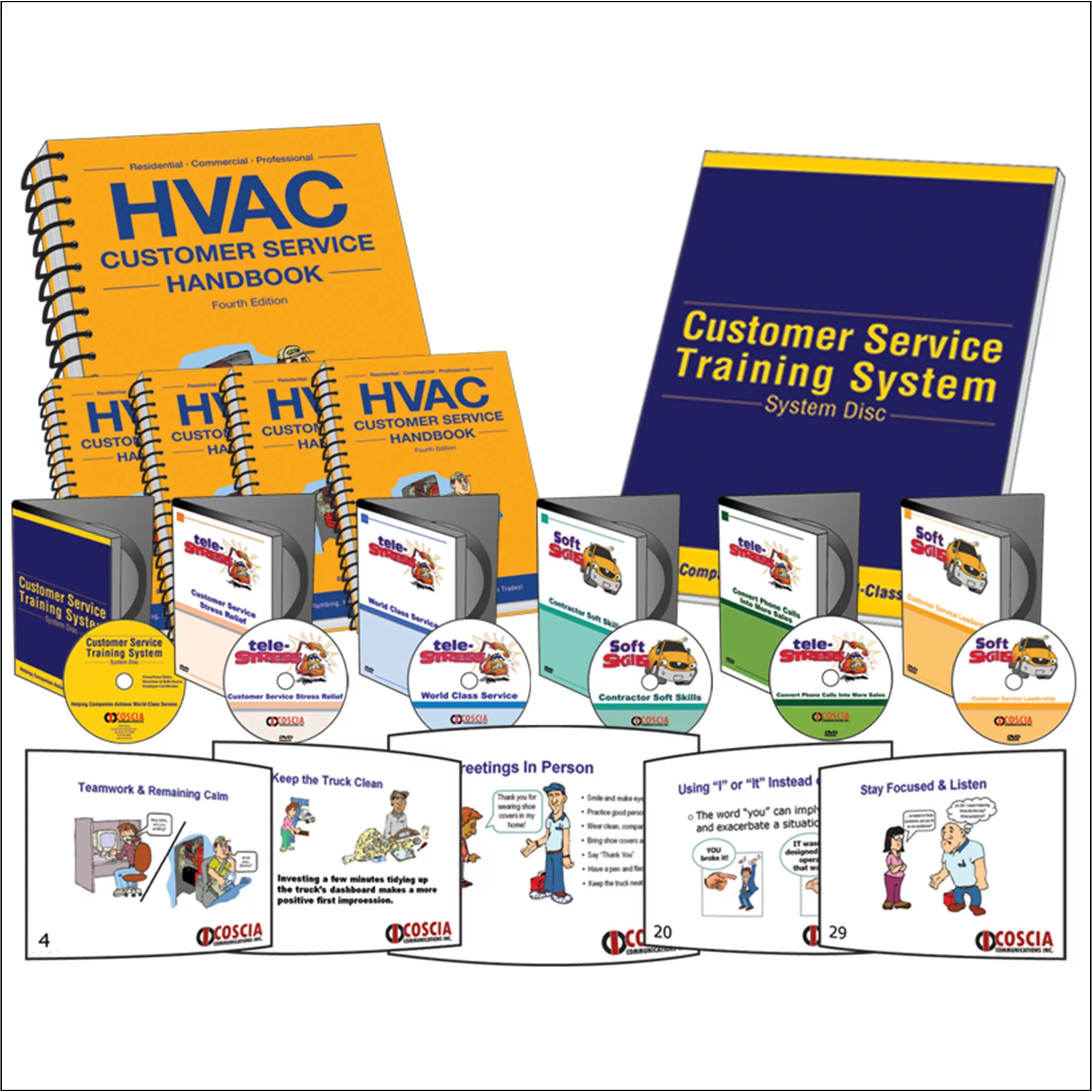
  • HVAC Customer Service Handbook, 4th Edition

  • front cover only.jpg

    How to Market Your HVAC Business

  • Training-System-2017.jpg

    Customer Service Training System by Steve Coscia

See More Products

Related Directories

  • Howe Corp.

    Howe manufactures flake ice making equipment for use with virtually any refrigerant including natural such as R-744, and R-717, Ice storage bins, Condensing units for our ice flakers.
×

Sign Up. Stay Informed.

The #1 trusted source for the HVACR industry since 1926

SUBSCRIBE
  • RESOURCES
    • Advertise
    • Contact Us
    • Advisory Board
    • Classifieds
    • Submit a Letter
    • Directories
    • Store
  • ACCOUNT CENTER
    • Create an Account
    • Start a Subscription
    • Manage My Account
    • Sign Up for Newsletters
    • Visit Customer Service
    • Update Preferences
  • SERVICES
    • Marketing Services
    • Reprints
    • Market Research
    • List Rental
    • Survey/Respondent Access
  • STAY CONNECTED
    • LinkedIn
    • Facebook
    • Instagram
    • YouTube
    • X (Twitter)
  • PRIVACY
    • PRIVACY POLICY
    • TERMS & CONDITIONS
    • DO NOT SELL MY PERSONAL INFORMATION
    • PRIVACY REQUEST
    • ACCESSIBILITY

Copyright ©2026. All Rights Reserved BNP Media, Inc. and BNP Media II, LLC.

Design, CMS, Hosting & Web Development :: ePublishing