ACHR News
search
Ask ACHR NEWS AI
cart
facebook twitter instagram linkedin youtube
  • Sign In
  • Subscribe
  • Sign Out
  • My Account
ACHR News
  • NEWS
    • Breaking News
    • New HVAC Products
    • Featured Products
    • Manufacturer Reports
    • HVAC Data
    • Legislation
    • ACHR NEWS Centennial
  • RESIDENTIAL
    • Air Conditioners
    • Furnaces
    • Residential Heat Pumps
    • Ductless
    • Residential IAQ
    • Testing, Monitoring, Tools
    • Components & Accessories
  • COMMERCIAL
    • Air Handlers
    • Rooftop Units
    • Chillers and Cooling Towers
    • Commercial Heat Pumps
    • Boilers and Hydronics
    • VRF/Ductless
    • Commercial IAQ
  • REFRIGERATION
    • Refrigerants
    • Refrigerant Regulations
    • Leak Management
  • CONTRACTOR PRO
    • Geothermal
    • Homeowner Study
    • VRF and VRV Ductless
    • Unitary Trends
  • EDUCATION
    • Training and Education
    • Business Management
    • Service and Maintenance
    • Continuing Education
    • Market Research >
      • HVAC Brand Awareness Report
      • VRV, VRF, VRVZ Report
      • Unitary Trends Report
      • Water Heat Professionals Report
    • Webinars
    • Sponsor Insights
    • eProducts Info
    • White Papers
  • EVENTS
    • HVAC Contractor Forum
    • Industry Events and Webinars
  • MEDIA
    • Videos
    • AHR Expo 2025 Videos
    • Podcasts >
      • ACHR News Podcast
      • HARDI Podcasts
      • AHR Expo Podcasts
      • ACCA Podcasts
    • Interactive Spotlights
    • Quizzes
    • eBooks
    • HVAC Talkback
  • HVAC GROUP
    • ACHR NEWS >
      • Current Issue
      • Digital Edition
      • Subscribe
    • Distribution Trends
    • SNIPS NEWS >
      • Join SNIPS NEWS
    • Engineered Systems News >
      • Join ES News
    • HVACR Directory
    • Contests
    • Newsletters
    • Contact
    • Advertise
    • My Account
HVAC ContractingService and Maintenance

Btu Buddy 127: A Hunting TXV

By Bill Johnson
October 21, 2013
Bob is a service technician who is well trained and nationally certified. However, he has sometimes suffered from the same confusion that all technicians occasionally do — the facts that he gathers may or may not point to the obvious cause of the problem or the best solution. But Bob has had something that no one else has. He recalled his long-time HVACR mentor and imagines him accompanying him as “Btu Buddy,” someone who reminded him to take time to stop and think before rushing to judgment, helping keep him on the right track, even with facts that are confusing.

Now, Bob’s company has promoted him to help train a new employee, right out of a school specializing in HVAC, just like Bob was. Bob is now Tim’s Btu Buddy. Tim is anxious to travel with Bob. Tim realizes that he is right out of school, with the theory and lab work that he accomplished in school, but still needs help. He knows that he worked with many of the components of the systems in the school, under ideal conditions with good light and air conditioning. Now it is into the field, sometimes under the house with poor lighting, or out on the rooftop in the sun, where the real action is. He is naturally and normally reluctant, but he has Bob to help guide him.

Bob and Tim were doing a routine service contract call on a 20-ton system in a mall. The contract called for them to put gauges on the system and check the pressures and temperatures. The condensing unit was on the roof and had to be accessed through a roof hatch. The air handler was in the stock room at the back of a large shoe store.

They had fastened the gauges to the compressor at the condensing unit and had a temperature lead fastened to the suction line at the evaporator coil. They were observing the pressures and temperatures and Tim said, “The suction pressure is not stable. Isn’t it supposed to be stable during a long running cycle?”

Bob said, “Yes it is and you are right. What is the suction line temperature doing?”

Tim said, “It is varying also. It is fluctuating between 45° and 55°F. This is not normal.”

Bob said, “It seems that the thermostatic expansion valve, or TXV, is hunting, trying to find equilibrium.”

“What can cause that?” asked Tim.

Looking for quick answers on air conditioning, heating and refrigeration topics? Try Ask ACHR NEWS, our new smart AI search tool. Ask ACHR NEWS →

Bob explained, “Hunting is when the valve cannot settle down. It feeds too much liquid until the sensing bulb senses the superheat is too low, then it overcompensates and shuts the valve down and underfeeds liquid. Something isn’t right.”

Tim asked, “What can cause these symptoms?”

Bob said, “There are several things, and most all of them concern the sensing bulb. Remember we had a sensing bulb a while back where the bulb was mounted after the external equalizer line. The valve had a slight leak allowing a small amount of liquid refrigerant to reach the sensing bulb, starving the coil of liquid refrigerant. That system was not hunting. It was just starved of liquid causing the system to operate under capacity.
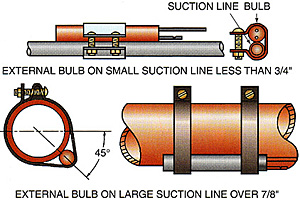
This is an example of how a sensing element of a thermostatic expansion valve (TXV) should be mounted.
Figure 1. This is an example of how a sensing element of a thermostatic expansion valve (TXV) should be mounted. (From Refrigeration & Air Conditioning Technology, seventh edition, by William Whitman, William Johnson, John Tomczyk, and Eugene Silberstein, published by Delmar Cengage Learning.) (©Delmar Cengage Learning.)

“Hunting is usually related to the sensing bulb not responding correctly. The sensing bulb has to have an accurate relationship with the temperature of the suction line. It has to be able to sense the temperature of the suction line to the point of being the same temperature as the suction gas inside the line. It has to be in close contact with the right location on the line. There are several problems that can occur when fastening the bulb to the line:

1. The bulb can be loose.

2. The bulb can have something under it, such as a small amount of corrosion which will act as an insulator.

3. The bulb can be on the line crooked and not making good contact.

4. The bulb can be mounted on the bottom of the line. This is not good because oil travels down the line and will act as an insulator and the bulb will not read the temperature of the vapor in the line.

5. Sometimes the bulb is mounted with one end up on a fitting, again, not making close contact with the line.

6. The bulb can be mounted in the wrong location, such as on a vertical line or on top instead of on the side of a larger suction line (Figure 1).

“We should shut the system down for a few minutes while we examine the bulb location. If we leave the system running and handle the bulb, we will surely cause the valve to overfeed with hand temperature.”

Tim shut the system down and removed the TXV sensing bulb and said, “The bulb was tightened down tight, but one end was setting up a little on a drop of solder. I guess that it was not tight down on the line. I could see light under it.”

Bob asked, “Did you notice anything else?”

Tim said, “Before we shut the system down, there seemed to be a lot of airflow close to where the bulb was mounted.”

Bob said, “You are right. The bulb is mounted on the line just outside the air handler and the hole where the suction line comes through the cabinet has a flow of air blowing on the bulb insulation and that insulation was not very tight. I think that the air, which is return air temperature, is probably affecting the bulb temperature. We will need to seal that airflow off from the bulb when we insulate the bulb again.”

Tim said, “Now what are we going to do special to get this bulb in control?”

Bob said, “We are going to do a textbook mounting and insulation of this bulb:

1. Clean the bulb contact point with sandpaper.

2. Clean the suction line contact point with sandpaper. Remember that the contact point will be about 45 degrees off of the bottom.

3. Use this thermal conductive grease at the contact point. It is a grease that will improve the contact and prevent corrosion between the bulb and line where it is bare copper on the bulb and bare copper on the line.

4. Then we are going to strap the bulb on the line, making sure that it fits down flat.

5. Then we will insulate the bulb and line with closed cell insulation.

6. Then we are going to wrap the end next to the air handler with rubber insulating tape to keep air from getting under the insulation.

7. Then we are going to seal the hole in the cabinet with rubber insulating tape to try to contain the air inside the cabinet.

“With this procedure, the bulb will control the superheat and it will be a job well done for a long time.”

They completed the process and started the unit. The superheat was now holding steady at about 11°.

Tim then said, “We sure paid a lot of attention to details with that bulb, but it paid off.”

Bob said, “Many technicians would have just changed the TXV, which is a big job. They would probably mount the new sensing bulb correctly and it would have worked. In my time in the industry, I have seen very few TXVs that were defective. They seem to be really reliable and it is a big cost to change the valve when it is not necessary. Let’s button everything up and go home. This job is really working like it should.”

Tim said, “Yep, that was a good lesson.”

Publication date: 10/21/2013

Want more HVAC industry news and information? Join The NEWS on Facebook, Twitter, and LinkedIn today!

KEYWORDS: TXV (thermostatic expansion valve)

Share This Story

Looking for a reprint of this article?
From high-res PDFs to custom plaques, order your copy today!


Active in the HVACR industry since the 1950s, Bill Johnson graduated in gas fuel technology and refrigeration from the Southern Technical Institute, a branch of Georgia Tech (now known as Southern Polytechnic Institute). He taught HVAC classes at Coosa Valley Vocational & Technical Institute for four years. He moved on to become service manager for Layne Trane, Charlotte, N.C. He taught for 15 years at Central Piedmont Community College, part of this time as program director. He had his own business for five years doing installation and service work. Now retired, he is the author of Practical Heating Technology and Practical Cooling Technology, and continues as a co-author of Refrigeration & Air Conditioning Technology, seventh edition, all published by Delmar Cengage Learning. For more information, he can be reached at 704-968-0000 or thebillj1@gmail.com.

Btu Buddy Notebook is a collection of more than 50 service call scenarios in book form covering both cooling season and heating season troubleshooting. For more information and to purchase the book, visit the HVACR Industry Store.

Recommended Content

JOIN TODAY
To unlock your recommendations.

Already have an account? Sign In

  • HVAC-enrollment

    The Trades Are Back: HVACR Programs See Nearly 30% Enrollment Spike

    A new wave of future technicians is entering the pipeline.  
    Training and Education
    By: Matt Jachman
  • 2025 Top 40 Under 40

    2025 Top 40 Under 40 HVACR Professionals List

    The 11th annual Top 40 Under 40 list highlights those...
    HVAC Residential Market
    By: Hannah Belloli-Oster
  • LG Ductless Mini-Split Systems

    The 9 Types of Heat Pumps

    As the U.S. moves toward electrification, heat pumps are...
    HVAC Residential Market
    By: Joanna R. Turpin
Subscription Center
  • Create an Account
  • Start a Subscription
  • Manage My Account
  • Sign Up for Newsletters
  • Visit Customer Service
  • Update Preferences

More Videos

Sponsored Content

Sponsored Content is a special paid section where industry companies provide high quality, objective, non-commercial content around topics of interest to The News audience. All Sponsored Content is supplied by the advertising company and any opinions expressed in this article are those of the author and not necessarily reflect the views of The News or its parent company, BNP Media. Interested in participating in our Sponsored Content section? Contact your local rep!

close
  • Piggy Bank
    Sponsored byWatercress Financial

    Energy Prices, Inflation, and HVAC: What Today’s Homeowners Care About

  • Refrigerated Food
    Sponsored bySolstice Advanced Materials

    R-455A Refrigeration: A Cold Storage Solution for the Future

  • Airex Rooftop Units
    Sponsored byAirex Manufacturing Inc

    Consolidating Roof Penetrations: A Growing Trend in Multifamily HVAC Design

Popular Stories

Refrigerants-and-gauge.jpg

HVAC Industry Warns of Counterfeit Refrigerants Entering U.S. Supply Chain

U.S. Supreme Court building

95% Furnace Efficiency Rule to Get New Hearing

Midea-training.jpg

HVAC Workforce Crisis Expands Beyond Technicians to Instructor Shortages

Data_Center_facility.jpg

HVAC Manufacturers Respond to Growing Data Center Backlash

HVAC Minute retail refrigeration system

EPA Final Rule’s Impact on R-410A Deadlines

View The ACHR NEWS
Centennial Anniversary Timeline

The ACHR News Timeline Chart
Submit a Letter
Submit a letter to our editors.

Events

November 6, 2025

Next-Gen Data Center Cooling: HVAC Innovation and Real-World Solutions

On Demand As AI workloads and high-density computing push traditional cooling methods to their limits, the data center industry is accelerating the adoption of next-generation HVAC technologies.

June 23, 2026

HVAC Duct Sealing Mastics: Why Selection Matters

In this webinar we will detail what HVAC material buyers and technicians need to know when selecting duct mastics, including matching mastic to substrate, alternatives to liquid mastic, and where UL 181 Listings fit into real world installations.

View All Submit An Event

Poll

Summer Staff

Are you fully staffed for the summer season?
View Results Poll Archive

Products

BNI Mechanical/Electrical Square Foot Costbook, 2026 Edition

BNI Mechanical/Electrical Square Foot Costbook, 2026 Edition

See More Products
HVAC Duct Sealing Mastics: Why Selection Matters - Free Webinar - 6/23/2026

Related Articles

  • Btu Buddy 52: Topping Off the Charge for a TXV System

    See More
  • BTU 1

    Btu Buddy 171: Charging a TXV System for Subcooling

    See More
  • Btu Buddy 77: Starved Evaporator, TXV

    See More

Related Products

See More Products
  • Understanding TXV Refrigeration Systems: Superheat and Subcooling DVD

  • A-Heat-Pump-Thats-Not-Delivering-Any-Air-DVD-Cover-218x300.jpg

    A Heat Pump That’s Not Delivering Any Air

  • A-Heat-Pump-That-Won__t-Cool-DVD-Cover-214x300.jpg

    A Heat Pump That Won't Cool

See More Products
×

Sign Up. Stay Informed.

The #1 trusted source for the HVACR industry since 1926

SUBSCRIBE
  • RESOURCES
    • Advertise
    • Contact Us
    • Advisory Board
    • Classifieds
    • Submit a Letter
    • Directories
    • Store
  • ACCOUNT CENTER
    • Create an Account
    • Start a Subscription
    • Manage My Account
    • Sign Up for Newsletters
    • Visit Customer Service
    • Update Preferences
  • SERVICES
    • Marketing Services
    • Reprints
    • Market Research
    • List Rental
    • Survey/Respondent Access
  • STAY CONNECTED
    • LinkedIn
    • Facebook
    • Instagram
    • YouTube
    • X (Twitter)
  • PRIVACY
    • PRIVACY POLICY
    • TERMS & CONDITIONS
    • DO NOT SELL MY PERSONAL INFORMATION
    • PRIVACY REQUEST
    • ACCESSIBILITY

Copyright ©2026. All Rights Reserved BNP Media, Inc. and BNP Media II, LLC.

Design, CMS, Hosting & Web Development :: ePublishing