ACHR News
search
Ask ACHR NEWS AI
cart
facebook twitter instagram linkedin youtube
  • Sign In
  • Subscribe
  • Sign Out
  • My Account
ACHR News
  • NEWS
    • Breaking News
    • New HVAC Products
    • Featured Products
    • Manufacturer Reports
    • HVAC Data
    • Legislation
    • ACHR NEWS Centennial
  • RESIDENTIAL
    • Air Conditioners
    • Furnaces
    • Residential Heat Pumps
    • Ductless
    • Residential IAQ
    • Testing, Monitoring, Tools
    • Components & Accessories
  • COMMERCIAL
    • Air Handlers
    • Rooftop Units
    • Chillers and Cooling Towers
    • Commercial Heat Pumps
    • Boilers and Hydronics
    • VRF/Ductless
    • Commercial IAQ
  • REFRIGERATION
    • Refrigerants
    • Refrigerant Regulations
    • Leak Management
  • CONTRACTOR PRO
    • Geothermal
    • Homeowner Study
    • VRF and VRV Ductless
    • Unitary Trends
  • EDUCATION
    • Training and Education
    • Business Management
    • Service and Maintenance
    • Continuing Education
    • Market Research >
      • HVAC Brand Awareness Report
      • VRV, VRF, VRVZ Report
      • Unitary Trends Report
      • Water Heat Professionals Report
    • Webinars
    • Sponsor Insights
    • eProducts Info
    • White Papers
  • EVENTS
    • HVAC Contractor Forum
    • Industry Events and Webinars
  • MEDIA
    • Videos
    • AHR Expo 2025 Videos
    • Podcasts >
      • ACHR News Podcast
      • HARDI Podcasts
      • AHR Expo Podcasts
      • ACCA Podcasts
    • Interactive Spotlights
    • Quizzes
    • eBooks
    • HVAC Talkback
  • HVAC GROUP
    • ACHR NEWS >
      • Current Issue
      • Digital Edition
      • Subscribe
    • Distribution Trends
    • SNIPS NEWS >
      • Join SNIPS NEWS
    • Engineered Systems News >
      • Join ES News
    • HVACR Directory
    • Contests
    • Newsletters
    • Contact
    • Advertise
    • My Account
RefrigerationRefrigerants

Looking Beyond Low GWP

Environmental Regulators Should Consider Refrigerant Performance as well as Global Warming Potential
By Peter Powell
June 3, 2013
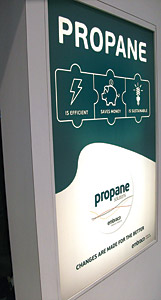
Natural refrigerants such as propane are drawing increasing attention as with this booth display by Embraco at the AHR Expo in Dallas and with its evaluation in an AHRI report.

Now that the battle regarding ozone depleting potential (ODP) refrigerants has ended with the phaseout of CFCs and HCFCs, the fighting has shifted to issues related to the global warming potential (GWP) of the remaining and newly developing refrigerants.

Remaining Effective

The field of combat not only includes f-gases such as HFCs and HFOs, but also so-called natural refrigerants such as propane, carbon dioxide, and ammonia.

In fact, a GWP line in the sand was drawn a number of years ago in Europe as regulators mandated that automotive air conditioning refrigerants maintain a GWP of less than 150. By contrast, the GWP of HFC-134a — the primary auto a/c refrigerant since 1987, when it replaced CFC-12 — registered at 1,430. Today, the automotive sector is considering switching to HFO-1234yf , which has a GWP of 4 and R-744 (carbon dioxide), which boasts a GWP of 1.

But, how does the long list of refrigerants that can be used in HVACR stack up, not only in terms of GWP but in their effectiveness as refrigerants? That has been the objective of the Air-Conditioning, Heating, and Refrigeration Institute (AHRI) with AHRI Project 8006 — Low Global Warming Potential Refrigerants.

A report of the project’s findings published earlier this year focused on refrigerants HFO-1234yf, propane (R-600a), ammonia (R-717), and carbon dioxide (R-744).

“All of these have low GWP, but some have potential drawbacks such as flammability, toxicity, potentially low efficiency, and/or operating conditions that are very different from those of conventional refrigerants,” states the executive summary of the 52-page report, which was prepared for AHRI by Navigant, an independent consulting service.

The report makes it clear that the industry wants regulators to understand that use of refrigerants cannot be based on low GWP only. This has sometimes been an issue in Europe, where environmental organizations have pressured regulators to focus on low GWP only and not total equivalent warming impact (TEWI) or life cycle climate performance (LCCP), which factors in greenhouse gas emissions if a low GWP refrigerant causes a system to run less efficient.

Looking for quick answers on air conditioning, heating and refrigeration topics? Try Ask ACHR NEWS, our new smart AI search tool. Ask ACHR NEWS →

And, as the industry deals with refrigerants outside the traditional HFCs, the report clearly noted that refrigerant changeover must be clearly defined and noted. “System configurations consistent with safety requirements and performance goals must be defined. Applicable codes and standards contain the relevant safety requirements. The costs and other relevant features of these system configurations (technical risk, suitability for the large replacement market, etc.) must be determined.”

The summary went on to note, “This evaluation provides a first step towards completing such assessments by identifying current applicable codes and standards that would dictate system design requirements, development of the most attractive system configurations compliant with the applicable codes for candidate low-GWP refrigerants, and definition of system configuration design details.”

Here were some of the findings:

R-744: “According to the safety requirements provided in ASHRAE Standard 15 and UL 1995, carbon dioxide systems are not limited in charge size or design. However, carbon dioxide systems must meet general strength requirements for all refrigerant-containing parts, requirements that are more restrictive for carbon dioxide due to the relatively high pressures of a transcritical carbon dioxide system.”

R-717: “According to the safety requirements provided in ASHRAE Standards 15 and 34, and UL 1995, use of ammonia is very restricted in direct systems and not restricted in indirect systems. The driving design requirement is the ASHRAE Standard 34 RCL limits, which only allow very small quantities of ammonia refrigerant in direct systems (compared to typical systems). There are no charge restrictions for indirect systems.”

R-600a: “According to the safety requirements provided by ASHRAE 15, UL 1995, and UL 484, use of propane is highly restricted. ASHRAE Standard 15 does not allow the use of A3 refrigerants in configurations other than portable-unit systems containing up to 150 g of refrigerant, and UL Standard 484 allows certain charge sizes based on the LFL (lower flammability limit) of the refrigerant; for example, up to 150 g of propane in room air conditioners without restriction (consistent with ASHRAE Standard 15 requirements) and up to 1 kg of propane with charge restrictions based on room size. The ASHRAE Standard 15 restriction effectively precludes consideration of the larger charge allowances of UL Standard 484.”

HFO-1234yf: “According to the safety requirements provided in ASHRAE Standard 15 and UL 1995, use of HFO-1234yf is somewhat restricted in direct systems and not restricted in indirect systems. ASHRAE Standard 15 restricts A2 systems from using direct configurations to unit systems using no more than 6.6 pounds of charge. There are no charge restrictions for indirect systems.”

Publication date: 6/3/2013

Want more HVAC industry news and information? Join The NEWS on Facebook, Twitter, and LinkedIn today!

KEYWORDS: AHRI CO2 refrigeration GWP (Global Warming Potential) refrigerants propane refrigerant refrigeration systems

Share This Story

Looking for a reprint of this article?
From high-res PDFs to custom plaques, order your copy today!


Peter Powell is Refrigeration Editor. He can be contacted at 815-654-7270 or peterpowell@achrnews.com. Peter was formerly Editor/Publisher of Service & Contracting, where he gained his refrigeration experience. Among his duties, Powell is responsible for the monthly Refrigeration Zone sections in The NEWS

Recommended Content

JOIN TODAY
To unlock your recommendations.

Already have an account? Sign In

  • HVAC-enrollment

    The Trades Are Back: HVACR Programs See Nearly 30% Enrollment Spike

    A new wave of future technicians is entering the pipeline.  
    News
    By: Matt Jachman
  • 2025 Top 40 Under 40

    2025 Top 40 Under 40 HVACR Professionals List

    The 11th annual Top 40 Under 40 list highlights those...
    HVAC Light Commercial Market
    By: Hannah Belloli-Oster
  • LG Ductless Mini-Split Systems

    The 9 Types of Heat Pumps

    As the U.S. moves toward electrification, heat pumps are...
    News
    By: Joanna R. Turpin
Subscription Center
  • Create an Account
  • Start a Subscription
  • Manage My Account
  • Sign Up for Newsletters
  • Visit Customer Service
  • Update Preferences

More Videos

Sponsored Content

Sponsored Content is a special paid section where industry companies provide high quality, objective, non-commercial content around topics of interest to The News audience. All Sponsored Content is supplied by the advertising company and any opinions expressed in this article are those of the author and not necessarily reflect the views of The News or its parent company, BNP Media. Interested in participating in our Sponsored Content section? Contact your local rep!

close
  • Piggy Bank
    Sponsored byWatercress Financial

    Energy Prices, Inflation, and HVAC: What Today’s Homeowners Care About

  • Refrigerated Food
    Sponsored bySolstice Advanced Materials

    R-455A Refrigeration: A Cold Storage Solution for the Future

  • Airex Rooftop Units
    Sponsored byAirex Manufacturing Inc

    Consolidating Roof Penetrations: A Growing Trend in Multifamily HVAC Design

Popular Stories

HVAC-Price-Increase-graphic

HVAC Price Increase List: June 2026

Trump-Section-232.jpg

Trump Reduces Section 232 Tariffs on HVAC Equipment to 15%

Refrigerants-and-gauge.jpg

HVAC Industry Warns of Counterfeit Refrigerants Entering U.S. Supply Chain

U.S. Supreme Court building

95% Furnace Efficiency Rule to Get New Hearing

Midea-training.jpg

HVAC Workforce Crisis Expands Beyond Technicians to Instructor Shortages

View The ACHR NEWS
Centennial Anniversary Timeline

The ACHR News Timeline Chart
Submit a Letter
Submit a letter to our editors.

Events

November 6, 2025

Next-Gen Data Center Cooling: HVAC Innovation and Real-World Solutions

On Demand As AI workloads and high-density computing push traditional cooling methods to their limits, the data center industry is accelerating the adoption of next-generation HVAC technologies.

June 23, 2026

HVAC Duct Sealing Mastics: Why Selection Matters

In this webinar we will detail what HVAC material buyers and technicians need to know when selecting duct mastics, including matching mastic to substrate, alternatives to liquid mastic, and where UL 181 Listings fit into real world installations.

View All Submit An Event

Poll

Summer Staff

Are you fully staffed for the summer season?
View Results Poll Archive

Products

BNI Mechanical/Electrical Square Foot Costbook, 2026 Edition

BNI Mechanical/Electrical Square Foot Costbook, 2026 Edition

See More Products
HVAC Duct Sealing Mastics: Why Selection Matters - Free Webinar - 6/23/2026

Related Articles

  • Low GWP in Refrigeration Discussed at Conference

    See More
  • Evaluating Low GWP

    See More
  • Refrigerant Manufacturers Looking Beyond R-22

    See More

Related Products

See More Products
  • low grade.png

    Low GWP Refrigerant Safety: Flammable & Mildly Flammable Refrigerants Manual

  • Manual Q.jpg

    Manual Q - Low Pressure, Low Velocity Duct System Design

See More Products

Events

View AllSubmit An Event
  • January 16, 2014

    AHRI Low-GWP AREP Conference

    Join AHRI in New York City before the ASHRAE Winter Conference to learn about the results of the AHRI Low-Global Warming Potential Alternative Refrigerants Evaluation Program (Low-GWP AREP).
View AllSubmit An Event

Related Directories

  • Hillphoenix

    UPDATE OR BUILD NEW? The answer is Hillphoenix. We've been offering low GWP, ODP solutions for years. Our expertise is grounded in time-tested experience.
  • Koura

    Koura, a global leader in refrigerants, produces innovative, low GWP Klea® refrigerant gases for the world's biggest organizations across commercial refrigeration, automotive and stationary air conditioning applications.
×

Sign Up. Stay Informed.

The #1 trusted source for the HVACR industry since 1926

SUBSCRIBE
  • RESOURCES
    • Advertise
    • Contact Us
    • Advisory Board
    • Classifieds
    • Submit a Letter
    • Directories
    • Store
  • ACCOUNT CENTER
    • Create an Account
    • Start a Subscription
    • Manage My Account
    • Sign Up for Newsletters
    • Visit Customer Service
    • Update Preferences
  • SERVICES
    • Marketing Services
    • Reprints
    • Market Research
    • List Rental
    • Survey/Respondent Access
  • STAY CONNECTED
    • LinkedIn
    • Facebook
    • Instagram
    • YouTube
    • X (Twitter)
  • PRIVACY
    • PRIVACY POLICY
    • TERMS & CONDITIONS
    • DO NOT SELL MY PERSONAL INFORMATION
    • PRIVACY REQUEST
    • ACCESSIBILITY

Copyright ©2026. All Rights Reserved BNP Media, Inc. and BNP Media II, LLC.

Design, CMS, Hosting & Web Development :: ePublishing