Wired, Wireless Sensors Offer Options
It’s no secret sensors play a critical role in building automation operation and efficiency. Their impact and effectiveness will depend on how the sensors correlate with other devices and components across the greater HVAC system. This requires some emphasis on effective design attributes and integration strategies.
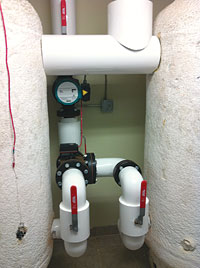
|
| Even though wireless sensors are appearing more frequently, wired sensors, such as the one shown here, still remain a reliable option. |
Sensor designs have not so much evolved as diversified. Notably, the growing array of designs is bringing more installation options to HVAC professionals, and the expanding options give HVAC installers specific solutions for varying environments, from typical wall-mount positions to underground and high-moisture locations.
Wireless sensors also are appearing on the market with more frequency, offering new solutions to age-old challenges of transporting data across difficult sites and terrains. It is expected that the trend to adopt more wireless solutions — similar to the migration trend from serial to IP networks — will gradually accelerate as the cost per device to support wireless configurations comes down.
Wireless Applications Grow
Modern HVAC systems can cleanly accommodate both wired and wireless sensors. Wired sensors remain the more common and sensible option for installers in most cases, offering lower cost, simple setup, and direct connections for trouble-free operation.
Wireless sensors are more commonly used for monitoring as opposed to actual HVAC control applications, though they are increasingly filling an important niche: cost and labor reduction in projects that may involve difficult wiring scenarios.
Sensor networks, whether wired or wireless, are typically comprised of numerous sensors to gather data from multiple rooms and locations. The preference to run wired sensors for the sake of familiarity and reliability may require reassessment if the job results in high labor costs.
This trend is especially coming into focus within older urban environments. Increasingly, DataNab is hearing from installers in New York City and other areas that are faced with retrofitting older brick or stone buildings, making it nearly impossible to run wires between rooms or floors. Simply put, they are finding the more traditional wired methods cost-prohibitive in these situations.
Looking for quick answers on air conditioning, heating and refrigeration topics? Try Ask ACHR NEWS, our new smart AI search tool. Ask ACHR NEWS
Getting wires across large spaces like gymnasiums and auditoriums offer a similar example. Measuring the temperature in areas on the far side of those spaces often times require a lift to be rented to run wires overhead. This can be time- and cost-prohibitive, and makes a wireless solution more appealing.
Reliable Networks
A major challenge when dealing with wireless networks has always been the complexity involved in getting the networks setup and commissioned to operate reliably. However, modern mesh-network technology and smarter wireless devices with more built-in intelligence have alleviated some of this pain.
Mesh networks can establish a redundant and self-healing network with no single point of failure, as the network uses various wireless nodes to provide alternative paths. Essentially, the pitfall of point-to-point wireless communications, such as an obstructed signal path, is avoided. This appears to be the most likely infrastructure for wireless sensing and control in building automation systems moving forward.
It’s important to stress that hard-wired solutions will remain the more reliable option in most cases, even as wireless-sensing deployments mature, because there is less concern about interference and noise. Additionally, there is no concern about battery replacement. This is a significant reason why hybrid networks are appearing more often as HVAC installers can easily retain reliability for the most critical processes, while simplifying the more challenging integration aspects with strategically deployed wireless solutions.
However, there are situations in which point-to-point architecture may make sense. If only a small number of sensors are needed and it is a fairly simple application, then a point-to-point wireless solution with a fairly obvious unobstructed path may be the most simple and cost-effective solution.
Simplified Deployment Options for Wired Sensors
In those applications that utilize a majority of wired sensors, the use of 1-Wire technology can further reduce costs and complexity associated with labor.
1-Wire sensors incorporate uniquely addressable chips that enable the sensors to communicate information to a central controller over a single-cable network, and in a daisy-chained fashion. This provides an efficient alternative to legacy solutions that require a dedicated cable to the controller from each sensor, eliminating the need for multiple wires and multiple analog-to-digital-input connections.
The 1-Wire design simplifies wiring and installation by eliminating the “home run” for each connected sensor. The technology also eliminates the need for separate input points on the controller for each sensor, which reduces hardware costs and makes the system very scalable for future expansion.
Physical Design
Physical sensor designs are changing to better adapt to various environments based on location. There are a wide variety of sensor designs available, making it simple to find an effective solution for almost any application. Some of the more innovative 1-Wire options on the market include:
• Unique inline potted sensor from DataNab, which are cost effective and ideal for use in a wide variety of environments and locations, even in those that risk direct contact with liquids. These designs embed and pot the sensor into the end of jacketed cables for maximum protection.
• Stainless steel probes are built for general-purpose temperature measurement and sensing liquid temperature in pipes. DataNab offers 1- and 3-inch probes with a diameter of 6 millimeters, available in a variety of cable lengths. These are ideal for strapping to pipes in mechanical rooms, or inserting into thermowells.
• Specialty flush mount designs, with plastic threaded casings that screw directly into drywall and can be painted over for near invisibility. This design is especially ideal in locations such as corporate board rooms and offices where cosmetic appearance is important.
Whichever path you choose, the intelligent use of sensors in building automation systems will help schools, businesses, and building owners improve operating efficiency and effectively measure system performance. The result is a comfortable environment with lower monthly bills.
Publication date: 1/28/2013
Looking for a reprint of this article?
From high-res PDFs to custom plaques, order your copy today!