ACHR News
search
Ask ACHR NEWS AI
cart
facebook twitter instagram linkedin youtube
  • Sign In
  • Subscribe
  • Sign Out
  • My Account
ACHR News
  • NEWS
    • Breaking News
    • New HVAC Products
    • Featured Products
    • Manufacturer Reports
    • HVAC Data
    • Legislation
    • ACHR NEWS Centennial
  • RESIDENTIAL
    • Air Conditioners
    • Furnaces
    • Residential Heat Pumps
    • Ductless
    • Residential IAQ
    • Testing, Monitoring, Tools
    • Components & Accessories
  • COMMERCIAL
    • Air Handlers
    • Rooftop Units
    • Chillers and Cooling Towers
    • Commercial Heat Pumps
    • Boilers and Hydronics
    • VRF/Ductless
    • Commercial IAQ
  • REFRIGERATION
    • Refrigerants
    • Refrigerant Regulations
    • Leak Management
  • CONTRACTOR PRO
    • Geothermal
    • Homeowner Study
    • VRF and VRV Ductless
    • Unitary Trends
  • EDUCATION
    • Training and Education
    • Business Management
    • Service and Maintenance
    • Continuing Education
    • Market Research >
      • HVAC Brand Awareness Report
      • VRV, VRF, VRVZ Report
      • Unitary Trends Report
      • Water Heat Professionals Report
    • Webinars
    • Sponsor Insights
    • eProducts Info
    • White Papers
  • EVENTS
    • HVAC Contractor Forum
    • Industry Events and Webinars
  • MEDIA
    • Videos
    • AHR Expo 2025 Videos
    • Podcasts >
      • ACHR News Podcast
      • HARDI Podcasts
      • AHR Expo Podcasts
      • ACCA Podcasts
    • Interactive Spotlights
    • Quizzes
    • eBooks
    • HVAC Talkback
  • HVAC GROUP
    • ACHR NEWS >
      • Current Issue
      • Digital Edition
      • Subscribe
    • Distribution Trends
    • SNIPS NEWS >
      • Join SNIPS NEWS
    • Engineered Systems News >
      • Join ES News
    • HVACR Directory
    • Contests
    • Newsletters
    • Contact
    • Advertise
    • My Account
HVAC Residential MarketHVAC Light Commercial MarketComponents & AccessoriesResidential ControlsCommercial Controls

Fail-Safe Protection
By Ed Trout
October 17, 2011
Record power demands during the last two winters caused electrical distribution zones to trip off-line. Fail Safe Protection“The outages were caused by the high demand — nearly triple the usual load — placed on [electric] heaters in the cold temperatures,” said Jeff Rogers, a spokesman for Gulf Power Co. The sudden load losses caused voltages to shoot up above the legal limits at points-of-use in zones that remained on-line. This overvoltage caused damage to electrical equipment of all types, including HVAC equipment, circuit boards, relays, reversing valves, as well as posing a fire risk for the end users. A noticeable increase in the number of reported incidents (including fires) in the last few years is the result of the combination of the increasing number of heat pumps installed during the past decade (which must necessarily use supplemental electric heat in temperatures below 20˚F), and the recent record cold weather temperatures that dipped below 20˚.

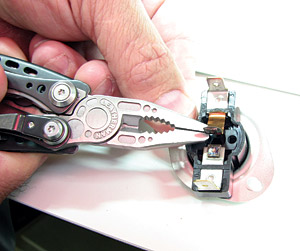
Some electric heaters used in air conditioning units and heat pumps were protected from overheating by safety fuse links which disconnected the heaters when overvoltage was present. In some cases, overvoltage was not recognized as the cause of the blown fuse links. The heaters were then mistakenly blamed for the no-heat complaints instead of overvoltage. As a result, the electric heaters were then replaced with heaters having only automatic reset temperature limits to control overheating, which do not contain safety fuse links.

Automatic reset temperature limits, commonly used in electric heaters, do not provide fail-safe overheating protection and should not be used alone to prevent overheating. These limits can cycle on and off excessively (or short cycle) when overheating occurs (due to overvoltage, low airflow, or fan failure). After operating in this abnormal condition, in time, the limit’s contacts can fail in the closed position with the contacts welded together, thus preventing disconnection of the heater. Out-of-control overheating and potential melt-down can result. During the equipment’s service life, this condition can go unnoticed by the end user, and may take weeks, months, or years (without any warning) for fire or other catastrophic damage to occur.

Some of the heaters that were used as replacements incorporate fuse links in addition to automatic reset temperature limits. However, these particular fuse links do not provide fail-safe overheating protection either, as stated in the following “Important Notice” disclaimer published by the manufacturer of both devices (fuse links and automatic reset temperature limits): “If failure of the control to operate could result in personal injury or property damage, the user should incorporate supplemental system control features to achieve the desired level of reliability and safety.”

Thermal fuse links are available that do not require supplemental control features and inherently pro-
vide fail-safe overheating protection. Other methods of supplemental system control, such as positive lock-out control circuits with manual reset features, can provide fail-safe overheating protection but are more expensive and thus are seldom used.

Fred Kobie, president of Kobie Kooling, Fort Myers, Fla., said, “I certainly agree that the fail rate over the past 18 months was blamed on the product instead of the condition. I also agree that without overheating protection a contractor is literally playing a life and death game. The fire danger and potential life loss is never worth the risk and with a system in place to prevent the risk, seems like a no-brainer.”

“Using load-carrying automatic reset thermostats as high limit safety devices without reliable backup protection is equivalent to installing potential hidden ticking time bombs,” said Gene Kisner, retired HVAC contactor and controls consultant, Fairmont, W.Va. “The cost and inconvenience of replacing a fuse link is far less than dealing with the consequences of fire.”

Installers should be cautioned that only electric heaters with fuse links that provide fail-safe overheating protection, or other fail-safe control systems that provide equivalent protection, should be used in homes and buildings to ensure safe operation throughout the life of the equipment.

Publication date: 10/17/2011

KEYWORDS: building controls safety and HVAC

Share This Story

Looking for a reprint of this article?
From high-res PDFs to custom plaques, order your copy today!


Ed Trout is vice president of operations and director of product safety for Warren Technology, Hialeah, Fla. He has been responsible for the testing and safety certification of over 4,000 electric heating products through Underwriters Laboratories (UL), Canadian Safety Association (CSA), Electrical Testing Laboratories (ETL), and Applied Research Laboratories (ARL). He has also held a State of Florida Air Conditioning Certification since 1980. For further information, contact heatersafety@warrenhvac.com.

Recommended Content

JOIN TODAY
To unlock your recommendations.

Already have an account? Sign In

  • HVAC-enrollment

    The Trades Are Back: HVACR Programs See Nearly 30% Enrollment Spike

    A new wave of future technicians is entering the pipeline.  
    Training and Education
    By: Matt Jachman
  • 2025 Top 40 Under 40

    2025 Top 40 Under 40 HVACR Professionals List

    The 11th annual Top 40 Under 40 list highlights those...
    HVAC Commercial Market
    By: Hannah Belloli-Oster
  • LG Ductless Mini-Split Systems

    The 9 Types of Heat Pumps

    As the U.S. moves toward electrification, heat pumps are...
    HVAC Residential Market
    By: Joanna R. Turpin
Subscription Center
  • Create an Account
  • Start a Subscription
  • Manage My Account
  • Sign Up for Newsletters
  • Visit Customer Service
  • Update Preferences

More Videos

Sponsored Content

Sponsored Content is a special paid section where industry companies provide high quality, objective, non-commercial content around topics of interest to The News audience. All Sponsored Content is supplied by the advertising company and any opinions expressed in this article are those of the author and not necessarily reflect the views of The News or its parent company, BNP Media. Interested in participating in our Sponsored Content section? Contact your local rep!

close
  • Piggy Bank
    Sponsored byWatercress Financial

    Energy Prices, Inflation, and HVAC: What Today’s Homeowners Care About

  • Refrigerated Food
    Sponsored bySolstice Advanced Materials

    R-455A Refrigeration: A Cold Storage Solution for the Future

  • Airex Rooftop Units
    Sponsored byAirex Manufacturing Inc

    Consolidating Roof Penetrations: A Growing Trend in Multifamily HVAC Design

Popular Stories

Outdoor-condensing-units.jpg

EPA Removes R-410A Installation Deadline

HVAC-Price-Increase-graphic

HVAC Price Increase List: June 2026

Trump-Section-232.jpg

Trump Reduces Section 232 Tariffs on HVAC Equipment to 15%

ACHR NEWS Editor Chris Gray Presenting HVAC Minute 5-18-2026

HVAC Manufacturers Fight Pricing Lawsuits

R410A-Refrigerant-Cylinder.jpg

Refrigerant Recovery is a Revenue Opportunity

View The ACHR NEWS
Centennial Anniversary Timeline

The ACHR News Timeline Chart
Submit a Letter
Submit a letter to our editors.

Events

November 6, 2025

Next-Gen Data Center Cooling: HVAC Innovation and Real-World Solutions

On Demand As AI workloads and high-density computing push traditional cooling methods to their limits, the data center industry is accelerating the adoption of next-generation HVAC technologies.

June 9, 2026

Before You Go All In on AI: Set Up Your Business to Actually Win

In this webinar, we'll walk you through exactly what to get in place before you add AI to your business. You'll leave with a clear picture of where you stand today and a practical action plan to set yourself up for real results.

View All Submit An Event

Poll

Summer Staff

Are you fully staffed for the summer season?
View Results Poll Archive

Products

BNI Mechanical/Electrical Square Foot Costbook, 2026 Edition

BNI Mechanical/Electrical Square Foot Costbook, 2026 Edition

See More Products
A2L Refrigerants - Free Webinar - May 21, 2026

Related Articles

  • Fail-Safe Overheating Protection: A Necessity for Electric Heaters

    See More
  • If You Fail to Plan, Plan to Fail

    See More
  • Five Ways to Fail-Proof a Business - The ACHR News

    Five Ways to Fail-Proof an HVAC Business

    See More

Related Products

See More Products
  • The ACHR News - February 2, 2026

    ACHR NEWS February 2, 2026, Issue

See More Products

Related Directories

  • SafeTraces (Manufacturer)

    SafeTraces provides veriDART®, the only indoor air quality verification that actively measures pathogen risk, leveraging patented aerosol tracing technology.
×

Sign Up. Stay Informed.

The #1 trusted source for the HVACR industry since 1926

SUBSCRIBE
  • RESOURCES
    • Advertise
    • Contact Us
    • Advisory Board
    • Classifieds
    • Submit a Letter
    • Directories
    • Store
  • ACCOUNT CENTER
    • Create an Account
    • Start a Subscription
    • Manage My Account
    • Sign Up for Newsletters
    • Visit Customer Service
    • Update Preferences
  • SERVICES
    • Marketing Services
    • Reprints
    • Market Research
    • List Rental
    • Survey/Respondent Access
  • STAY CONNECTED
    • LinkedIn
    • Facebook
    • Instagram
    • YouTube
    • X (Twitter)
  • PRIVACY
    • PRIVACY POLICY
    • TERMS & CONDITIONS
    • DO NOT SELL MY PERSONAL INFORMATION
    • PRIVACY REQUEST
    • ACCESSIBILITY

Copyright ©2026. All Rights Reserved BNP Media, Inc. and BNP Media II, LLC.

Design, CMS, Hosting & Web Development :: ePublishing