Home Health and Comfort: Keeping Customers Healthy and Safe
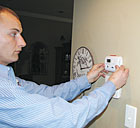
David Faulkenberry, a technician at Oren Atchley Co., checks out a recently installed CO monitor.
Improper IAQ can seriously affect homeowners’ comfort and health. While increased comfort in a home is obviously a desirable goal, improving health and safety through the elimination of indoor pollutants is an even more important issue that contractors need to discuss with homeowners.
There are a variety of health problems that may result from indoor pollutant exposure. These can range from coughing, headaches, and allergy symptoms to more serious issues, such as the increased risk of cancer due to radon exposure or even death from high levels of CO. Fortunately, contractors can often provide solutions that will prevent or mitigate even the worst IAQ problems.
RADON TESTING
Radon testing and/or mitigation is an important service that contractors should consider providing to homeowners, especially in areas that have high levels of the naturally occurring radioactive element. Radon is estimated to cause about 21,000 lung cancer deaths per year, according to the Environmental Protection Agency’s (EPA’s) 2003 Assessment of Risks from Radon in Homes (EPA 402-R-03-003). Only smoking causes more lung cancer deaths, and if homeowners smoke and their home has high radon levels, their risk of lung cancer is especially high.Some states require contractors to obtain special certification or licenses in order to provide radon testing and/or mitigation services (see the National Radon Safety Board website at www.nrsb.org for more information). In other states, certification is voluntary, although states may list privately certified radon professionals (see www.epa.gov/radon/radontest.html), and it may be beneficial to obtain certification to appear on that list.
Radon is invisible, and only through testing can homeowners learn if their home has a problem. While there are do-it-yourself kits available, contractors are the obvious choice to perform a radon test, especially if they are in the home already for furnace or air conditioner maintenance.
Contractors may choose to perform either a short-term or long-term radon test. Short-term tests remain in a home for two to 90 days, depending on the device. Because radon levels tend to vary from day to day and season to season, EPA states a short-term test is less likely than a long-term test to determine the year-round average radon level. If a short-term test results in radon levels higher than 4 Pico curies per liter of air (pCi/L), then a long-term test should be performed. Long-term tests remain in a home for more than 90 days and will provide a reading that is closer to a home’s year-round average radon level.
There are several proven methods to reduce radon in a home, according to the EPA, but the one primarily used is a vent pipe system and fan, which pulls radon from beneath the house and vents it to the outside. This system, known as a soil suction radon reduction system, does not require major changes to a home. Sealing foundation cracks and other openings makes this kind of system more effective and cost efficient. Similar systems can also be installed in houses with crawl spaces. The right system can be determined by a trained contractor and will depend on the design of a home and other factors.

Mike Atchley has been offering CO alarms as long as they have been available because he feels strongly in offering products that make a difference in the customer’s health, comfort, or safety inside the home.
CO ALARMS
CO is known as the silent killer because it is impossible to see or smell, but at high levels it can kill a person in minutes. CO is produced whenever any fuel such as gas, oil, kerosene, wood, or charcoal is burned, and hundreds of people die accidentally every year from CO poisoning caused by malfunctioning or improperly used fuel-burning appliances. That is why it is important for contractors to offer CO alarms as part of their regular service and maintenance calls.Mike Atchley, president, Oren Atchley Air Conditioning and Heating, Fort Smith, Ark., said his residential and light commercial add-on and retrofit company has been offering CO alarms as long as they have been available. “My dad always wanted to be considered as someone who would offer outside-the-box solutions, and offering accessories like CO alarms differentiated us. But he also wanted to be somebody who could offer real solutions. He wanted to make a difference in the customer’s health, comfort, or safety inside the home.”
Atchley tried selling several different types of CO detectors over the years but usually ended up having problems with their reliability. About four years ago, he switched over to using National Comfort Institute’s NSI 3000 low-level CO alarm, and it is now the company’s best-selling accessory. “The technicians love it, it’s easy to install, and it’s easy to sell. I can’t speak highly enough of that particular product.”
Customers primarily use gas in Atchley’s service area, but homes in the rural areas are often electric. Even without a gas appliance, Atchley encourages his technicians to offer CO alarms to homeowners. “Many times, CO alarms will go off in the winter because people are warming up their cars in the attached garage. That’s why it’s important for technicians to bring it up on every heating call they go on.”
Richard Dean, vice president, Environmental Systems Associates, Columbia, Md., is also an advocate of CO alarms, and his residential service and replacement company has sold them for about 10 years. “About two years ago, we became involved with The Comfort Institute and learned about the benefits of selling low-level CO monitors. There’s a huge difference in CO detectors, and the CO Expert alarms we sell for $185 are vastly superior to the CO alarms you can get at a big box store for $40. We strongly recommend them for all customers, even if they have electric heat.”
The big difference between the low- and high-end CO alarms is that many off-the-shelf products will not sound an alarm until they register at least 30 ppm of CO for 4 to 6 hours, said Dean. This can result in homeowners suffering from headaches but not necessarily understanding what is causing them. Low-level CO alarms often go off immediately upon sensing 15 ppm CO, which means homeowners can take quick action and vacate the premises.
As with any other type of upgraded equipment, it is necessary to educate customers on the benefits of a more expensive CO alarm. “We’re a low-pressure company,” said Dean, “and sometimes it is difficult to sell people on the difference in alarms and how important we feel early detection is. They may understand it, but they feel the $40 alarm will probably save their life.”
Atchley agreed, noting that there are far too many people out there taking the attitude that CO poisoning won’t happen to them. “The easiest person to sell a low-level CO monitor to is someone who already has a regular CO detector in their house. If they have that, they know something about it, and when we can point out the advantages of the low-level monitor over their regular detector, it becomes much easier to sell.”
Offering CO alarms on every service call is not only beneficial to the homeowner, it’s a great way to enhance a contractor’s image, said Dean. “It’s the idea of a complete service. It shows we’re concerned about their safety, and we have proven products that will enhance their safety and make them feel more comfortable and safer in their own home.”
Obviously, there is a monetary benefit to selling CO alarms as well, noted Atchley. “Every dollar helps cover overhead, but there are other benefits. There’s the initial sale, then there is the recurring revenue. On CO alarms, the sensor is good for about three years, and after that, people have to buy another one. We’re at a point now where people are buying their second CO detector. That helps. The other benefit is that by offering reliable products, technicians feel confident about providing the customer with a solution that most of our competitors aren’t doing. It’s the snowball effect. It takes a little while to figure out which products are good, but once you’ve got that ball moving downhill, it gets bigger and it gets easier.”
Publication date: 05/31/10
Looking for a reprint of this article?
From high-res PDFs to custom plaques, order your copy today!


