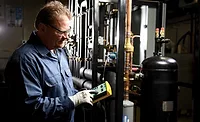
Road to Reclaim Purity Is a Complex One
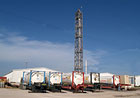
The reclaim sector of the market sector has especially complex chemical processes designed to produce refrigerants just as good as virgin HCFCs. (Feature photos courtesy of PureChem.)
As contractors step up their willingness to use the reclamation option to offset decreasing supplies and increasing costs of virgin HCFCs, especially R-22, they are entering a sector of the market with especially complex chemical processes designed to produce refrigerants just as good as virgin HCFCs.
A big part of the complexity issue is the fact that contractors are bringing in recovered refrigerant that they are pretty sure is far from pure enough to reintroduce to a system. In the olden days, that refrigerant was just vented into the atmosphere and relatively inexpensive virgin refrigerant put in its place. But now, since venting is banned by the Environmental Protection Agency (EPA) and costs of HCFCs such as R-22 are rising, reclamation is gaining in importance.
Throughout 2009, The NEWS has been looking at reclamation as part of its overall coverage of refrigerant-related issues pointing to 2010 when R-22 will no longer be able to be used in new equipment. For the story, The NEWS sent out a brief five question survey allowing for open-ended response to 12 major companies among the more than 50 listed as certified by the EPA to perform reclamation. Of those 12, six responded in time for the deadline.
THE PROCESS
By reviewing responses, contractors can get a pretty good idea of what’s involved in bringing refrigerant back to acceptable purity - that of AHRI-700, the same as required of virgin refrigerant. “The basic process we use to reclaim refrigerants is distillation,” said Maureen Beatty of National Refrigerants. “Very simply stated, distillation will remove the non-refrigerant contaminants. But additional technical processes are needed to remove refrigerant contaminants in order to bring the refrigerant back to original purity standards. We use a much more technically sophisticated process to separate severe or multi-refrigerant mixes.”Gordon McKinney of ICOR, expands on that. “Through specialized filtration and distillation processes, we can separate all of the contaminants (oil, metal shavings, acids, moisture, non-condensables) normally found in recovered refrigerant. The distillation process itself consists of boiling refrigerants to assist in separating out the non-condensables and oils. The distillation process leaves a pure, uncontaminated finished product that can be returned to the industry cycle.”
Another factor is the quality of the equipment being used, said Fred Schwartz of PureChem, who also points to the complexity of the process in citing the procedures at his company.
“All refrigerant received is reclaimed through one of two high capacity reclamation units to remove oil, water, air, acid from burn out, and particulates. Each reclamation unit has a capacity of 1,250 pounds per hour. Any mixed refrigerants are then stored for separation by purity and type.”
He also noted, “PureChem Separation, L.P. has the additional capability of separating mixed refrigerants, with an emphasis on R-22, utilizing a fractional distillation column. This column is over 100 feet tall and has a diameter of 18 inches that allows for the separation of up to 2.8 million pounds annually, depending on the composition of the refrigerant mixture. The column operates at pressure up to 435 psi.”
Here is yet another view of the preciseness needed in the process, this from Wayne Zhang of RemTec.
“Depending on the level of contamination and pressure of the materials, recovered refrigerants are consolidated into different bulk tanks for different reclamation procedures. Failed purity mixtures (less than 99.5 percent) are refined in a simple fractionation column or more complicated azeotropic and extractive distillation columns to lift up the usable component to AHRI-700 standard, which is normally 99.5 percent or above. Other separation facilities involving special techniques, such as chemical reactor, cryogenic separation and oil-gas separator, are also used to enhance the reclamation process. Moisture is usually removed in an adsorption column or replaceable core filter driers.”
All of those responding pointed out that analysis as to the viability of refrigerant submitted for reclamation is the first part of the process.
Patti Conlan of Arkema said, “The refrigerant is analyzed to determine if it is feasible to reclaim. If deemed acceptable, the refrigerant is then evaporated off, leaving the oil behind, thus effectively separating the oil from the refrigerant. After properly disposing of the oil, the refrigerant is distilled to separate it from impurities.
“The distillation process takes advantage of the fact that the different refrigerants will have different boiling points. In the case of blends, the composition typically needs to be adjusted since one or more components are off from specification. Once the refrigerant is at the right purity level, it is dried using desiccants to bring its moisture level to the spec. Keep in mind, the process is complicated by the number of single component refrigerants and blended refrigerants made up of multiple fluorochemicals.”
Chris LaPietra of Honeywell also stresses the analysis aspect.
“Reclaimed refrigerant is returned to the plant and then analyzed for purity. Based on purity level, the refrigerant is placed into the appropriate storage tank. If the refrigerant contains any visible water or oil, this is separated by siphoning it off. To remove the remaining impurities (mixed oil and water), the refrigerant is processed (leaving behind the oil and moisture and other impurities) and then re-condensed. The resulting refrigerant meets or exceeds AHRI-700.”
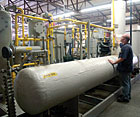
Contractors are bringing in recovered refrigerant that they are pretty sure is far from pure enough to reintroduce to a system. Thus the need for advanced reclamation equipment.
TIME AND PERCENTAGES
How long it takes and how much refrigerant can actually get back to AHRI-700 purity is part of the equation for reclamation companies. Both relate to the shape of the refrigerant that comes to them.Said National’s Beatty, “If you only need to remove non-refrigerant contaminants, then the process does not take very long. Basically, the dirtier the used refrigerant, the longer the processing time.”
PureChem’s Schwartz said, “The most significant time constraint for bringing a refrigerant to AHRI purity is the degree of separation required based on the other refrigerants present. In many cases other refrigerants present are both higher and lower boilers thus necessitating a second distillation in order to meet the minimum AHRI purity level of 99.5 percent. The time it takes to separate mixed refrigerants depends on the purity of the major refrigerant component to start.
“As an example, a mix containing 90 percent R-22 and 10 percent other refrigerants may take 36 hours to reach 99.5 percent purity while a mix with 75 percent R-22 and 25 percent other refrigerants may take twice as long to achieve the minimum 99.5 percent purity specification.”
RemTec’s Patti Ellingson said the process “can vary from a half day to a few days.” She also noted, “The yield is dependent on the initial condition of the materials. Typically, all refrigerant recovered can be brought back to AHRI-700 standards.”
There is also the safety issue, noted McKinney of ICOR. “The process itself is fairly quick but it does require a significant amount of energy use and human oversight. Since the safety concerns are moderate to high, the reclaim process requires additional policy and procedure considerations. These safeguards are necessary to ensure worker safety but do have an impact on processing speed and costs.”
In regards to the reclaim percentages, he said, “We accept all recovered refrigerants including blends and mixed refrigerants. In our experiences the percentage of recovered refrigerant that can be returned to the industry cycle ranges from 75-80 percent.”
The issue of mixed refrigerants also enters into the equation said Honeywell’s LaPietra. “Our process is set up to move the refrigerant through the plant efficiently. Our Danville, Ill., plant is capable of receiving a cylinder of reclaimed refrigerant and having AHRI-700 grade product in the tank within 72 hours. The plant is designed to handle thousands of pounds a day of reclaimed refrigerant.
“The only impediment to reclaiming refrigerant is when it is mixed. Some fluorocarbons when mixed with 22, like HFC-125, cannot be separated from HCFC-22 via distillation.”
Conlan of Arkema noted, “The time required to properly clean a batch of refrigerant varies depending on the original condition of the refrigerant. This includes the amount of oil, water, and impurities and the final batch size. Theoretically, most refrigerants can be brought back to specification. However, in some severe cases, the amount of work required to do so makes it uneconomical and, as a result, the refrigerant is properly destroyed.”
DESTRUCTION METHODS
While the companies may vary on the processes for reclamation, the amount of time it takes and how much can be recovered, they are generally in agreement that the refrigerant which cannot be reclaimed is usually destroyed by incineration. (One company, RemTec, noted it used PLASCON in-flight plasma-arc system for destruction, which it said involves inputs of electricity, argon, steam and sodium creating liquid effluent is a low volume, concentrated inorganic salt solution suitable for discharge to an industrial sewer.)The destruction process in itself is a complex process. Noted ICOR’s McKinney, “The process of separating refrigerants is very cost prohibitive and in some cases, depending on the actual composition of the refrigerants being separated, it can be impractical to impossible. In those cases, the ‘witches brew’ of refrigerants must be destroyed. The most common form of destruction is incineration. This process also requires a great deal of energy use and those costs must be passed down. The bottom line is that when refrigerant users have accidents or make bad decisions and refrigerants get mixed, everyone pays the price.”
Conlan of Arkema said that good service practices at job sites can help prevent too much refrigerant coming back to reclaimers that ends up having to be destroyed. “It is important to emphasize to users in the field that by keeping refrigerants from mixing, maintaining them dry, and avoiding excess oil, more refrigerant will be available for reclaim.”
THE AHRI-700 STANDARD
All those who responded were on the same page in assuring contractors that the refrigerant they reintroduce to the market as reclaimed meets or exceeds AHRI-700 standards.“All reclaimed refrigerants go through strict laboratory tests in our AHRI-certified laboratory and quality control procedures. The refrigerant reintroduced into the market is guaranteed to meet or exceed AHRI-700 standard,” said RemTec’s Ellingson.
PureChem’s Schwartz put it this way. “PureChem Separation operates a full-service refrigerant testing laboratory for internal quality assurance. Once a tank has been certified as meeting all AHRI test parameters, a sample is then submitted to a third-party laboratory for final testing.”
For National’s Beatty, it gets down to knowing the supplier of the service. “Contractors and equipment owners should maintain relationships with refrigerant suppliers that they know and trust who supply well-known quality brand refrigerants. In addition. contractors should make sure that the company reclaiming the refrigerant is EPA-certified to reclaim refrigerant. Additionally, they should utilize a reclaimer that participates in AHRI’s independent reclaimer certification program because, under that program, the reclaimed refrigerants are subject to random testing to verify conformance to AHRI-700 specifications. That is going to be their best assurance that the refrigerant they are purchasing is the quality they expect.”
And said Honeywell’s LaPietra, “Like any product, it comes down to trust. Reclaimed refrigerant is sampled at the end of the reclaim process to ensure specifications are met. Bringing refrigerants to qualified reclaimers is the only way to be sure.”
Publication date: 09/28/2009
Looking for a reprint of this article?
From high-res PDFs to custom plaques, order your copy today!