Demystifying HVAC Drive Anomalies
If anyone can wring every last ounce of functionality out of a piece of electronic test equipment, it’s Chris Vogel, HVAC technician for Siemens Building Technologies. At Siemens, Vogel has his work cut out for him keeping HVAC systems running at their peak for the company’s large commercial customers during peak Florida weather marked by seemingly nonstop 90°F temperatures and 95 percent humidity. Using Fluke’s 199C ScopeMeter® test tool, Vogel has learned to more intricately assess the HVAC systems in his care and ensure they are working properly and efficiently.
He explained that component-level repair, especially on a large site where VFDs are monitored and maintained, can “often mean the difference between a $20 repair part and a $100,000 repair bill. I know firsthand because we recently documented that very scenario,” he said. “Of course, a transistor is basically a lightning-fast switch that switches back and forth between open and closed, and it can sometimes start to break down.”
According to Vogel, when this happens, the motors begin to behave strangely. “For example,” he said, “at load stage, we’ll actually see the motor banging back and forth as if it is not sure which way to turn.”
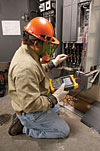
“The scope allows me to record information, and from a number of sources - sine waves on the inputs and outputs of VFDs, current, and voltage - and make comparisons of current and voltage so that I can derive a power factor for the circuit,” said Vogel.
The ScopeMeter allows Vogel to store up to 25 permanent records for recall at any time. “Sometimes I will see a suspect waveform and say, ‘Here’s what it looks like during this slice of time, but here’s what it should look like.’”
With that, he can recall a stored image of the same waveform recorded when the drive was operating properly. “Storage scopes create a graphical representation of the problem versus a merely empirical value that a multimeter would show,” he pointed out.
Shortly after the drive was replaced, it began to ground-fault, causing failures in the building’s electrical distribution network.
“So they asked me to come out,” remembered Vogel. “After doing some low-level diagnostics - throwing amp clamps on the wires and comparing phases and phase draws - I placed a ScopeMeter on the system and discovered that we had a lot of line notching going on.”
He then explained that nonlinear ac loads - loads in which voltage and current are out of phase - create harmonic distortion.
According to Vogel, distortion is a result of the nonsinusoidal waveform the drive generates.
“Any time you have long conduit runs, the wires create magnetic fields around themselves,” he said. “With harmonic distortion, current is actually reflected back into the wiring. It becomes a self-sustaining loop. That’s what we call line notching. It is the electrical equivalent of opening and closing a valve on a water pipe very fast, causing pulsations in the flow.”
Circling back to the original problem, Vogel later noted that the high current for each of the three phases had led the original installers to use four parallel conduits for each phase. In such a configuration, a smaller conductor for each phase would typically have been run down a single conduit, with multiple conduits going to the equipment and each smaller conductor terminated on a terminal block for its appropriate phase. But instead, the installers had run feeds A and B in one conduit, B and C in another, and C and A in the third.
“The drives were passing almost 42 amps to ground, causing them to trip on ground faults and overvoltages,” said Vogel. “Of course, with the phase conductors running through conduits and the sheer number of conductors (16 500 MCM runs), they were concealed, and nobody had thought to look further.”
As chill-water temperature came down, the power factor would drop nominally from about 0.7, which was acceptable, to about 0.32. Then, as Vogel staged the equipment down - namely, drives on the cooling towers, drives on the primary loop pumps, and drives on the primary chill water system - the phases would come back in sync and the power factor would rise again.
“You can view readings on the meter, but you don’t understand what’s causing the power-factor drop until you look at the waveform itself,” explained Vogel. “You can see the field collapsing as the motor winds down, and you can see the current and voltage phases come closer to being in sync. As the power factor comes back and approaches 1.0, it’s fascinating to watch, even for me, and the customer is more likely to understand the problem. More importantly, he can understand how to correct it.”
Many electric utilities charge building owners a penalty for low power factor. One utility, for example, charges building owners $0.14 per kilo volt-ampere reactive power hour (kvarh) when the power factor drops below 0.97.
“According to our calculations, with an added 65 kvar of capacitance, it’s about a $200,000 proposition to add these caps,” said Vogel. “The customer is running two 800-ton machines fully loaded during the peak of summer here in the 95°F Florida heat and 90 percent humidity.”
Essentially, the customer’s air conditioning plant is running at 100 percent electrically but not mechanically, noting that the customer’s electric bill varies from $50,000 to $60,000 a month.
“We determined that if we can increase the power factor on this panel to 0.85, the customer’s electrical consumption will drop by almost one-third,” said Vogel. “That correction, considering the utility’s high power consumption, will give them a payback period of less than one year. And, they could get additional capacity without any work on the mechanical system.
“ScopeMeter identified the problem,” he said. “We took it to the customer and said ‘Hey, as we stage these motors down, as we shut things off, your power factor starts to rise again.’ First, we measured the signal on the MCC panel, and then we measured the signal on their main power panel. We set the same function up on the chiller plant, and we could see the power factor clean up.”
The customer now understands the nature of the problem.
Publication date: 04/06/2009
SERVICE DIVERSITY
On large variable-frequency drives (VFDs), Vogel uses his ScopeMeter to uncover capacitance problems, transistor firing mishaps, and even bleed-throughs on a gate.He explained that component-level repair, especially on a large site where VFDs are monitored and maintained, can “often mean the difference between a $20 repair part and a $100,000 repair bill. I know firsthand because we recently documented that very scenario,” he said. “Of course, a transistor is basically a lightning-fast switch that switches back and forth between open and closed, and it can sometimes start to break down.”
According to Vogel, when this happens, the motors begin to behave strangely. “For example,” he said, “at load stage, we’ll actually see the motor banging back and forth as if it is not sure which way to turn.”
With the new and improving technology of HVAC drives, assessing their functionality and efficiency is simplified when the proper tools are used to measure and verify the results. (Photo courtesy of Fluke Corp.)
STORING TIME
Besides uncovering capacitance problems, according to Vogel, it is important that the technician be able to characterize VFD problems by capturing a waveform from the offending drive. His premise: A signal is much more telling when presented in a waveform view than in a single, static voltage reading. It has a shape and value that may look right at a glance, but could just as easily have a distortion or rough “edge,” or a commentary spike almost too short to be seen. Either problem, or a host of other signal anomalies, would be indistinguishable with just a numeric reading of the signal.“The scope allows me to record information, and from a number of sources - sine waves on the inputs and outputs of VFDs, current, and voltage - and make comparisons of current and voltage so that I can derive a power factor for the circuit,” said Vogel.
The ScopeMeter allows Vogel to store up to 25 permanent records for recall at any time. “Sometimes I will see a suspect waveform and say, ‘Here’s what it looks like during this slice of time, but here’s what it should look like.’”
With that, he can recall a stored image of the same waveform recorded when the drive was operating properly. “Storage scopes create a graphical representation of the problem versus a merely empirical value that a multimeter would show,” he pointed out.
NONLINEAR LOADS ABOUND
In Florida, it’s not uncommon for line voltages to rise and fall precipitously. Vogel recalls working on a current source drive that he wanted to retrofit because it had been hit by lightning. At the time, the crew working on it suspected that the drive had been damaged beyond economical repair, and they decided to replace it, but not the main feeds.Shortly after the drive was replaced, it began to ground-fault, causing failures in the building’s electrical distribution network.
“So they asked me to come out,” remembered Vogel. “After doing some low-level diagnostics - throwing amp clamps on the wires and comparing phases and phase draws - I placed a ScopeMeter on the system and discovered that we had a lot of line notching going on.”
He then explained that nonlinear ac loads - loads in which voltage and current are out of phase - create harmonic distortion.
According to Vogel, distortion is a result of the nonsinusoidal waveform the drive generates.
“Any time you have long conduit runs, the wires create magnetic fields around themselves,” he said. “With harmonic distortion, current is actually reflected back into the wiring. It becomes a self-sustaining loop. That’s what we call line notching. It is the electrical equivalent of opening and closing a valve on a water pipe very fast, causing pulsations in the flow.”
Circling back to the original problem, Vogel later noted that the high current for each of the three phases had led the original installers to use four parallel conduits for each phase. In such a configuration, a smaller conductor for each phase would typically have been run down a single conduit, with multiple conduits going to the equipment and each smaller conductor terminated on a terminal block for its appropriate phase. But instead, the installers had run feeds A and B in one conduit, B and C in another, and C and A in the third.
“The drives were passing almost 42 amps to ground, causing them to trip on ground faults and overvoltages,” said Vogel. “Of course, with the phase conductors running through conduits and the sheer number of conductors (16 500 MCM runs), they were concealed, and nobody had thought to look further.”
POWER FACTOR ISSUES
Vogel recently was called on to solve a power factor problem in a large commercial building. A number of 250-horsepower chiller motors were in place, but they were “super old,” according to Vogel. “In high ambient weather conditions the chillers would load up, and using a ScopeMeter, I could see the phases moving farther and farther apart.”As chill-water temperature came down, the power factor would drop nominally from about 0.7, which was acceptable, to about 0.32. Then, as Vogel staged the equipment down - namely, drives on the cooling towers, drives on the primary loop pumps, and drives on the primary chill water system - the phases would come back in sync and the power factor would rise again.
“You can view readings on the meter, but you don’t understand what’s causing the power-factor drop until you look at the waveform itself,” explained Vogel. “You can see the field collapsing as the motor winds down, and you can see the current and voltage phases come closer to being in sync. As the power factor comes back and approaches 1.0, it’s fascinating to watch, even for me, and the customer is more likely to understand the problem. More importantly, he can understand how to correct it.”
PAYBACK TIME
One of Vogel’s new projects is to install power-factor correction capacitors on a Motor Control Center (MCC) panel at a utility customer’s site. The capacitors will be installed in parallel with the connected circuits. According to him, it is not just about improving power factor but about keeping costs in line.Many electric utilities charge building owners a penalty for low power factor. One utility, for example, charges building owners $0.14 per kilo volt-ampere reactive power hour (kvarh) when the power factor drops below 0.97.
“According to our calculations, with an added 65 kvar of capacitance, it’s about a $200,000 proposition to add these caps,” said Vogel. “The customer is running two 800-ton machines fully loaded during the peak of summer here in the 95°F Florida heat and 90 percent humidity.”
Essentially, the customer’s air conditioning plant is running at 100 percent electrically but not mechanically, noting that the customer’s electric bill varies from $50,000 to $60,000 a month.
“We determined that if we can increase the power factor on this panel to 0.85, the customer’s electrical consumption will drop by almost one-third,” said Vogel. “That correction, considering the utility’s high power consumption, will give them a payback period of less than one year. And, they could get additional capacity without any work on the mechanical system.
“ScopeMeter identified the problem,” he said. “We took it to the customer and said ‘Hey, as we stage these motors down, as we shut things off, your power factor starts to rise again.’ First, we measured the signal on the MCC panel, and then we measured the signal on their main power panel. We set the same function up on the chiller plant, and we could see the power factor clean up.”
The customer now understands the nature of the problem.
Publication date: 04/06/2009
Looking for a reprint of this article?
From high-res PDFs to custom plaques, order your copy today!