Chiller Challenges: Innovations, Payback, Regulations, Stimulus
The chiller sector continues turning out new, more environmentally correct, and energy-efficient equipment, even as it deals with the twin challenges of increasing regulations and understanding how the economic stimulus package might benefit the chiller distribution chain from manufacturer to wholesaler to contractor.
How manufacturers are responding to all this formed the basis of an informal, open-ended survey taken by The NEWS in April.
Given the diversity of manufacturers, responses in each aspect - innovations, payback, regulations, and stimulus - were varied.
“Customers are increasingly expecting products that offer the higher reliability matched with the highest of efficiencies.” Watson cited such trends as “state-of-the-art controls” in the overall system design; use of variable-speed drives, heat recovery, and free cooling options; and district energy (chiller) plants in such locations as data centers, health care facilities, college campuses, and city centers.
Sam Macrane, director of engineering for Chil-Pak, noted “greater acceptance and curiosity associated with magnetic oilless chillers.” Macrane saw variable-speed screw compressors as “a technology that may pick up momentum because of the energy-saving benefits and is perfect for positive displacement applications.”
And, he added, “There will be an increase in the use of absorption chillers, especially in small scale combined cooling and power systems.”
Ron Conry, founder of Danfoss Turbocor Compressors, said, “We are seeing a move away from focusing on full load performance and concentrating on part load efficiencies and life cycle costs.”
Rob Southwood, director of OEM sales, Emerson Climate Technologies, refrigeration division, noted the innovation of modulation using digital scrolls. “Whether the chiller is operating for comfort cooling or process cooling, the ability to closely match required load and do it effectively is important.”
Regarding large chillers, Larry Kouma, who is director of large tonnage package chillers for Johnson Controls, said, “The most important trend is still equipment efficiency. Energy prices continue to rise. In addition, most building owners and designers are conscious that electricity created by fossil-fuel power plants results in greenhouse-gas emissions.”
Said Ian Casper, senior program manager for small-tonnage chillers at Johnson Controls, “In the small-tonnage segment, we see a strong demand for higher efficiency, especially with the off-design efficiency of air-cooled chillers. We have experienced continual growth in shipments of variable-speed, air-cooled screw chillers since their release in 2005. For scroll chillers, the focus is completing the refrigerant conversion from HCFC-22 to HFC-410A.”
Another technology among small tonnage chillers, said Craig Messmer of Unico Inc., is air-to-water heat pumps. He also noted “a big push in the marketplace to use packaged chillers to replace distributed refrigeration systems.”
Another advocate of the small chiller sector was John Seppamaki of Aqua Products who noted the “use of several small chillers together for larger loads which give you staging and backup.” Among the smaller size approaches, he cited, were 1.5- to 5-ton chillers built using micro-channel technology and a reverse cycle chiller that can produce hot water forced air or radiant floor heating or chiller water for air conditioning.
Yet another innovation, according to Mark Key, vice president of sales and marketing for RediControls, is use of purger technology for centrifugal chillers that deals with issues of oil migration and allows for the regaining of chiller capacity and energy savings.
Conry noted, “Paybacks of three years which property owners were looking at now seems to be stretching out to five years and more, and the paybacks are on the cost difference between the lowest cost equipment and the highest efficiency equipment.”
“The greatest challenge will remain the economic,” said Macrane. “The tension between energy efficiency and first cost will continue to stretch the sector. The declining economic conditions add even more pressure to future chiller sales.”
Robert Wilkins, president of Danfoss Inc., said, “Today’s chiller systems are considerably more efficient than 20 years ago, but there are still roughly 250,000 chillers in federal, state, commercial and institutional buildings in the U.S. Approximately 10 percent of these are old, inefficient CFC-chillers. The Air Conditioning, Heating, Refrigerating Institute has initiated an industry task force to accelerate replacing CFC chillers in all sectors. Not only is this a good economic opportunity, but it has the added benefit of eliminating CFCs and substantially reducing energy consumption, which support the climate and energy initiatives coming out of Washington.”
Both Conry and Macrane noted the oilless chiller concept as having an impact in this aspect but with somewhat different perspectives. Said Conry, “Building owners who are aggressively looking at maximizing their operating efficiency are investing in a high performance oil-free technology where energy savings can mean a one year payback.”
Macrane said oilless magnetic compressors “are technologically and environmentally interesting, but does come with the economic penalty of higher first cost.”
In general, said Watson, “properly balancing low first cost against low operating costs is part of a benefit analysis that also includes environmental responsibility and documentation of performance, emissions, and energy consumption.”
Like many in the industry, Southwood sees the continual need to replace “large tonnage CFC chillers. The concern continues, but evidence suggests that these chillers are slowly being converted or replaced due to environmental and business reasons.”
Said Conry, “The main challenge facing the industry with these changes is getting the end user to come to grips with what the new regulations mean. There are many areas where systems can be made to operate more efficiently. Whatever the approach, the end results for the industry are job creation, and positive impact on CO2 emissions and greatly reduced equipment operating costs.”
Watson said, “Owners and servicing contractors must commit to the requirement of sustaining and documenting their system’s performance for the overall life of the building. This documentation is best done using a robust building automation system combined with an intelligent services offering.”
Smaller packaged chillers “will become extremely important if the U.S. passes a cap-and-trade bill on refrigerants,” said Messmer. “We predict that these products will continue to increase in popularity such that efficiency, rather than controllability, becomes the main driver.”
“Refrigerant management remains an important factor in the chiller sector,” said Macrane. “Chiller manufacturers are still maneuvering to provide environmental friendly refrigerants which require new or upgraded chiller designs.”
And, he added, “Regulatory efficiency targets will continue to drive water-cooled chiller sales and make variable-speed drive options more necessary.”
“Codes being considered by many municipal and state governments will force everyone to carefully consider chiller energy consumption,” said Kouma. “As a result, nearly four out of five centrifugal chillers shipped from our U.S. operations are equipped with a variable-speed drive. This technology delivers impressive annual energy savings, reducing both utility bills and CO2 emissions.”
Casper said, “We are expecting to see increasing requirements for small-tonnage chillers that can recover the energy captured within HVAC systems, so that it can be used effectively in building systems.
Danfoss’ Wilkins said, “The stimulus package allocated $63 billion for energy efficiency upgrades to federally-supported public housing. Included in all this is new insulation, windows and frames, so it is much broader than just equipment invested. But it presents a good opportunity to chiller manufacturers. The package provides incentives to upgrade chillers in federal and state buildings.
“Overall, the HVACR industry will benefit from the parts of the stimulus package that involve infrastructure investments,” said Southwood of Emerson. “New commercial and government buildings, including schools and hospitals, and airport improvements will require HVACR systems including chillers and new tax credits will promote the purchase of new efficiency systems. But these infrastructure benefits will not happen immediately - they will phase in over the next one to three years.”
For Johnson Controls’ Casper, “The plan to upgrade many government facilities and schools with newer and more efficient systems will likely result in rapid adoptions of the latest energy-efficient technology. In addition, it is highly likely that all the small-tonnage chillers in these facilities are charged with R-22. This should lead to higher demand for current chillers that are charged with R-134a and R-410A.”
Chil-Pak’s Macrane said the stimulus package “is a welcome boost to nudge some projects forward. This is especially true for school and federal projects.”
Unico’s Messmer is a bit less optimistic. “The economic stimulus package as it relates to air conditioning and heating is not much of a stimulus package. Congress set the bar too high. Only 3.7 percent of the air conditioners and 8 percent of all heat pumps manufactured today comply with the tax credit rules.”
Contractors can benefit said Key of RediControls, “Knowing how and where to find stimulus funding will be key for contractors moving toward selling energy saving and green products to both state and federal facilities. I expect contractors seeing the result of this drive within a year as these facilities start realizing they need to get moving on making improvements.”
Publication date: 05/11/2009
How manufacturers are responding to all this formed the basis of an informal, open-ended survey taken by The NEWS in April.
Given the diversity of manufacturers, responses in each aspect - innovations, payback, regulations, and stimulus - were varied.
INNOVATIONS
“Today, chiller manufacturers are embracing all types of technology to look for improved designs that impact efficiency, reliability, sound, emissions, refrigerant charge, and refrigerant selection,” said Jeff Watson, equipment and solutions leader, Trane.“Customers are increasingly expecting products that offer the higher reliability matched with the highest of efficiencies.” Watson cited such trends as “state-of-the-art controls” in the overall system design; use of variable-speed drives, heat recovery, and free cooling options; and district energy (chiller) plants in such locations as data centers, health care facilities, college campuses, and city centers.
Sam Macrane, director of engineering for Chil-Pak, noted “greater acceptance and curiosity associated with magnetic oilless chillers.” Macrane saw variable-speed screw compressors as “a technology that may pick up momentum because of the energy-saving benefits and is perfect for positive displacement applications.”
And, he added, “There will be an increase in the use of absorption chillers, especially in small scale combined cooling and power systems.”
Ron Conry, founder of Danfoss Turbocor Compressors, said, “We are seeing a move away from focusing on full load performance and concentrating on part load efficiencies and life cycle costs.”
Rob Southwood, director of OEM sales, Emerson Climate Technologies, refrigeration division, noted the innovation of modulation using digital scrolls. “Whether the chiller is operating for comfort cooling or process cooling, the ability to closely match required load and do it effectively is important.”
Regarding large chillers, Larry Kouma, who is director of large tonnage package chillers for Johnson Controls, said, “The most important trend is still equipment efficiency. Energy prices continue to rise. In addition, most building owners and designers are conscious that electricity created by fossil-fuel power plants results in greenhouse-gas emissions.”
Said Ian Casper, senior program manager for small-tonnage chillers at Johnson Controls, “In the small-tonnage segment, we see a strong demand for higher efficiency, especially with the off-design efficiency of air-cooled chillers. We have experienced continual growth in shipments of variable-speed, air-cooled screw chillers since their release in 2005. For scroll chillers, the focus is completing the refrigerant conversion from HCFC-22 to HFC-410A.”
Another technology among small tonnage chillers, said Craig Messmer of Unico Inc., is air-to-water heat pumps. He also noted “a big push in the marketplace to use packaged chillers to replace distributed refrigeration systems.”
Another advocate of the small chiller sector was John Seppamaki of Aqua Products who noted the “use of several small chillers together for larger loads which give you staging and backup.” Among the smaller size approaches, he cited, were 1.5- to 5-ton chillers built using micro-channel technology and a reverse cycle chiller that can produce hot water forced air or radiant floor heating or chiller water for air conditioning.
Yet another innovation, according to Mark Key, vice president of sales and marketing for RediControls, is use of purger technology for centrifugal chillers that deals with issues of oil migration and allows for the regaining of chiller capacity and energy savings.
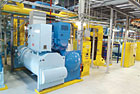
Variable-speed technology, one of the newer innovations in the chiller sector, is used with this 1,500-ton centrifugal in Montreal. (Courtesy of Johnson Controls.)
PAYBACK
The issue of payback justifying upfront costs of new equipment continues to be a challenge.Conry noted, “Paybacks of three years which property owners were looking at now seems to be stretching out to five years and more, and the paybacks are on the cost difference between the lowest cost equipment and the highest efficiency equipment.”
“The greatest challenge will remain the economic,” said Macrane. “The tension between energy efficiency and first cost will continue to stretch the sector. The declining economic conditions add even more pressure to future chiller sales.”
Robert Wilkins, president of Danfoss Inc., said, “Today’s chiller systems are considerably more efficient than 20 years ago, but there are still roughly 250,000 chillers in federal, state, commercial and institutional buildings in the U.S. Approximately 10 percent of these are old, inefficient CFC-chillers. The Air Conditioning, Heating, Refrigerating Institute has initiated an industry task force to accelerate replacing CFC chillers in all sectors. Not only is this a good economic opportunity, but it has the added benefit of eliminating CFCs and substantially reducing energy consumption, which support the climate and energy initiatives coming out of Washington.”
Both Conry and Macrane noted the oilless chiller concept as having an impact in this aspect but with somewhat different perspectives. Said Conry, “Building owners who are aggressively looking at maximizing their operating efficiency are investing in a high performance oil-free technology where energy savings can mean a one year payback.”
Macrane said oilless magnetic compressors “are technologically and environmentally interesting, but does come with the economic penalty of higher first cost.”
In general, said Watson, “properly balancing low first cost against low operating costs is part of a benefit analysis that also includes environmental responsibility and documentation of performance, emissions, and energy consumption.”
REGULATIONS
In general, manufacturers see the broad brushstroke issues related to efficiencies and emission control as reaching the chiller sector. Key said, “Decreasing energy consumption is going to become a major concern for our industry since it is becoming a primary issue with the new administration and HVACR is one of the largest energy consumers for most facilities.”Like many in the industry, Southwood sees the continual need to replace “large tonnage CFC chillers. The concern continues, but evidence suggests that these chillers are slowly being converted or replaced due to environmental and business reasons.”
Said Conry, “The main challenge facing the industry with these changes is getting the end user to come to grips with what the new regulations mean. There are many areas where systems can be made to operate more efficiently. Whatever the approach, the end results for the industry are job creation, and positive impact on CO2 emissions and greatly reduced equipment operating costs.”
Watson said, “Owners and servicing contractors must commit to the requirement of sustaining and documenting their system’s performance for the overall life of the building. This documentation is best done using a robust building automation system combined with an intelligent services offering.”
Smaller packaged chillers “will become extremely important if the U.S. passes a cap-and-trade bill on refrigerants,” said Messmer. “We predict that these products will continue to increase in popularity such that efficiency, rather than controllability, becomes the main driver.”
“Refrigerant management remains an important factor in the chiller sector,” said Macrane. “Chiller manufacturers are still maneuvering to provide environmental friendly refrigerants which require new or upgraded chiller designs.”
And, he added, “Regulatory efficiency targets will continue to drive water-cooled chiller sales and make variable-speed drive options more necessary.”
“Codes being considered by many municipal and state governments will force everyone to carefully consider chiller energy consumption,” said Kouma. “As a result, nearly four out of five centrifugal chillers shipped from our U.S. operations are equipped with a variable-speed drive. This technology delivers impressive annual energy savings, reducing both utility bills and CO2 emissions.”
Casper said, “We are expecting to see increasing requirements for small-tonnage chillers that can recover the energy captured within HVAC systems, so that it can be used effectively in building systems.
STIMULUS
The benefits of the recent economic stimulus package are still being measured.Danfoss’ Wilkins said, “The stimulus package allocated $63 billion for energy efficiency upgrades to federally-supported public housing. Included in all this is new insulation, windows and frames, so it is much broader than just equipment invested. But it presents a good opportunity to chiller manufacturers. The package provides incentives to upgrade chillers in federal and state buildings.
“Overall, the HVACR industry will benefit from the parts of the stimulus package that involve infrastructure investments,” said Southwood of Emerson. “New commercial and government buildings, including schools and hospitals, and airport improvements will require HVACR systems including chillers and new tax credits will promote the purchase of new efficiency systems. But these infrastructure benefits will not happen immediately - they will phase in over the next one to three years.”
For Johnson Controls’ Casper, “The plan to upgrade many government facilities and schools with newer and more efficient systems will likely result in rapid adoptions of the latest energy-efficient technology. In addition, it is highly likely that all the small-tonnage chillers in these facilities are charged with R-22. This should lead to higher demand for current chillers that are charged with R-134a and R-410A.”
Chil-Pak’s Macrane said the stimulus package “is a welcome boost to nudge some projects forward. This is especially true for school and federal projects.”
Unico’s Messmer is a bit less optimistic. “The economic stimulus package as it relates to air conditioning and heating is not much of a stimulus package. Congress set the bar too high. Only 3.7 percent of the air conditioners and 8 percent of all heat pumps manufactured today comply with the tax credit rules.”
Contractors can benefit said Key of RediControls, “Knowing how and where to find stimulus funding will be key for contractors moving toward selling energy saving and green products to both state and federal facilities. I expect contractors seeing the result of this drive within a year as these facilities start realizing they need to get moving on making improvements.”
Publication date: 05/11/2009
Looking for a reprint of this article?
From high-res PDFs to custom plaques, order your copy today!