ACHR News
search
Ask ACHR NEWS AI
cart
facebook twitter instagram linkedin youtube
  • Sign In
  • Subscribe
  • Sign Out
  • My Account
ACHR News
  • NEWS
    • Breaking News
    • New HVAC Products
    • Featured Products
    • Manufacturer Reports
    • HVAC Data
    • Legislation
    • ACHR NEWS Centennial
  • RESIDENTIAL
    • Air Conditioners
    • Furnaces
    • Residential Heat Pumps
    • Ductless
    • Residential IAQ
    • Testing, Monitoring, Tools
    • Components & Accessories
  • COMMERCIAL
    • Air Handlers
    • Rooftop Units
    • Chillers and Cooling Towers
    • Commercial Heat Pumps
    • Boilers and Hydronics
    • VRF/Ductless
    • Commercial IAQ
  • REFRIGERATION
    • Refrigerants
    • Refrigerant Regulations
    • Leak Management
  • CONTRACTOR PRO
    • Geothermal
    • Homeowner Study
    • VRF and VRV Ductless
    • Unitary Trends
  • EDUCATION
    • Training and Education
    • Business Management
    • Service and Maintenance
    • Continuing Education
    • Market Research >
      • HVAC Brand Awareness Report
      • VRV, VRF, VRVZ Report
      • Unitary Trends Report
      • Water Heat Professionals Report
    • Webinars
    • Sponsor Insights
    • eProducts Info
    • White Papers
  • EVENTS
    • HVAC Contractor Forum
    • Industry Events and Webinars
  • MEDIA
    • Videos
    • AHR Expo 2025 Videos
    • Podcasts >
      • ACHR News Podcast
      • HARDI Podcasts
      • AHR Expo Podcasts
      • ACCA Podcasts
    • Interactive Spotlights
    • Quizzes
    • eBooks
    • HVAC Talkback
  • HVAC GROUP
    • ACHR NEWS >
      • Current Issue
      • Digital Edition
      • Subscribe
    • Distribution Trends
    • SNIPS NEWS >
      • Join SNIPS NEWS
    • Engineered Systems News >
      • Join ES News
    • HVACR Directory
    • Contests
    • Newsletters
    • Contact
    • Advertise
    • My Account

Ice Breaker: PTC Starting Relays
By Joe Marchese
September 1, 2008
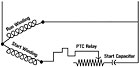
Figure 1. PTC relay with start capacitor

One type of starting relay used on fractional horsepower compressors is the positive temperature coefficient (PTC) relay. It performs the same function as a current relay or potential relay but in a much different manner. A PTC relay uses a positive temperature coefficient thermistor to remove the start winding and/or start capacitor from the circuit. A PTC thermistor is basically a resistor whose resistance increases on an increase in temperature.


The circuit is wired so that the PTC thermistor is wired in series with the start winding of the motor (Fig. 1). If the motor requires a start capacitor, it will also be wired in series with the start winding and PTC relay. When the motor starts, the resistance of the thermistor will initially be very low and sufficient current will flow through the PTC thermistor, the start winding and/or start capacitor to allow the motor to start normally. As the current flows through the PTC thermistor, it will quickly heat up and its resistance will quickly increase to a point where the current flow will dramatically reduce, essentially removing the start winding and/or start capacitor from the circuit.

Another use for a PTC relay is with a permanent split capacitor (PSC)-style compressor. These compressors are designed to operate with a run capacitor in the motor circuit to give them better running efficiency. Sometimes these compressors will require the addition of a start capacitor to assist the starting of the compressor. Normally a potential relay will be used to disconnect the start capacitor from the circuit. However, a PTC relay can also be used for the same purpose. There are two ways in which a PTC relay can be used to assist in starting a PSC-style compressor.
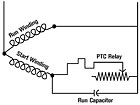


Figure 2. PTC relay with run capacitor

A PTC relay can simply be wired in parallel with a run capacitor (Fig. 2). During starting, the PTC relay causes a short across the run capacitor. This will allow full-line voltage to the start winding during start-up, giving the motor a stronger phase shift to get started. Once the thermistor warms up, the short across the run capacitor is removed and the motor runs normally.

The other method is to use the PTC relay with a start capacitor (Fig. 3). The PTC relay is wired in series with a start capacitor, and both the PTC relay and start capacitor are wired in parallel with the run capacitor. During the starting of the motor, both the start and run capacitors are in the circuit to assist in starting the motor. Once the thermistor heats up, the start capacitor is essentially removed from the circuit and the motor runs normally.


Figure 3. PTC relay with start and run capacitor

The one disadvantage to using this type of relay is once the motor circuit is shut down, it takes about two to five minutes for it to cool down to a point that its resistance reaches a point where the motor could be started again. If the motor tries to start before the PTC relay has cooled enough, the motor’s overload protector will trip the motor circuit. Once the motor’s protector has reset and thermistor cools down sufficiently, the motor should start normally.

Troubleshooting these relays is normally simple. Remove the relay from the circuit and allow it to cool to room temperature. Place an ohmmeter across the terminals of the relay. At room temperature, the measured resistance should be low. If an infinite resistance is measured the relay needs to be replaced.

Publication date: 09/01/2008

Share This Story

Looking for a reprint of this article?
From high-res PDFs to custom plaques, order your copy today!


Joe marchese

Joe Marchese is an author, instructor and HVACR service contractor. He can be reached at joe@koldcraft.com.

Recommended Content

JOIN TODAY
To unlock your recommendations.

Already have an account? Sign In

  • HVAC-enrollment

    The Trades Are Back: HVACR Programs See Nearly 30% Enrollment Spike

    A new wave of future technicians is entering the pipeline.  
    Training and Education
    By: Matt Jachman
  • 2025 Top 40 Under 40

    2025 Top 40 Under 40 HVACR Professionals List

    The 11th annual Top 40 Under 40 list highlights those...
    HVAC Residential Market
    By: Hannah Belloli-Oster
  • LG Ductless Mini-Split Systems

    The 9 Types of Heat Pumps

    As the U.S. moves toward electrification, heat pumps are...
    Ground Source Heat Pumps
    By: Joanna R. Turpin
Subscription Center
  • Create an Account
  • Start a Subscription
  • Manage My Account
  • Sign Up for Newsletters
  • Visit Customer Service
  • Update Preferences

More Videos

Sponsored Content

Sponsored Content is a special paid section where industry companies provide high quality, objective, non-commercial content around topics of interest to The News audience. All Sponsored Content is supplied by the advertising company and any opinions expressed in this article are those of the author and not necessarily reflect the views of The News or its parent company, BNP Media. Interested in participating in our Sponsored Content section? Contact your local rep!

close
  • Piggy Bank
    Sponsored byWatercress Financial

    Energy Prices, Inflation, and HVAC: What Today’s Homeowners Care About

  • Refrigerated Food
    Sponsored bySolstice Advanced Materials

    R-455A Refrigeration: A Cold Storage Solution for the Future

  • Airex Rooftop Units
    Sponsored byAirex Manufacturing Inc

    Consolidating Roof Penetrations: A Growing Trend in Multifamily HVAC Design

Popular Stories

Refrigerants-and-gauge.jpg

HVAC Industry Warns of Counterfeit Refrigerants Entering U.S. Supply Chain

U.S. Supreme Court building

95% Furnace Efficiency Rule to Get New Hearing

Data_Center_facility.jpg

HVAC Manufacturers Respond to Growing Data Center Backlash

Midea-training.jpg

HVAC Workforce Crisis Expands Beyond Technicians to Instructor Shortages

Lennox equipment

Platinum Equity to Sell Heat Controller to Lennox

View The ACHR NEWS
Centennial Anniversary Timeline

The ACHR News Timeline Chart
Submit a Letter
Submit a letter to our editors.

Events

November 6, 2025

Next-Gen Data Center Cooling: HVAC Innovation and Real-World Solutions

On Demand As AI workloads and high-density computing push traditional cooling methods to their limits, the data center industry is accelerating the adoption of next-generation HVAC technologies.

November 2, 2026

HVAC Contractor Forum

HVAC Contractor Forum Logo

The HVAC Contractor Forum is built for residential contractors navigating a changing landscape. Through peer-to-peer learning, structured dialogue, and technical case sessions, the event delivers grounded, field-tested insights for those responsible for day-to-day operational outcomes and big picture planning.

View All Submit An Event

Poll

Summer Staff

Are you fully staffed for the summer season?
View Results Poll Archive

Products

BNI Mechanical/Electrical Square Foot Costbook, 2026 Edition

BNI Mechanical/Electrical Square Foot Costbook, 2026 Edition

See More Products
Designing Systems Using A2L Refrigerant - Free Webinar - 7/22/2026

Related Articles

  • HVACR Motor Starting Relays

    See More
  • Current Starting Relays

    See More
  • Potential Starting Relays

    See More

Related Products

See More Products
  • fanfelaysdvd.jpg

    Understanding Fan Relays and Multiple Speed Motors

  • potentialrelaysdvd.jpg

    Understanding Potential Relays and Start Capacitors DVD

See More Products
×

Sign Up. Stay Informed.

The #1 trusted source for the HVACR industry since 1926

SUBSCRIBE
  • RESOURCES
    • Advertise
    • Contact Us
    • Advisory Board
    • Classifieds
    • Submit a Letter
    • Directories
    • Store
  • ACCOUNT CENTER
    • Create an Account
    • Start a Subscription
    • Manage My Account
    • Sign Up for Newsletters
    • Visit Customer Service
    • Update Preferences
  • SERVICES
    • Marketing Services
    • Reprints
    • Market Research
    • List Rental
    • Survey/Respondent Access
  • STAY CONNECTED
    • LinkedIn
    • Facebook
    • Instagram
    • YouTube
    • X (Twitter)
  • PRIVACY
    • PRIVACY POLICY
    • TERMS & CONDITIONS
    • DO NOT SELL MY PERSONAL INFORMATION
    • PRIVACY REQUEST
    • ACCESSIBILITY

Copyright ©2026. All Rights Reserved BNP Media, Inc. and BNP Media II, LLC.

Design, CMS, Hosting & Web Development :: ePublishing