PEAK Performance for the Technical Professional - Part Two

Jim Johnson
THE TECHNICAL PROFESSIONAL'S PERSONAL POLICY
Sometimes, when we begin our discussion on the subject of policy in our workshops, I notice that some of those in attendance bristle just a bit. What I usually find out (at the end of the workshop when people are telling me they were pleasantly surprised that the experience wasn’t what they thought it would be) is that the reason that happens is because sometimes people walk into a workshop like ours with some preconceived notions about why we’re there. They might have jumped to the conclusion that what we’re really doing there is spying on their organization, and that the objective of our visit is to help management weed out people with a “bad attitude.” Or, some are concerned that our PEAK Performance workshop is one of those “rah rah team” kind of things, and they really don’t want to waste any of their valuable time sitting listening to a lot of bull from some guy who’s supposed to motivate them. And, like I said, they find out by the end of the workshop that none of that is true. The objective of the PEAK Performance for the Technical Professional program is to provide the technician with the knowledge and the tools they need to do the best job they can do. And, one of those tools is the technical professional’s personal policy.What is a "personal policy" for a technical professional, you may ask? Well, let me explain it to you.
Most everyone is aware of the fact that a company usually has what's referred to as a policy manual. It's the source of information that the supervisory and management staff is supposed to consult when dealing with a situation that comes up in the day-to-day operations of a business.
When something happens, an owner, supervisor, or service manager has to decide how to deal with it, and one way is to go to the policy manual. The manual is referenced, and the specific action that's outlined in the manual is taken. Problem solved, situation handled.
Well, I want to go on record as saying that that's all well and good to a point. I have to agree with the idea that unless we're going to live on deserted islands with no responsibilities, there has to be some rules and regulations in place in order to prevent chaos. So I'm not railing against policy manuals. I just want to say that when a technical professional is doing the best job they can do, they can implement a simple personal policy to help themselves along. The personal policy isn't something that's supposed to replace a company’s policy manual, it's just a simple philosophy that you can implement to help you follow the policy manual.
And, unlike policy manuals that are often many pages long, the technical professional's personal policy can fit on a 3 x 5 index card.
With that thought in mind, imagine with me for a moment that you have a 3 x 5 index card in front of you. And what you're going to do is record your personal policy on this card. There are two parts to it and you are going to record part one on one side and part two on the opposite side of the card.
On the first side of the card, here's what you would write:
“Part One: Provide Outstanding Customer Service.”
That's it. That's all you have to fit on one side of the card to express one full half of your personal policy. “Part One: Provide Outstanding Customer Service.”
With part one fully recorded on your index card, now imagine that you're flipping the card over so you can write part two of your personal policy on the opposite side.
And here's what you would write on that second side of the card:
“Part Two: Use Your Own Best Judgment In Any Situation.”
And there you have it. Your very own "policy manual." And it's not many pages long with detailed explanations on what you should do about what particular problem or incident you may find yourself dealing with at any given time. It's, like I said, a simple philosophy that allows you to be a technical professional.
How would you put this personal policy to use?
Well, if you were to ask yourself "What is my responsibility here?" or "What is it I'm supposed to be doing here?", you could simply take a look at side one of your index card and you would have the answer: "Provide Outstanding Customer Service."
Then, if you were to find yourself dealing with a customer and wondering what you're supposed to do about any specific situation that's come up, you could look at side two of your index card. And you would again have the answer to your question: "Use Your Own Best Judgment In Any Situation."
And, if the questions continued along the lines of “But what should I do if what happens is …” whatever it may be, the response is again a simple one. “Refer to Part One on your index card.”
Does that make the idea of taking a professional approach to doing your job simple? I believe it does. It doesn't give you step-by-step processes to follow, but what it does do is remind you of how simple it is to stay focused on your overall objective as a technical professional, which is to do the best job you can do, to always be striving toward PEAK Performance.
And now that we're clear on the elements of a technical professional's personal policy, I want to talk a bit more about Part Two.
Part One is relatively simple and straightforward and really doesn't need any further explanation. Providing outstanding customer service is something all businesses strive toward every day. But if you were to read Part Two from a strictly literal standpoint, it might seem as though I'm advocating the idea that a technician should handle everything about every situation they come up against all by themselves without any assistance from anyone else.
Well, I'm not.
The simple fact that I want you to understand here is that sometimes "using your own best judgment" means that you go to a supervisor or service manager for advice or direction on what to do about a particular situation.
I do want to go on record, however, as saying that I firmly believe that it's a technical professional's responsibility to take charge of their environment to as much a degree as is possible. In my mind, the technician who is quick to lean on the phrase "that's not my job" when it comes to solving situations isn't being a true professional. It's my opinion that taking that approach, or the approach where somebody is quick to say that performing a certain task or certain responsibility "isn't in their job description," is a form of scorekeeping.
What's scorekeeping? It's the idea that some people hold in their minds as they go through their workday. The idea that they're only making a certain amount of money, so therefore they're careful to "keep score" and make sure that they're not doing something they are, as they say, "not being paid to do."
That's scorekeeping. And not only does it take a lot of effort on the part of the scorekeeper, causing a great deal of stress along the way, it serves to diminish the professionalism of individuals and the business they work in. That's why the personal policy works well for the technical professional. From a standpoint of professionalism, the job description is simple, yet all encompassing. It’s on side one of your index card, and it reads “Provide Outstanding Customer Service.”
And, oh, by the way, now that I’ve raised the issue of “making a certain amount of money,” I want to address it in more detail so you understand where I’m coming from. I’m not advocating that a person should be taken advantage of, or used unfairly. I’m all for a technical professional maximizing his or her earnings. I believe that if you're providing good customer service, then you're entitled to benefit from taking that approach to doing your job. That also means, very simply, that a technical professional never expects to get something for nothing.
What I mean is probably best explained by a simple quote from very well known and successful gentleman by the name of Zig Ziglar. He said simply:
"When we do more than we are paid to do, eventually we will be paid more for what we do."
That's the difference between scorekeeping and professionalism.
When a technical professional is willing to put forth the extra effort, then eventually, they're going to increase their earnings in one of two ways. Either they're going to start earning more in their present environment, or they're going to be able to move on to an environment where they can earn more money. And, this idea of increasing your earnings as a technical professional takes us to our next topic of discussion. It's a topic that many technicians are not comfortable with, I know, but we’re going to be addressing it in Part Three of our series.
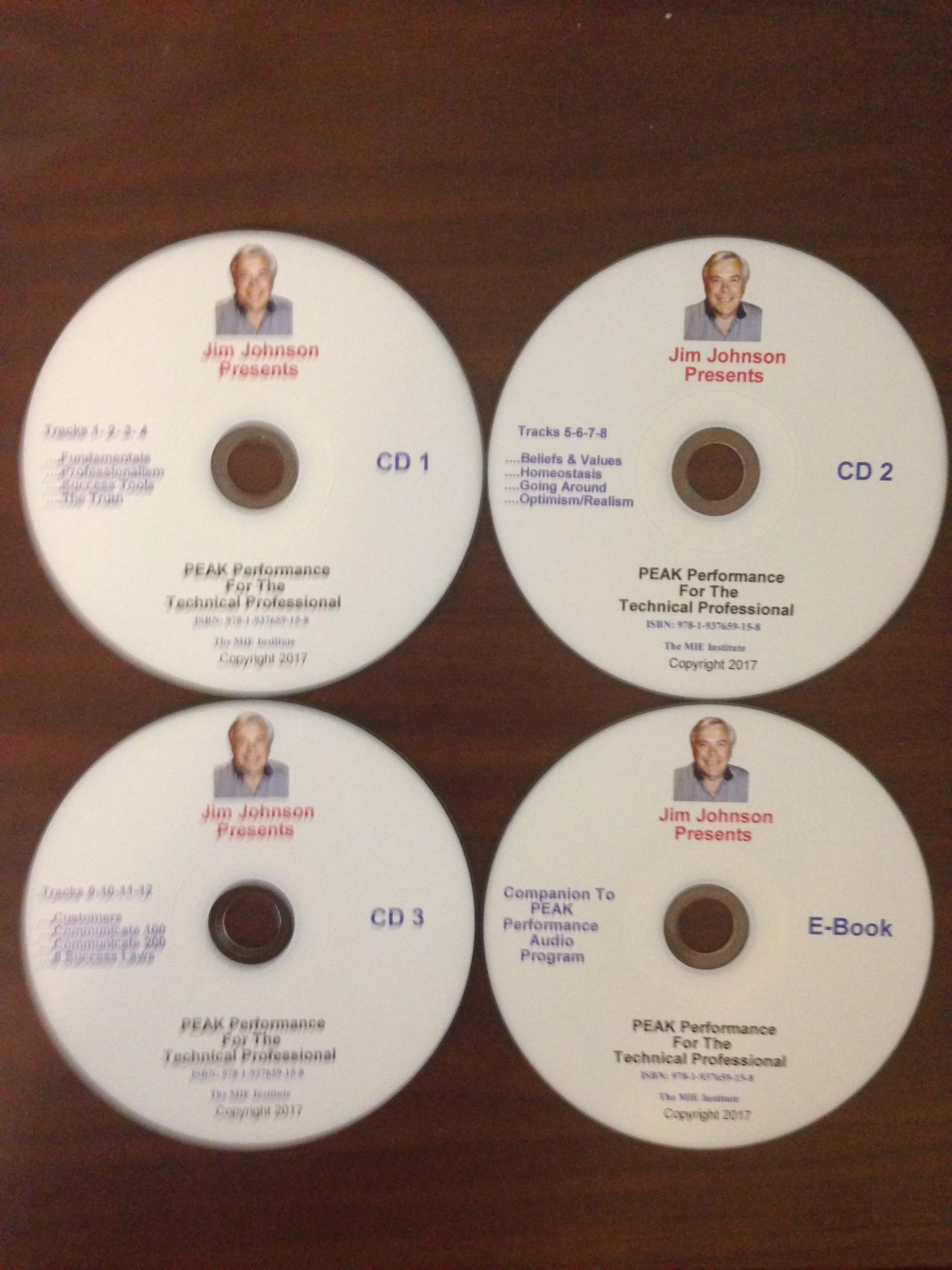
Note: The information for this article series is excerpted from Jim Johnson’s “PEAK Performance for the Technical Professional,” an audio learning program designed to help technicians develop their sales and communication skills. The three CD set can be ordered from: Technical Training Associates, HC 70 Box 3172, Sahuarita, AZ 85629 for $39.95 (shipping and handling included). Mail check or money order, or send Visa or MasterCard information to the above address. Credit card orders may also be faxed to 520-648-3334. For more information, visit www.technicaltrainingassoc.com.
Copyright © 2007, Technical Training Associates
Publication date: 05/07/2007
Looking for a reprint of this article?
From high-res PDFs to custom plaques, order your copy today!