Contractor Pro Ductless Series
Simultaneous Heating & Cooling in VRF: Market Slows, but Value Holds
September 8, 2025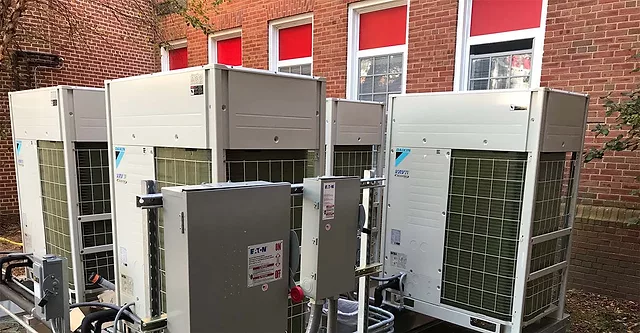
Contractor Pro Ductless Series
Simultaneous Heating & Cooling in VRF: Market Slows, but Value Holds
September 8, 2025BEHIND THE SHIFT: Costs, codes, and complexity are reshaping SHC adoption in VRF systems. Yet for hotels, multifamily, and schools, the technology remains a top choice for efficiency and occupant comfort. (Courtesy of Daikin Comfort)


Once considered a must-have feature for modern VRF systems, simultaneous heating and cooling (SHC) is starting to lose its momentum after years of steady gains.
A new industry survey shows usage sliding from its apparent peak three years ago, raising questions about whether costs, codes, complexity, or a combination of the three could be a factor, but that’s not to say SHC isn’t still a dominant force in the VRF marketplace.
Simultaneous Heating & Cooling
Down from 2022, an average of 47% of VRV, VRF, VRFZ projects are utilizing simultaneous heating and cooling in 2024. About half of professionals indicate half or more of their VRV, VRF, VRFZ projects utilize simultaneous heating and cooling.

Click chart to enlarge
THE DIP: SHC usage declined to 47% of projects in 2024 from a peak of 53% in 2022, with results highlighting market polarization between high- and low-adoption firms. (Courtesy of myClearOpinion Insights Hub)
In 2024, an average of 47% of VRV/VRF projects utilized simultaneous heating and cooling technology, but this marks a modest, but telling, decline from 2022, when the share was 53%.
Despite the dip, about half of industry professionals reported that 50% or more of their projects included simultaneous heating and cooling capabilities.
Respondents to the 2024 survey were spread across the spectrum: 30% of projects (median) included simultaneous heating/cooling, and a notable share of respondents reported high adoption (75%-100% of projects), but another substantial group reported low adoption (0%-24%). This polarization indicates that while some contractors and engineers are fully embracing the technology, others remain cautious or limited in application.
So what does this mean for the market?
Industry experts emphasize that SHC is still central to VRF’s value proposition.
As Sachin Dixit, vice president - commercial products, Daikin Comfort Technologies North America Inc., explains, Heat Recovery (H/R) technology for VRV/VRF systems is an integral part of this approach — not only can the system provide cooling or heating to all zones at one time, but it can also mix the heating and cooling in different zones at the same time, based on the desired setpoints in each zone. This simplifies the overall system design and helps reduce energy consumption.
Looking for quick answers on air conditioning, heating and refrigeration topics? Try Ask ACHR NEWS, our new smart AI search tool. Ask ACHR NEWS
Looking for a reprint of this article?
From high-res PDFs to custom plaques, order your copy today!
The Economy, Regulations, and Complexity — A Three-Pronged Hurdle
The modest decline in SHC adoption from 2022 to 2024 reflects a mix of regulatory, technical, and economic factors, said Steven Hunt, VRF product manager at Carrier.
“One of the most significant influences has been the transition to A2L refrigerants, which has prompted some engineers and specifiers to reevaluate the use of large refrigerant volume systems in occupied spaces,” Hunt said. “This shift has introduced new code interpretations and safety considerations that vary by jurisdiction, creating uncertainty in system design and application.”
For engineers, the pressure to balance costs while also adhering to local regulations is the likely culprit behind this slight decline, and when the switch to A2Ls is factored in, the whole picture begins to come into focus.
Then there’s the fact that SHC systems inherently involve more complex components — such as branch boxes that enable heat recovery between zones — which can increase both upfront costs and installation complexity.
“For projects where simultaneous heating and cooling isn’t a core requirement, engineers may opt for simpler, more cost-effective alternatives,” Hunt said. “In short, the decision to specify SHC often hinges on whether the application demands dual-mode operation across zones for extended periods.”
But not everyone sees the dip as negative. Will Scott, commercial sales manager at Mitsubishi Electric Trane HVAC US (METUS), sees this slight downward trend as a refinement in how the industry applies different system types.
“Heat pump-only VRF systems remain attractive thanks to lower installation costs,” Scott said. “These systems also align well with grid resiliency and electrification objectives by integrating seamlessly with renewable energy sources.”
Dixit also speculates that slight decline of VRF H/R could be attributed to lower-cost heat pump systems entering the market.
“Like many high-end products, VRV/VRF systems with H/R could also be experiencing industry-wide slower growth in the past three years due to economic conditions that have favored the lower first cost of heat pump systems versus the long-term TCO benefits achieved with VRV/VRF H/R systems,” Dixit said.
The ROI and TOC Are Still Strong Selling Points
H/R systems cost more upfront than heat pumps, but their value lies in long-term TCO.
Dixit said Daikin continues to see long-term growth for VRV systems, with continued momentum towards VRV H/R systems when the decision makers are long-term building owners, where the TCO is important.
“However, increased penetration and more adoption of VRV systems have led to engineers leveraging the application of VRV systems correctly by using a mix of both heat pump and H/R,” Dixit explained.
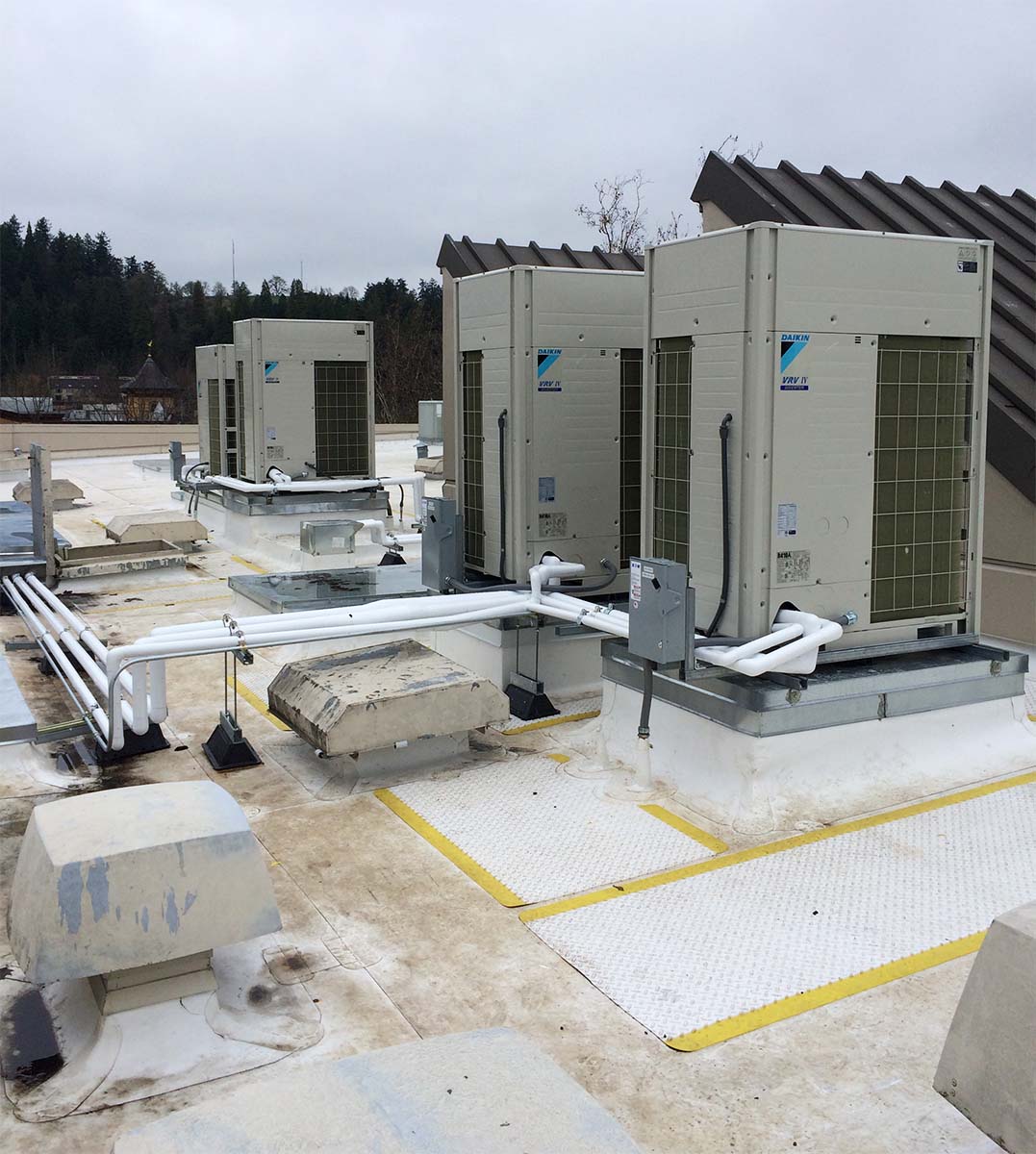
STILL VITAL: Adoption of SHC in VRF projects slipped in 2024, but industry experts say it remains vital in the right applications. (Courtesy of Daikin Comfort)
Where Dixit highlights strategy and system design, Scott emphasizes the on-the-ground applications where SHC becomes less of a luxury and more of a necessity.
SHC systems provide measurable ROI across a wide range of applications and climates, Scott said, and in properties like hotels, schools, senior living communities, and multifamily housing, which often have varying comfort needs throughout the building, SHC is an optimal choice, especially in climates with wide seasonal temperature swings.
“In hospitality, guest comfort expectations make SHC nearly essential,” Scott said. “In housing developments like dormitories or assisted living facilities, the ROI depends on the expected price point of the property. Where precise room-to-room temperature control is a must, SHC is the right fit.”
Conditioning Unique and Difficult Buildings
When it comes to delivering uniform comfort to a building with diverse spaces, SHC is unmatched — think multifamily housing, dormitories, assisted living facilities, and light commercial buildings — especially during shoulder seasons.
“These environments often experience diverse thermal preferences: for example, one resident may prefer heating in the morning while another seeks cooling in the afternoon,” Hunt said. “SHC systems allow both to be accommodated simultaneously, enhancing comfort without compromising energy efficiency.”
At Daikin, their VRV H/R systems are suitable for all climates, with cold climate solutions that provide heating down to -22°F, capable of providing heating and air conditioning comfort in a wide range of applications throughout North America.
“With the ability to provide simultaneous heating and cooling, Daikin’s H/R systems are ideal for commercial buildings where occupants desire individual comfort control, especially when building occupancy shifts from room to room,” Dixit said.
Some common applications where VRV H/R can have the greatest return on investment (ROI) are:
- Office buildings with glass exterior where solar loading is not uniform and causes uneven heating.
- Multi-use spaces such as offices with server rooms, break rooms, common meeting areas, that all require simultaneous heating and cooling in different zones based on load profile.
- Restaurants where we are balancing the comfort of customers in the restaurant with the need to take the heat out of the kitchen area.
- Schools and universities where classrooms, libraries, labs, and other rooms can have shifting loads due to occupancy changes, as well as heat loads on exterior walls of rooms with sun exposure.
System Evolution
Hunt said that as the North American market continues to prioritize energy efficiency, electrification, and occupant comfort, they expect SHC-enabled VRF systems to gain traction — particularly in applications where zoning flexibility is critical.
“Advances in controls, refrigerant technologies, and system integration are making SHC more accessible and cost-effective,” Hunt said. “We anticipate broader adoption as engineers and building owners recognize the long-term value of right-sized, adaptable HVAC solutions that can meet evolving regulatory and comfort demands.”
For Scott, the future is hybrid.
“I expect the adoption of SHC VRF systems to increase, but it will be hybrid VRF leading that change,” Scott said. “Hybrid VRF builds on the strengths of conventional VRF systems and minimizes installation costs. Factors such as water-rated lines, press fittings, no purging, and fiberglass insulation can combine to make Hybrid VRF less expensive, all while maintaining the benefits of conventional VRF.”
From a sustainability standpoint, Dixit said both VRV heat pump and H/R systems are all-electric and therefore better suited for building owners or states where decarbonization is an important, long-term design criteria, compared to traditional gas heating commercial HVAC systems.
“Heat Recovery is one of the greatest advantages of VRV systems when customers require diverse heating and cooling needs with optimal performance and lowest TCO,” Dixit said. “However, the economy will play a key role, and with the current economic activity picking up, we expect these segments to grow at a faster pace.”
Other Emerging Trends
The use of SHC systems to support outside air ventilation strategies is gaining in popularity. By leveraging branch boxes and fan coils, these systems can condition incoming air — removing humidity and delivering neutral air to occupied spaces.
“This approach not only meets fresh air requirements but also aligns with tightening local regulations around indoor air quality,” Hunt said. “As building codes evolve, we expect SHC systems to play a larger role in integrated ventilation and comfort solutions.”
Despite the slowdown in adoption over the past few years, SHC remains one of VRF’s defining strengths and, as codes evolve and costs fluctuate, the technology's role may shift, but its value proposition is likely to remain strong.
Want deeper insights? The data in this article comes from the exclusive VRV/VRF/VRFZ CLEAReport, conducted by myCLEARopinion Insights Hub. This in-depth report identifies brand familiarity, evaluates manufacturer performance and industry leadership, explores key factors influencing specification decisions, and tracks trends shaping the ductless HVAC market.





.webp?height=300&t=1783699250&width=300 "LA Heating_Craning moving new hvac condensing unit onto roof (2).jpg")