ASHRAE, Air Control Experts Explain How to Have Safe Buildings
Facts, best practices, and trends for contractors in a post-COVID-19 market

GETTING READY: Thousands of building owners across the nation are preparing to reintroduce the workforce safely to their air handlers and ventilation systems.
The reopening of commercial buildings as quarantine measures begin to relax has many owners and occupants questioning how much control is held over the air quality within the structure. Safety is on a lot of minds as conflicting narratives endeavor to bring calm and instruction.
Amidst the noise, the governance of ASHRAE members and standards don’t merely suggest but instead prove that the air in a building can be controlled and its occupants can be safe.
“Key elements of a strategy to limit the spread of the COVID-19 virus are to perform needed HVAC system maintenance, including filter changes, and to run HVAC equipment, prior to re-occupancy,” said William Bahnfleth, ASHRAE Epidemic Task Force chair, ASHRAE Environmental Health Committee voting member, and 2013-14 ASHRAE presidential member. “Indoor air contaminants may also be gases or particles, including particles containing microorganisms or those that are of biological origin (e.g., skin flakes and dust mites). Ventilation with outdoor air is the catch-all method for removing these contaminants, but the effectiveness of ventilation varies with the characteristics of the contaminant.”
A complete guide and further information is available at www.ashrae.org, but the organization’s latest determination on the topic states that, “In general, disabling the HVAC systems is not a recommended measure to reduce the transmission of the virus.”
What is needed is air control.
Control Integration Makes A Way
Balancing air safety, quality, and volume often requires more than a ventilation system installation, which on its own overlooks the need for fresh air, IAQ measures, and controls that regulate air volume.
“Control integration is important for validating ventilation air volume — not only to ensure you are meeting the required code minimums but also to ensure that you are not over-ventilating,” said Michael Schires, senior product manager, Modine. “Proper treatment of ventilation air can be energy intensive, so monitoring the system is important in ensuring fresh, healthy air is provided most cost effectively.”
Looking for quick answers on air conditioning, heating and refrigeration topics? Try Ask ACHR NEWS, our new smart AI search tool. Ask ACHR NEWS
He further explained that contractors can find help navigating fresh air and building demand by learning local and federal building codes.
“The building codes drive not only the amount of ventilation air required but at what conditions that air is delivered,” said Schires. “While air needs to be delivered at the right temperature, it is vitally important that it be delivered at a low enough dew point that it will not increase the relative humidity in the space to levels that promote mold and mildew growth.”
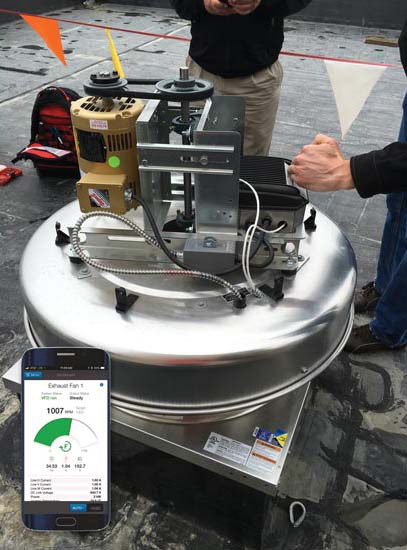
INTEGRATED CONTROLS: Contractors install and set up a Greenheck exhaust fan with a Bluetooth enabled Vari-Green drive and phone app.
Air control for proper ventilation can be explained as starting, stopping, and adjusting speed of air movement devices such as fans, according to Tony Rossi, vice president of marketing, Greenheck.
“This process, via control integration for occupant comfort and energy savings, is an important element for building ventilation, and has been for some time,” he said. “Variable frequency drives with Bluetooth communication, assembled with fans, have made flow balancing easier for the contractor. More advanced control integration with fans includes integral flow and pressure monitoring as well as vibration and bearing temperature monitoring.”
In essence, the more sophisticated the air movement application requirements, the more sophisticated controls are necessary to ensure performance and reliability.
Control integration not only improves the air safety, quality, and volume, but it also helps lower the cost. Scott Cochrane, president and CEO of Cochrane Supply & Engineering, said that in existing buildings, control systems are typically diversified over time as repairs and updates are needed. This is where the role of the controls integrator becomes imperative.
“Integrators have capabilities like never before. Integrated systems can talk to everything down to the sensors and report back real-time data about conditions for all the systems responsible for airflow in the building,” he explained. “This allows the building owner to prove the building is safer for the occupants. If we try to rip and replace a system or update a bunch of equipment controls to make this happen, the costs will outweigh the gain. But by re-utilizing most of the existing control equipment, it makes it a reasonable cost to incorporate some of the new safety measures.”
Professional Air Quality Suggestions
With air cleanliness and security on the mind, many building owners are looking for someone to come in with a plan and tell them what they need to do in order to maintain safety and allow occupants to literally breathe easy. This is where contractors can get into some murky water with their words and good intentions. The professionals in this article have some suggestions to help contractors navigate and in some cases altogether avoid those waters.

AIR SECURITY: Although limited by current sensor technology, air security can still be attained to a measure with maintenance vigilance.
Bahnfleth noted that ventilation, filtration, and anti-microbial air cleaners all help to reduce indoor exposures without the need for detection.
“Volatile organic compounds (VOCs), biological particles are always in the air, so useful detection would require identification of pathogens that may be present,” he said. “Sensors to identify biological air contaminants have been a subject of research for a long time, but they don’t seem to have reached the level of being practical/affordable for widespread use. The important thing is to consider infection risk in the development of standards and design for non-healthcare facilities.”
Cochrane thoughtfully pointed out that if a sensor of this magnitude were available, it would have likely been used by now, especially at some testing sites.
“I don’t think there is a way to detect a virus in the air with a sensor; remediation is another story,” he said. “While we cannot guarantee the HVAC system can provide 100 percent clean air, we can pressurize a room to make sure the contamination does not spread to other areas. To ensure safe areas now, pressure is the key.”
According to Cochrane, achieving air control or static pressure control requires the entire system to properly operate in unison with the control system and its sensors. He encourages contractors to learn about air control from the vendors with which they are currently working.
“As a result of rethinking how we use air control, new information is coming out on a daily basis on how to properly mitigate the risk of airborne diseases,” he said. “It will be key to stay up-to-date on this information, and I recommend following CDC recommendations as well as the ASHRAE COVID-19 resource page for help with navigating these challenges.”
Rossi reminded contractors that suggestions for improved air movement and cleanliness depend on the building type and application. The one-size-fits-all approach doesn’t exist in these matters. Not only that, but it is imperative, according to Rossi, that contractors define what clean means to their customers. His primary suggestion to contractors is to ensure the building has balanced supply make-up and exhaust air, plus adequate air changes per hour.
“High-efficiency filters and HEPA filters address removing particulate, bacteria, and viruses,” said Rossi. “On systems with large percentages of recirculated air, UV can be installed in HVAC systems to kill or deactivate pathogens. However, spaces that are occupied will require the exhausting of stale, spent, oxygen-depleted air, and fresh outside air conditioned and supplied.”
He further explained that controls should be provided to monitor filter pressure drop, indicating when filters should be replaced and ensuring adequate airflow. Other types of controls can also monitor carbon dioxide or occupancy levels within spaces and adjust fresh outdoor air supply and exhaust air accordingly.
The Future of Air Movement
COVID-19 is pushing air movement trends faster than expected, just as the disease has done in many other economic and equipment examples. The future at this point is a little less certain than before the pandemic, but some trends in air movement control and ventilation will likely still emerge in the coming years.
One of those trends Schires has noticed is an increase in moisture removal efficiency. Along with it are an ease of integration with common building management system communication protocols and increased ease of serviceability.
“Looking further down the road, emerging trends will likely include more cloud-based, data-centric machine learning to optimize performance and communicate trends,” he said. “This could provide improved predictive measures for being proactive in equipment maintenance, improving equipment performance, efficiency, and reducing life-cycle costs.”
For Bahnfleth, he explained that dedicated outdoor air systems (DOAS) will continue to grow in adoption, although there are still strong proponents of VAV systems — with some good reasons, such as the ability to benefit from economizer operation in certain climates.
“In the future, I would expect to see more use of demand controlled ventilation, which I hope would be combined with ventilation rates that are higher so that air quality is better when needed than it typically is today,” he said. “I also expect to see more use of air cleaners — chemical and biological — to improve air quality without increasing ventilation. This requires, of course, that we have a better understanding of what needs to be controlled and how available air cleaning technologies perform.”
Bahnfleth said that efforts to add a list of design compounds to the ASHRAE standard 62.1 Indoor Air Quality Procedure are a step in the right direction.
“I also expect, and hope, to see continued increase in the level of particulate filtration considered minimally acceptable,” he said. “MERV 6 and 8 are still too low, in my opinion.”
Looking for a reprint of this article?
From high-res PDFs to custom plaques, order your copy today!