Improper Furnace Installations Can End Up Imperiling Homeowners
Shortcuts and mistakes can reduce comfort and energy savings, as well as put occupants in danger
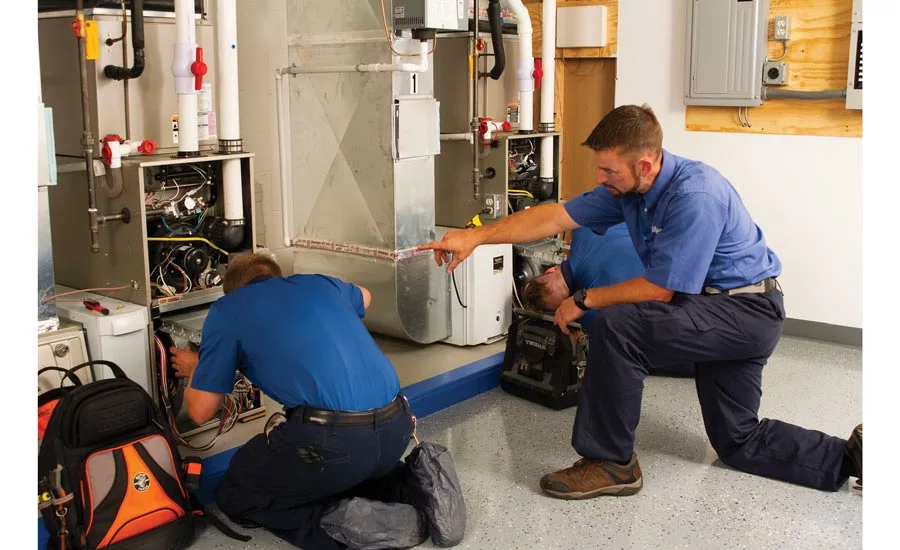
TROUBLESHOOTING TRAINING: Betlem Heating technicians Zach (left) and Miles practice troubleshooting furnaces in the company’s training lab under the watchful eye of their trainer, Andy (center).
The first arctic chill of the season has already descended upon a large swath of the U.S., causing many homeowners to realize that it may be time to replace their gas-fired furnace. Buying a new furnace is likely a new experience for most homeowners, so they may not know just how important it is to have the equipment installed correctly. Or they may not care, as the cost of the furnace may be what concerns them most.
Knowing that homeowners are often price sensitive when it comes to buying expensive HVAC systems, some contractors may cut corners on the installation in order to keep their bid low. Others may make mistakes that — while not intentional — can still result in a system that does not deliver the comfort or energy savings that was promised during the sales call. And while this is also true of cooling systems, proper installation of furnaces is even more important, because if they are not vented correctly, carbon monoxide could spill into the living space, posing a danger to occupants.
SAFETY FIRST
Brian Stevens, field supervisor at Frederick Air Inc. in Frederick, Maryland, wishes he could say that he has never encountered an improperly installed furnace that posed a safety hazard for occupants, but that wouldn’t be true.
“Mostly it is due to improper venting, such as incorrectly sized vent pipe, wrong material, and even some that were never vented at all,” he said. “With high-efficiency furnaces, sometimes we see cases where a vent for the exhaust was installed, but you also need to install a fresh air intake. We see a lot of people cut corners by not running the fresh air intake out of the house, or if they do run it outside, it is not in the best place for the unit to be the most efficient.”
In addition to improper venting, Stevens often sees furnaces that are not sized correctly for the space — or else there are issues with the ductwork, which can cause airflow problems. While customers may save 25 percent or more by hiring a contractor who cuts corners on the installation, in some cases he said that it can cost them double — or more — what they saved in order to correct the problems, especially if there is a lot of ductwork to fix or if the whole furnace needs to be removed and then reinstalled.
Jim Betlem, residential division manager at John Betlem Heating, Cooling & Electrical in Rochester, New York, is often called upon to resolve performance issues after customers have chosen low-bid contractors to install their new furnaces. Some of the problems he sees include poor wiring; air, gas, refrigerant, and water leaks; improper setup; code violations; and design and duct issues. The most serious problem involves vent pipes that are installed without taking into account regional issues, such as snowfall heights and prevailing winds.
“We also see older vented appliances ‘spilling’ because original drafting mechanisms were not accounted for,” he said. “Locating the vents in accordance with the manufacturer’s instructions, along with state and local building codes, is essential to avoid combustion products from re-entering the dwelling.”
Looking for quick answers on air conditioning, heating and refrigeration topics? Try Ask ACHR NEWS, our new smart AI search tool. Ask ACHR NEWS
While Betlem agrees that some mistakes are honest, he believes they are often due to oversights caused by the speed at which low-cost installations must be completed in order to be profitable. He said that by virtue of being the cheapest contractor, mistakes or omissions may be built into the proposal, as well as cost-cutting measures that can include reusing items such as old circuitry and undersized return air ducts, using inferior quality materials, and paying low wages to the people doing the work.
“Choosing to install a single vent system for a sealed combustion furnace is another way to cheapen the job — not a mistake, but not delivering the full capabilities of the high-efficiency furnace to save on labor and materials,” he said. “Who ultimately pays the price for that?”
Paul DeHart, a comfort consultant at Bolster – DeHart Inc. in Pittsburgh, Pennsylvania, believes that most poor furnace installations are due to a lack of training, but he does agree that some contractors just don’t care about quality. For example, he said that some don’t install the PVC intake to take the combustion air from the house, or they leave the filter access door unsealed, so the return draws from the mechanical room that is in the basement or attic.
“Most installation crews don’t check for gas leaks or static pressure to verify airflow or the furnace temperature rise recommendations from the manufacturer,” he said. “They turn on the switch, the burner ignites, the blower starts, and out the driveway they go. They are not required to perform a proper start-up.”
He added that even though customers may be saving money initially, it can cost thousands to correct a serious problem.
“There have been jobs where we have removed the equipment and all of the ductwork, designed the system properly using Manual D and Manual J, and installed an entirely new system,” he said.
Fortunately, it doesn’t always cost an arm and a leg to fix a poorly installed furnace. Bill Sauber, president of Performance Plumbing and Heating in Farmington, Minnesota, said that most of the contractors who cut cornerss in his area usually do sloppy work on the gas piping, which he says is not usually difficult or expensive to fix.
“It could be a minimum of $200 to $300 or up to $1,000 to straighten things out,” he said. “I’ve found that high-efficiency furnaces are installed incorrectly more often, and the problem is usually the length of the flue and number of fittings. This can happen as a result of not following the directions from the manufacturer. The biggest problem is lack of airflow — basically, the ductwork is too small for the size of the furnace. If you are switching from a 75 percent to a 90 percent AFUE furnace, more airflow is needed.”
MANUFACTURERS WEIGH IN
In addition to safety issues, improper furnace installations can result in poor performance and increased energy consumption, said Doug Priestley, manager of technical services at Nortek Global HVAC.
“Contractors often replace a furnace with the same size furnace, and in many cases, this is not correct,” he said. “A load calculation should be done to ensure that a furnace is properly installed for the home that it’s going in.”
Priestley added that it is important for contractors to treat each job differently, because there will always be differences in how the home is constructed, as well as the equipment selected for the job. For example, there are major differences in the ways in which 80 percent and 90 percent-plus AFUE furnaces are installed.
“Many mistakes can be prevented if the instructions are read prior to installation,” he said. “It is also important to attend training frequently, because equipment changes from year to year.”
Philip Oglesby, manager of education and content development at Rheem Manufacturing, agrees that quality, ongoing training is essential.
“As products evolve with advancements in technology, as well as updates to meet regulatory standards and government requirements, it’s more important than ever for contractors and technicians to stay up to date with training to ensure their approach to installation evolves with the equipment,” he said.
Like many manufacturers, Rheem offers numerous educational opportunities for HVAC professionals. For example, in-person training programs are offered at their five Innovation Learning Centers located throughout the U.S. and Canada. Each center offers live demonstration rooms, where contractors and technicians can get hands-on experience as well as classroom training. Rheem also partners with distributors to provide training sessions at a local level, and online training materials and resources are available on demand for technicians to tap into as needed.
“Beyond training and certification, it’s also important to equip technicians with easy access to real-time support when they’re in the field, as issues will inevitably arise from time to time,” said Oglesby. “For example, our RealSupport function within the Rheem contractor app allows the technician to interact live from the jobsite with an expert who can help troubleshoot and identify solutions for specific situations.”
HOMEOWNER INVOLVEMENT
Another way to ensure the furnace is installed properly is for contractors to equip homeowners with a list of questions they should ask of all those who may be bidding on the job. Oglesby suggests the following:
- Is the installing technician NATE-certified?
- Is the furnace properly sized and matched with existing and/or new equipment that is being installed?
- Is the ductwork adequate to deliver the correct amount of airflow?
- What maintenance is recommended and how often?
- Where is my filter and what size is it?
- Will the technician be setting up a new thermostat, and if so, can they demonstrate how to use it?
Stevens adds that homeowners should also ask if the contractor is licensed, as well as for a copy of the load calculation of the space the furnace is going to be conditioning and a copy of the startup checklist once the installation is complete.
“They should also ask the contractor what questions they should be asking — good contractors will always help guide their customers,” he said. “We always tell all our customers that there are no questions not worth asking.”
See more articles from this issue here!
Looking for a reprint of this article?
From high-res PDFs to custom plaques, order your copy today!