ACHR News
search
Ask ACHR NEWS AI
cart
facebook twitter instagram linkedin youtube
  • Sign In
  • Subscribe
  • Sign Out
  • My Account
ACHR News
  • NEWS
    • Breaking News
    • New HVAC Products
    • Featured Products
    • Manufacturer Reports
    • HVAC Data
    • Legislation
    • ACHR NEWS Centennial
  • RESIDENTIAL
    • Air Conditioners
    • Furnaces
    • Residential Heat Pumps
    • Ductless
    • Residential IAQ
    • Testing, Monitoring, Tools
    • Components & Accessories
  • COMMERCIAL
    • Air Handlers
    • Rooftop Units
    • Chillers and Cooling Towers
    • Commercial Heat Pumps
    • Boilers and Hydronics
    • VRF/Ductless
    • Commercial IAQ
  • REFRIGERATION
    • Refrigerants
    • Refrigerant Regulations
    • Leak Management
  • CONTRACTOR PRO
    • Geothermal
    • Homeowner Study
    • VRF and VRV Ductless
    • Unitary Trends
  • EDUCATION
    • Training and Education
    • Business Management
    • Service and Maintenance
    • Continuing Education
    • Market Research >
      • HVAC Brand Awareness Report
      • VRV, VRF, VRVZ Report
      • Unitary Trends Report
      • Water Heat Professionals Report
    • Webinars
    • Sponsor Insights
    • eProducts Info
    • White Papers
  • EVENTS
    • HVAC Contractor Forum
    • Industry Events and Webinars
  • MEDIA
    • Videos
    • AHR Expo 2025 Videos
    • Podcasts >
      • ACHR News Podcast
      • HARDI Podcasts
      • AHR Expo Podcasts
      • ACCA Podcasts
    • Interactive Spotlights
    • Quizzes
    • eBooks
    • HVAC Talkback
  • HVAC GROUP
    • ACHR NEWS >
      • Current Issue
      • Digital Edition
      • Subscribe
    • Distribution Trends
    • SNIPS NEWS >
      • Join SNIPS NEWS
    • Engineered Systems News >
      • Join ES News
    • HVACR Directory
    • Contests
    • Newsletters
    • Contact
    • Advertise
    • My Account
HVAC ContractingTechnical

Optimizing Home or Business Thermostat Settings
By Ron Roth
EE_Technical 1
EE_Technical 2
EE_Technical 1
EE_Technical 2
December 24, 2018

Now that winter has arrived, your client's heating system is operating to keep their house or business warm. However, a significant number of furnace units may not be operating efficiently due to being oversized and/or are operating with an unoptimized thermostat default configuration. This brief guide provides a brief summary of the issue and specific instructions on how to correct it. Candidates for this thermostat parameter update require the following characteristics:

  • Forced air gas furnaces with 80 percent efficiencies or higher;
  • Programmable (digital) thermostats, but not a smart thermostats such as those sold by NEST, etc.; and
  • Mean furnace run (ON) times of 4 to 8 minutes.

As part of the thermostat optimization, we will be increasing the furnace run time. As a trade-off, the controlled room temperature will increase from +/- 0.5° F to +/- 1.0° F of the setpoint.

BACKGROUND

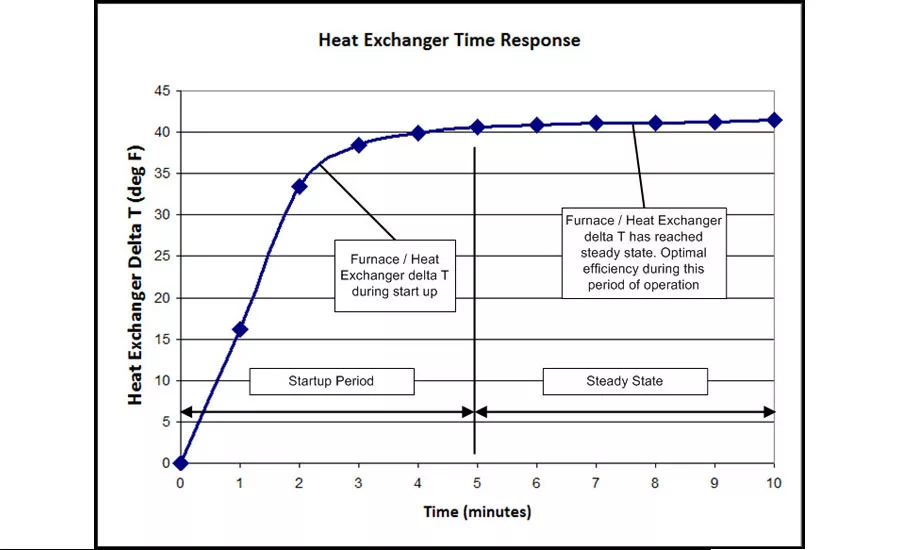
When the furnace turns on there is a period of time in which the system takes to heat up and reach steady-state operation. During this phase, the furnace is delivering minimal heat to the designed space/room as it takes time for the furnace, ductwork, and other items to heat up. During this period the furnace has a 50 percent runtime efficient (at best). An actual furnace startup time response profile (delta T versus runtime) is shown below.

For best furnace efficiency it is desirable for the unit to spend as much time as possible in the steady-state phase of operation.  

RUN TIME MEASUREMENT

The first step is to measure or estimate the furnace ON runtime. This measurement may be done by changing (increasing) the thermostat set point by 1 degree and measuring the furnace ON time with a watch or smartphone timer.

  • The ON start time point (time = zero) is when the user determines that the blower fan has started;
  • The ON end time point (time = cycle ended) is when the user determines that the blower fan is stopped; and
  • It is best to perform this measurement four to five times over a period of a few days. Some units continue running after the furnace has stopped producing heat. This time should be excluded from the runtime measurement.

Alternatively, many of the HVAC monitoring devices on the market for residential units calculate this metric directly (e.g. www.mhvacmonitor.com).

If the average of your results is above ten minutes your system is optimal and does not need to be adjusted. However, if the results are in the four to eight-minute range your system is a good candidate for adjustment.

THERMOSTAT CONFIGURATION

It is relatively simple to update programmable thermostat settings, but it does require entering the Installer Setup portion of the thermostat. This article references two major thermostat manufacturers but the general procedure provided here applies to all thermostat manufacturers. 

Looking for quick answers on air conditioning, heating and refrigeration topics? Try Ask ACHR NEWS, our new smart AI search tool. Ask ACHR NEWS →

Honeywell Systems: The instructions below apply to the VisioPRO™ 8000 thermostat.

  • Press and release the System Key;
  • Press and hold the two blank keys on either side of the center blank key for five seconds;
  • Release the two bank keys when the Installer setup is displayed;
  • Update Settings 0240 to two (2) Cycles per hour;
  • Update Setting 0250 to two (2) Cycles per hour if your system includes dual-stage heating; and
  • Select the DONE function key when completed.

For a Lennox branded system, you will need to determine if the thermostat is a Honeywell branded thermostat in which the prior instructions apply and/or the thermostat is an actual Lennox thermostat. For a true Lennox thermostat, you should increase the Stage 1 Difference value per the following guideline.

  • If the current value is 0.5° F, you should increase it 1.0° or even 1.5°; 
  • If the current value is 1.0°, you should increase it to 1.5°;
  • For units with dual-stage heat capability, you should also increase the value of Stage 2 Delay. On a typical system, it is set to 20 minutes so you should increase it to 25 or even 30 minutes. This update delays the Stage 2 heat cycle allowing the system to run in low heat mode longer.

RESULTS

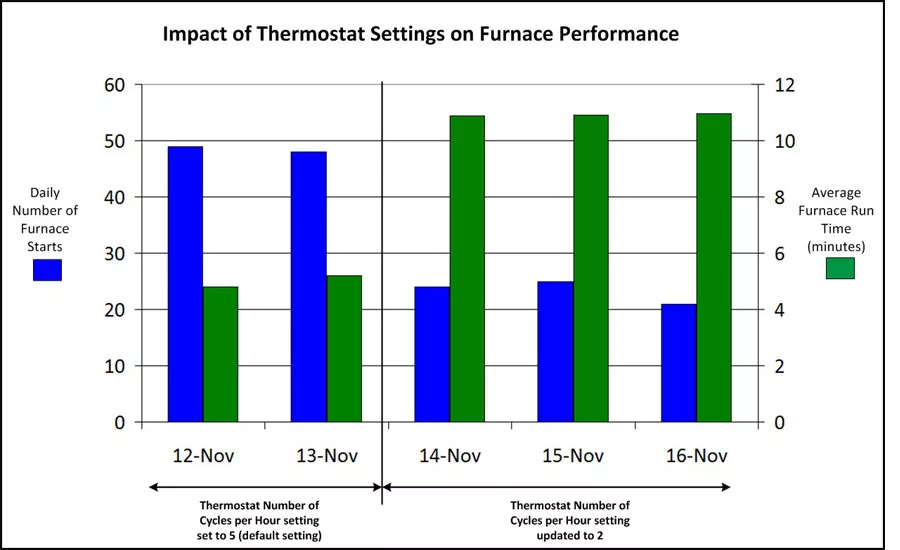
The following bar chart summarizes the actual results obtained for an oversized furnace in a residential unit. The results before and after adjustments are as follows:

  • Before the adjustment, the number of furnace start (ON) events was approximately 47 times per day or two every hour. The mean furnace runtime was five (5) minutes. As configured the furnace was approximately 50 percent efficient as during operation the furnace spent most of its time in startup mode.
  • After the adjustment, the number of furnace start (ON) events was reduced by 50 percent to 23 times per day or one every hour. The mean furnace runtime was increased to over 10 minutes. As a result, the actual furnace runtime efficiency was increased to 75 percent. The furnace operates the first 5 minutes in the startup phase at 50 percent runtime efficiency followed by an additional 5 minutes operation at 100 percent runtime efficiency.

By changing the cycles per hour from two (2) to one (1), it is possible to increase the mean furnace runtime to a higher number (15 - 18 minutes) but the room temperature swing will be larger.

SUMMARY

Optimizing the thermostat furnace and air conditioning settings can save your customers money in energy costs as well as prevent premature failure of your unit due to short cycle run times.

Publication date: 12/24/2018

Want more HVAC industry news and information? Join The NEWS on Facebook, Twitter, and LinkedIn today!

KEYWORDS: furnace efficiency programmable thermostats troubleshooting and HVACR

Share This Story

Looking for a reprint of this article?
From high-res PDFs to custom plaques, order your copy today!


Ron roth

Ron Roth, Ph.D. is the principal for RT Automation located in San Antonio, TX. RT Automation develops and markets equipment monitoring products for residential and industrial applications.

Recommended Content

JOIN TODAY
To unlock your recommendations.

Already have an account? Sign In

  • HVAC-enrollment

    The Trades Are Back: HVACR Programs See Nearly 30% Enrollment Spike

    A new wave of future technicians is entering the pipeline.  
    News
    By: Matt Jachman
  • 2025 Top 40 Under 40

    2025 Top 40 Under 40 HVACR Professionals List

    The 11th annual Top 40 Under 40 list highlights those...
    News
    By: Hannah Belloli-Oster
  • LG Ductless Mini-Split Systems

    The 9 Types of Heat Pumps

    As the U.S. moves toward electrification, heat pumps are...
    Ground Source Heat Pumps
    By: Joanna R. Turpin
Subscription Center
  • Create an Account
  • Start a Subscription
  • Manage My Account
  • Sign Up for Newsletters
  • Visit Customer Service
  • Update Preferences

More Videos

Sponsored Content

Sponsored Content is a special paid section where industry companies provide high quality, objective, non-commercial content around topics of interest to The News audience. All Sponsored Content is supplied by the advertising company and any opinions expressed in this article are those of the author and not necessarily reflect the views of The News or its parent company, BNP Media. Interested in participating in our Sponsored Content section? Contact your local rep!

close
  • Piggy Bank
    Sponsored byWatercress Financial

    Energy Prices, Inflation, and HVAC: What Today’s Homeowners Care About

  • Refrigerated Food
    Sponsored bySolstice Advanced Materials

    R-455A Refrigeration: A Cold Storage Solution for the Future

  • Airex Rooftop Units
    Sponsored byAirex Manufacturing Inc

    Consolidating Roof Penetrations: A Growing Trend in Multifamily HVAC Design

Popular Stories

Refrigerants-and-gauge.jpg

HVAC Industry Warns of Counterfeit Refrigerants Entering U.S. Supply Chain

U.S. Supreme Court building

95% Furnace Efficiency Rule to Get New Hearing

Midea-training.jpg

HVAC Workforce Crisis Expands Beyond Technicians to Instructor Shortages

Data_Center_facility.jpg

HVAC Manufacturers Respond to Growing Data Center Backlash

HVAC Minute retail refrigeration system

EPA Final Rule’s Impact on R-410A Deadlines

View The ACHR NEWS
Centennial Anniversary Timeline

The ACHR News Timeline Chart
Submit a Letter
Submit a letter to our editors.

Events

November 6, 2025

Next-Gen Data Center Cooling: HVAC Innovation and Real-World Solutions

On Demand As AI workloads and high-density computing push traditional cooling methods to their limits, the data center industry is accelerating the adoption of next-generation HVAC technologies.

June 23, 2026

HVAC Duct Sealing Mastics: Why Selection Matters

In this webinar we will detail what HVAC material buyers and technicians need to know when selecting duct mastics, including matching mastic to substrate, alternatives to liquid mastic, and where UL 181 Listings fit into real world installations.

View All Submit An Event

Poll

Summer Staff

Are you fully staffed for the summer season?
View Results Poll Archive

Products

BNI Mechanical/Electrical Square Foot Costbook, 2026 Edition

BNI Mechanical/Electrical Square Foot Costbook, 2026 Edition

See More Products
HVAC Duct Sealing Mastics: Why Selection Matters - Free Webinar - 6/23/2026

Related Articles

  • Service Nation Alliance offers best practice training through webinar, phone, or training.

    Five Smart Home Business Tips for Contractors

    See More
  • guest commentary

    Four Barriers You Must Overcome in the Connected Home Business

    See More
  • May 20, 2014: New Wireless Sensors for Home, Business Automation Connect via Wi-Fi

    See More

Related Products

See More Products
  • Optimizing Social Media from a B2B Perspective

  • front cover only.jpg

    How to Market Your HVAC Business

  • Guide Home Evaluations.jpg

    Technician's Guide & Workbook for Home Evaluations and Performance Improvements

See More Products

Related Directories

  • Network Thermostat

    Network Thermostat delivers user-friendly HVAC solutions with powerful time and energy savings features to our institutional, commercial, and industrial customers.
  • Thermostat Recycling Corp.

    The Thermostat Recycling Corporation (TRC) is a non-profit stewardship organization that facilitates and manages the safe collection and proper disposal of mercury-containing thermostats. Our collective goal is simple: keep mercury out of the waste stream in order to protect the environment.
  • Filterbuy Business

    As a domestic manufacturer, Filterbuy Business combines the value of American-made products, account management tools, and fast delivery times to deliver quality replacement filters.
×

Sign Up. Stay Informed.

The #1 trusted source for the HVACR industry since 1926

SUBSCRIBE
  • RESOURCES
    • Advertise
    • Contact Us
    • Advisory Board
    • Classifieds
    • Submit a Letter
    • Directories
    • Store
  • ACCOUNT CENTER
    • Create an Account
    • Start a Subscription
    • Manage My Account
    • Sign Up for Newsletters
    • Visit Customer Service
    • Update Preferences
  • SERVICES
    • Marketing Services
    • Reprints
    • Market Research
    • List Rental
    • Survey/Respondent Access
  • STAY CONNECTED
    • LinkedIn
    • Facebook
    • Instagram
    • YouTube
    • X (Twitter)
  • PRIVACY
    • PRIVACY POLICY
    • TERMS & CONDITIONS
    • DO NOT SELL MY PERSONAL INFORMATION
    • PRIVACY REQUEST
    • ACCESSIBILITY

Copyright ©2026. All Rights Reserved BNP Media, Inc. and BNP Media II, LLC.

Design, CMS, Hosting & Web Development :: ePublishing