ACHR News
search
Ask ACHR NEWS AI
cart
facebook twitter instagram linkedin youtube
  • Sign In
  • Subscribe
  • Sign Out
  • My Account
ACHR News
  • NEWS
    • Breaking News
    • New HVAC Products
    • Featured Products
    • Manufacturer Reports
    • HVAC Data
    • Legislation
    • ACHR NEWS Centennial
  • RESIDENTIAL
    • Air Conditioners
    • Furnaces
    • Residential Heat Pumps
    • Ductless
    • Residential IAQ
    • Testing, Monitoring, Tools
    • Components & Accessories
  • COMMERCIAL
    • Air Handlers
    • Rooftop Units
    • Chillers and Cooling Towers
    • Commercial Heat Pumps
    • Boilers and Hydronics
    • VRF/Ductless
    • Commercial IAQ
  • REFRIGERATION
    • Refrigerants
    • Refrigerant Regulations
    • Leak Management
  • CONTRACTOR PRO
    • Geothermal
    • Homeowner Study
    • VRF and VRV Ductless
    • Unitary Trends
  • EDUCATION
    • Training and Education
    • Business Management
    • Service and Maintenance
    • Continuing Education
    • Market Research >
      • HVAC Brand Awareness Report
      • VRV, VRF, VRVZ Report
      • Unitary Trends Report
      • Water Heat Professionals Report
    • Webinars
    • Sponsor Insights
    • eProducts Info
    • White Papers
  • EVENTS
    • HVAC Contractor Forum
    • Industry Events and Webinars
  • MEDIA
    • Videos
    • AHR Expo 2025 Videos
    • Podcasts >
      • ACHR News Podcast
      • HARDI Podcasts
      • AHR Expo Podcasts
      • ACCA Podcasts
    • Interactive Spotlights
    • Quizzes
    • eBooks
    • HVAC Talkback
  • HVAC GROUP
    • ACHR NEWS >
      • Current Issue
      • Digital Edition
      • Subscribe
    • Distribution Trends
    • SNIPS NEWS >
      • Join SNIPS NEWS
    • Engineered Systems News >
      • Join ES News
    • HVACR Directory
    • Contests
    • Newsletters
    • Contact
    • Advertise
    • My Account
HVAC ContractingTechnical

The Value of Remote Residential HVAC Monitoring and Diagnostics

It's a win-win for contractors and homeowners
By Ron Roth
Tech 1

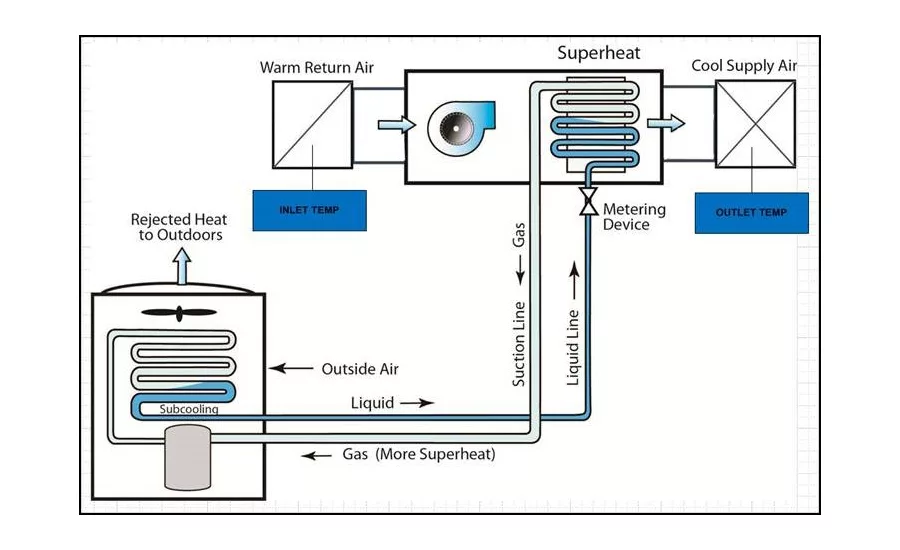
FIGURE 1: Delta T measurement schematic.

Tech 2

FIGURE 2: Optimal performance of a/c central unit.
Tech 3

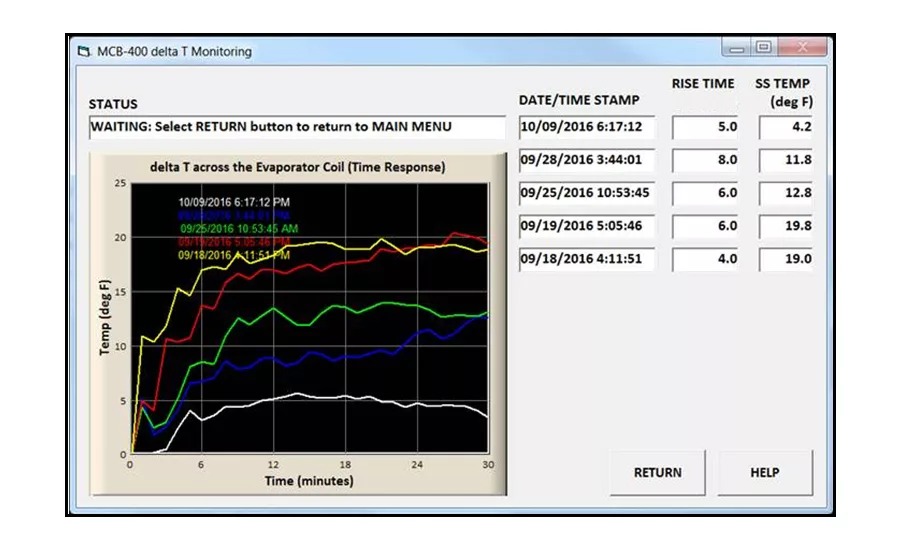
FIGURE 3: Rise time analysis.

Tech 4

FIGURE 4: Bad motor starting capacitor.

Tech 1
Tech 2
Tech 3
Tech 4
June 19, 2017

Field surveys have shown that 60 percent of HVAC systems are operating below the manufacturer's specifications. Deviation from manufacturer's specifications can mean a large increase in energy consumption. For example, a 10 percent undercharge in a system can mean the loss of almost two seasonal energy efficiency ratio (SEER) rating points, and a 23 percent undercharge can mean a 52 percent loss of efficiency.

To keep their units operating at peak efficiency, homeowners are encouraged to schedule regular system maintenance. However, there are a number of problems with this approach.

  • If the coolant levels are correct, the filters are clean, and there are no other problems, the maintenance call may not have been necessary. This results in unnecessary expense and inconvenience for the homeowner.
  • If system maintenance has just been performed, a leak may develop and/or a component may malfunction shortly after the maintenance call. The problem may not be noticed by the homeowner and, therefore, not corrected until the next scheduled tune-up. This could result in ever increasing utility bills for the homeowner, and it could result in permanent damage to the HVAC system.

As a result, companies are developing hardware/software products to provide a means for monitoring and maintaining optimum performance of residential HVAC units. This article provides three case studies to provide objective evidence of the value of these systems in residential HVAC installations.

INSTALLATION

For the purposes of this article, we assume a simple monitoring installation as shown in Figure 1. Three sensors are installed: (a) inlet temperature (return air), (b) outlet temperature (supply air), and (c) current sensor installed on the blower fan. While the schematic illustrates the installation for an a/c system, the same sensors are also used for heat (furnace) mode as well.

A Wi-Fi based microprocessor unit measures the outputs from the installed sensors and transmits the

data to a cloud based MySQL database every 60 seconds.  This recording frequency provides 1,440 sample points for the installed unit every 24 hours. The stored data may be downloaded from a remote location and analyzed by a back office software application.

CASE STUDY 1 — OPTIMAL PERFORMANCE

Looking for quick answers on air conditioning, heating and refrigeration topics? Try Ask ACHR NEWS, our new smart AI search tool. Ask ACHR NEWS →

The first case study illustrates the optimal performance of an HVAC residential installation in Texas. As seen in Figure 2, the back office software program provides a delta T/AC run time percentage graph (left graph) as well as the actual inlet (yellow) and outlet (blue) temperatures (right graph). The implementation of filtering algorithms to the data set provide meaningful delta T results that minimize the effects of humidity and transient (startup) measurements from distorting the true performance of the HVAC system being monitored. In this case study, the HVAC installation is running optimally.

CASE STUDY 2 — REFRIGERANT LEAK

The second case study illustrates the value in acquiring and storing the measurement data in the time domain. The back office software utilized provides the capabilities for analyzing and providing rise time results. Rise time is defined as the amount of time (in minutes) the system requires to go from fully off to 63.2 percent of the final steady state value.  For an installed HVAC system, we desire that the a/c reach its steady state operating delta T (in this case 20°F) as well as reach the steady state operating condition in a reasonable amount of time (typically 5-10 minutes).

In this case study, we provide results from the installation where a refrigerant leak in the a/c system occurred over a period of three weeks (Figure 3).

  • On 09/18/2016 the a/c unit was performing properly. The steady state delta T of the unit was 19° and the rise time was 4 minutes.
  • On 09/25/2016, the a/c unit was beginning to degrade. The steady state delta T of the unit was 12.8°. At this point, the monitoring software detected that the performance of the unit had degraded. The degradation was not noticed by the homeowner.
  • Finally, on 10/09/2016, the a/c unit was only able to obtain a steady state delta T of 4.2°. It was at this point the homeowner noted that the unit was not working.

The implementation of a remote HVAC monitoring and diagnostic system on this residential unit moved forward the detection of a refrigerant leak by two weeks. This event was fully recorded by the monitoring system.

CASE STUDY 3 — BAD MOTOR STARTER CAPACITOR

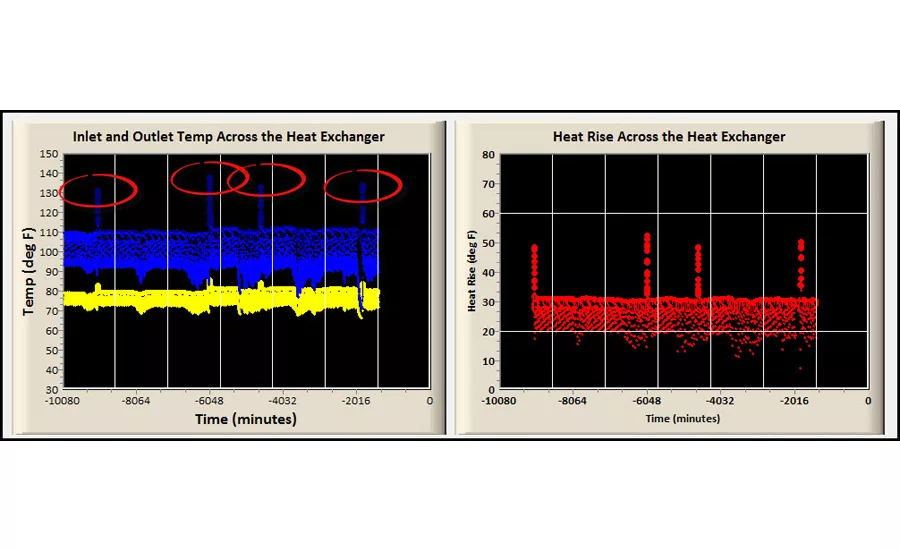
The last case study illustrates the implementation of the system in a residential HVAC system in Iowa. The monitoring time period shown was during the month of December, so the HVAC system was operating in heat or furnace mode. As seen in Figure 4, The output of the monitoring software provides two different graphical views of the recording data (a) inlet temperature (yellow line) to the furnace (left graph), (b) outlet temperature (blue line) of the furnace (left graph) and (c) heat rise = outlet temperature minus inlet temperature (right graph).

In this data set, the graphical results illustrate four temperature spikes that occurred over a six day time period. Further examination of the data illustrated that the furnace was turning on, but the blower fan was not. The furnace temperature would eventually set the high temperature limit switch (typically set to 155°-160°). After cooling off for several minutes, the furnace and blower would both come on successfully.

Further diagnostics of the HVAC system found that the blower fan motor starting capacitor was beginning to exhibit early indications of failure. The motor starter capacitor was replaced by the HVAC contractor on the monitored unit. This case study illustrates a situation where an issue was uncovered by the monitoring system that would have never been observed by an HVAC service technician in the field. Eventually the capacitor would have failed completely, resulting in an emergency service call to the HVAC service company by the homeowner. Instead the repair was completed during normal service hours with minimal disruption to the homeowner.

SUMMARY

The implementation of Residential HVAC Monitoring and Diagnostics systems provide a direct tool for minimizing wasted power as well as providing a means to the consumer to determine the current operating state of their installed HVAC unit.

Publication date: 6/19/2017

Want more HVAC industry news and information? Join The NEWS on Facebook, Twitter, and LinkedIn today!

KEYWORDS: energy efficiency Remote Monitor

Share This Story

Looking for a reprint of this article?
From high-res PDFs to custom plaques, order your copy today!


Ron roth

Ron Roth, Ph.D. is the principal for RT Automation located in San Antonio, TX. RT Automation develops and markets equipment monitoring products for residential and industrial applications.

Recommended Content

JOIN TODAY
To unlock your recommendations.

Already have an account? Sign In

  • HVAC-enrollment

    The Trades Are Back: HVACR Programs See Nearly 30% Enrollment Spike

    A new wave of future technicians is entering the pipeline.  
    Training and Education
    By: Matt Jachman
  • 2025 Top 40 Under 40

    2025 Top 40 Under 40 HVACR Professionals List

    The 11th annual Top 40 Under 40 list highlights those...
    HVAC Residential Market
    By: Hannah Belloli-Oster
  • LG Ductless Mini-Split Systems

    The 9 Types of Heat Pumps

    As the U.S. moves toward electrification, heat pumps are...
    News
    By: Joanna R. Turpin
Subscription Center
  • Create an Account
  • Start a Subscription
  • Manage My Account
  • Sign Up for Newsletters
  • Visit Customer Service
  • Update Preferences

More Videos

Sponsored Content

Sponsored Content is a special paid section where industry companies provide high quality, objective, non-commercial content around topics of interest to The News audience. All Sponsored Content is supplied by the advertising company and any opinions expressed in this article are those of the author and not necessarily reflect the views of The News or its parent company, BNP Media. Interested in participating in our Sponsored Content section? Contact your local rep!

close
  • Piggy Bank
    Sponsored byWatercress Financial

    Energy Prices, Inflation, and HVAC: What Today’s Homeowners Care About

  • Refrigerated Food
    Sponsored bySolstice Advanced Materials

    R-455A Refrigeration: A Cold Storage Solution for the Future

  • Airex Rooftop Units
    Sponsored byAirex Manufacturing Inc

    Consolidating Roof Penetrations: A Growing Trend in Multifamily HVAC Design

Popular Stories

HVAC-Price-Increase-graphic

HVAC Price Increase List: June 2026

Trump-Section-232.jpg

Trump Reduces Section 232 Tariffs on HVAC Equipment to 15%

R410A-Refrigerant-Cylinder.jpg

Refrigerant Recovery is a Revenue Opportunity

Heat-pump-cutaway.jpg

PFAS Rules and A2L Building Codes Continue to Evolve

Kroger.jpg

Kroger to Spend $100 Million to Reduce Refrigerant Leaks

View The ACHR NEWS
Centennial Anniversary Timeline

The ACHR News Timeline Chart
Submit a Letter
Submit a letter to our editors.

Events

November 6, 2025

Next-Gen Data Center Cooling: HVAC Innovation and Real-World Solutions

On Demand As AI workloads and high-density computing push traditional cooling methods to their limits, the data center industry is accelerating the adoption of next-generation HVAC technologies.

June 9, 2026

Before You Go All In on AI: Set Up Your Business to Actually Win

In this webinar, we'll walk you through exactly what to get in place before you add AI to your business. You'll leave with a clear picture of where you stand today and a practical action plan to set yourself up for real results.

View All Submit An Event

Poll

Summer Staff

Are you fully staffed for the summer season?
View Results Poll Archive

Products

BNI Mechanical/Electrical Square Foot Costbook, 2026 Edition

BNI Mechanical/Electrical Square Foot Costbook, 2026 Edition

See More Products
A2L Refrigerants - Free Webinar - May 21, 2026

Related Articles

  • Midea Heat Pump Installation

    Boosting the Value of Multi-Family Units With Smart HVAC Upgrades

    See More
  • Green Valley Team

    Win Over Wallets By Selling the Value of High-End HVAC

    See More
  • Reitmeier HVAC Services

    HVAC Contractors Debate the Value of Energy Star

    See More

Related Products

See More Products
  • HVAC Value Pack Bundle (2 Books, 1 Audio CD + Consulting)

See More Products

Related Directories

  • Lennox Residential HVAC

    Air is Life. Make it Perfect. Lennox Residential offers the quietest and most efficient HVAC units and Indoor Air Quality products on the market.
  • Value Added HVAC Distributors

    Headquartered in Richmond, VA, Value Added HVAC Distributors is one of the largest independent wholesale distributors of residential and light commercial HVAC equipment on the east coast.
  • Dexen Industries Inc.

    Gas control system and remote monitoring system for the HVAC industry.
×

Sign Up. Stay Informed.

The #1 trusted source for the HVACR industry since 1926

SUBSCRIBE
  • RESOURCES
    • Advertise
    • Contact Us
    • Advisory Board
    • Classifieds
    • Submit a Letter
    • Directories
    • Store
  • ACCOUNT CENTER
    • Create an Account
    • Start a Subscription
    • Manage My Account
    • Sign Up for Newsletters
    • Visit Customer Service
    • Update Preferences
  • SERVICES
    • Marketing Services
    • Reprints
    • Market Research
    • List Rental
    • Survey/Respondent Access
  • STAY CONNECTED
    • LinkedIn
    • Facebook
    • Instagram
    • YouTube
    • X (Twitter)
  • PRIVACY
    • PRIVACY POLICY
    • TERMS & CONDITIONS
    • DO NOT SELL MY PERSONAL INFORMATION
    • PRIVACY REQUEST
    • ACCESSIBILITY

Copyright ©2026. All Rights Reserved BNP Media, Inc. and BNP Media II, LLC.

Design, CMS, Hosting & Web Development :: ePublishing