ACHR News
search
Ask ACHR NEWS AI
cart
facebook twitter instagram linkedin youtube
  • Sign In
  • Subscribe
  • Sign Out
  • My Account
ACHR News
  • NEWS
    • Breaking News
    • New HVAC Products
    • Featured Products
    • Manufacturer Reports
    • HVAC Data
    • Legislation
    • ACHR NEWS Centennial
  • RESIDENTIAL
    • Air Conditioners
    • Furnaces
    • Residential Heat Pumps
    • Ductless
    • Residential IAQ
    • Testing, Monitoring, Tools
    • Components & Accessories
  • COMMERCIAL
    • Air Handlers
    • Rooftop Units
    • Chillers and Cooling Towers
    • Commercial Heat Pumps
    • Boilers and Hydronics
    • VRF/Ductless
    • Commercial IAQ
  • REFRIGERATION
    • Refrigerants
    • Refrigerant Regulations
    • Leak Management
  • CONTRACTOR PRO
    • Geothermal
    • Homeowner Study
    • VRF and VRV Ductless
    • Unitary Trends
  • EDUCATION
    • Training and Education
    • Business Management
    • Service and Maintenance
    • Continuing Education
    • Market Research >
      • HVAC Brand Awareness Report
      • VRV, VRF, VRVZ Report
      • Unitary Trends Report
      • Water Heat Professionals Report
    • Webinars
    • Sponsor Insights
    • eProducts Info
    • White Papers
  • EVENTS
    • HVAC Contractor Forum
    • Industry Events and Webinars
  • MEDIA
    • Videos
    • AHR Expo 2025 Videos
    • Podcasts >
      • ACHR News Podcast
      • HARDI Podcasts
      • AHR Expo Podcasts
      • ACCA Podcasts
    • Interactive Spotlights
    • Quizzes
    • eBooks
    • HVAC Talkback
  • HVAC GROUP
    • ACHR NEWS >
      • Current Issue
      • Digital Edition
      • Subscribe
    • Distribution Trends
    • SNIPS NEWS >
      • Join SNIPS NEWS
    • Engineered Systems News >
      • Join ES News
    • HVACR Directory
    • Contests
    • Newsletters
    • Contact
    • Advertise
    • My Account
HVAC ContractingService and MaintenanceHVAC Residential MarketFurnaces

Btu Buddy 169: Oil Furnace Burner Malfunction — Part 2
By Bill Johnson
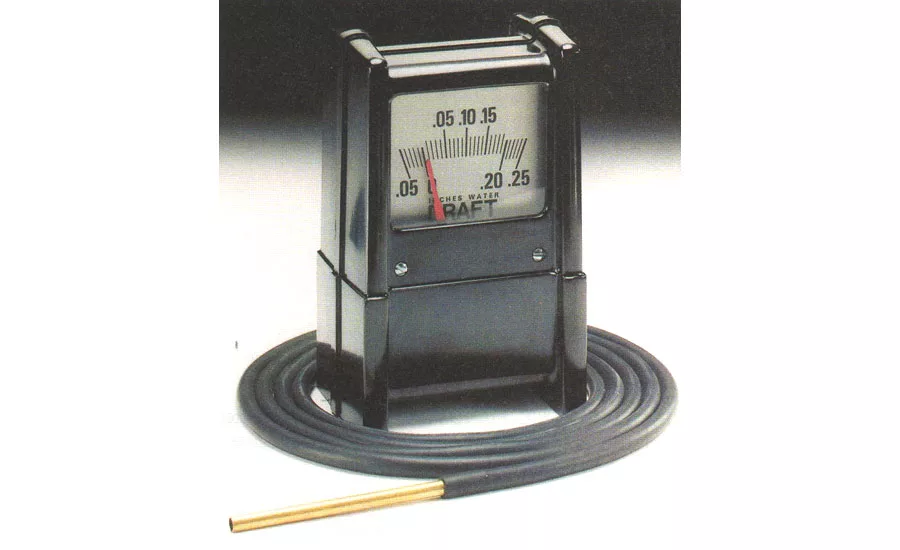
Figure 1

FIGURE 1: This draft gage reads inches of water column (W. C.). It registers both positive and negative pressure. 
(Figures are from Refrigeration & Air Conditioning Technology, 7th Edition, by William Whitman, William Johnson, John Tomczyk and Eugene Silberstein published by Delmar Cengage Learning.) (©Delmar Cengage Learning.)
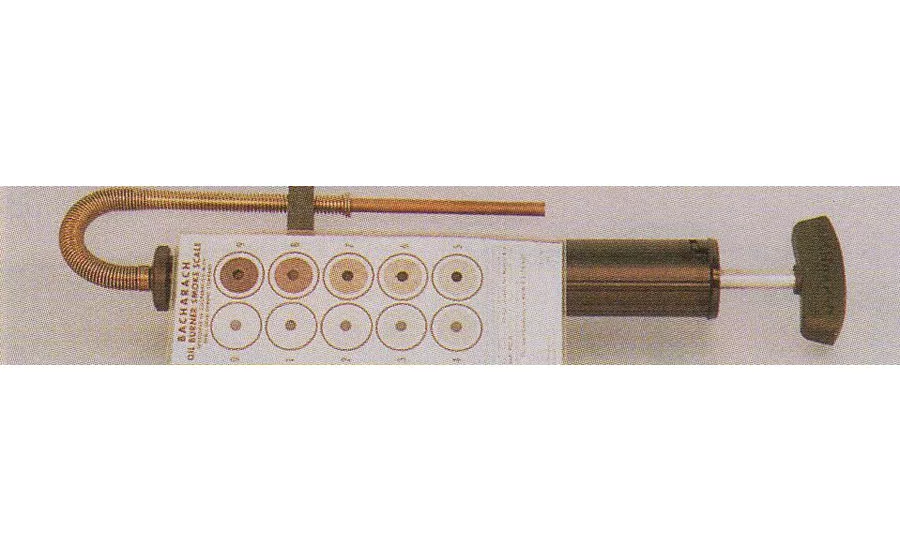
Figure 2

FIGURE 2: This is a photo of a smoke tester. When you insert the tube into the flue with a fresh piece of filter paper in the chamber and pull the handle a prescribed number of times, it draws a measured volume of flue gas through the filter paper. You then remove the filter paper and insert it into the sample chart and choose the closest match, which gives you the smoke content in percentage of the total sample.
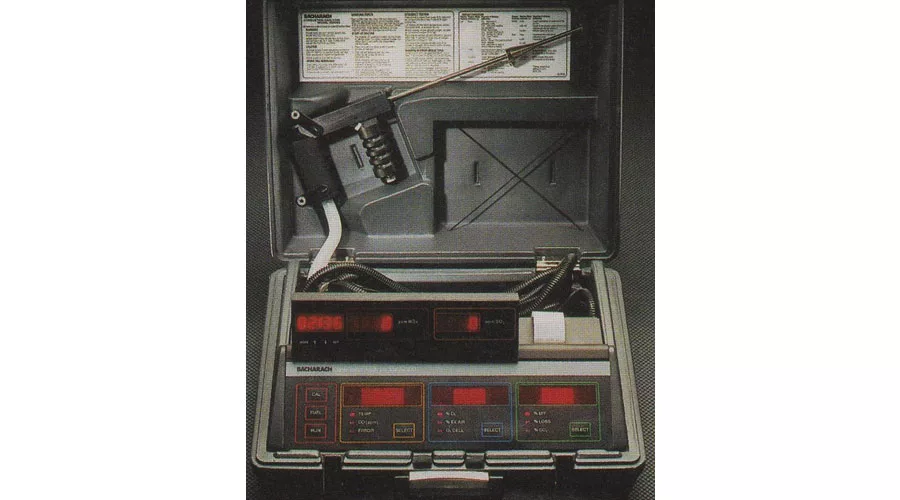
Figure 3

FIGURE 3: This a photo of a flue gas analyzer that is used to analyze flue gases on gas and oil furnaces. The furnace efficiency can be indicated with this instrument.

Figure 1
Figure 2
Figure 3
April 17, 2017

Bob and Tim are at lunch after tuning up an oil burner. When they arrived at the job the home was cold and the oil burner was burning erratically if burning at all. They gave the system a tune-up, started the furnace, and decided to take a lunch break while the furnace heated the house. Then they were going back to do a combustion check on the furnace to make sure that it was set up for the best combustion.

“What exactly are we looking for in this combustion check?” Tim askes.

“An oil burner is the most sensitive heating unit that we work with as far as combustion efficiency is concerned. A gas furnace virtually needs no combustion analysis or tune-up in today’s market. The gas burners are designed so that dust does or cobwebs do not build up in the modern-day burners. There is just no room for adjustment with gas burners in today’s market in small appliances, and, of course, electric heat requires no adjustment. Heat pumps require the correct charge and maintenance, but it is nothing like an oil burner. The oil burner is burning a fuel that must be filtered, water must be removed from it, and the burner should be tested for efficiency every year,” said Bob.

“The things that we will be looking for are:

  • The draft over the fire and in the flue. The draft tells us the vacuum is below atmospheric pressure, which will draw all the gases up the flue. The flue pipe must operate in a vacuum for the flue gases to rise up the chimney or flue pipe (Figure 1).
  • We will also perform a smoke test, which will give us an indicator that the flue gases are burned as completely as possible (Figure 2).
  • Then, we will do a full analysis to make sure the efficiency is as close as we can get to what the manufacturer recommends (Figure 3).

We will need the smoke test kit, the draft gage, and the electronic analysis kit.”

They made their way back to the job and started the furnace again as the house had warmed up and satisfied the need for the furnace. The first thing they did was put a thermometer in the flue gas pipe leaving the furnace. This is a standard efficiency fuel oil furnace that is piped up a metal flue pipe and has a draft diverter above the furnace to adjust the draft in the vent. They waited for the temperature to stop rising in the flue pipe and it stopped at about 660°F. They took the temperature in the room where the furnace was, in the basement. The room temperature was 60°. So, the net rise of combustion gases across the furnace was 600° (660°-60° = 600°).

They performed a smoke test in the flue pipe by drawing a known quantity sample of flue gas through a filter and comparing it to a template of comparisons. They found the flue gas had about 5 percent smoke, which was about correct for this furnace.

Then, they did a draft test over the fire and found the draft to be -0.02 inches of water column (W.C.) acceptable. Draft in the flu was about .05 inches of W.C., which looked real good for this furnace.

Looking for quick answers on air conditioning, heating and refrigeration topics? Try Ask ACHR NEWS, our new smart AI search tool. Ask ACHR NEWS →

The next step was to do the combustion analysis test. They were looking for a CO2 reading of 8-10 percent. The combustion analysis test showed the CO2 range to be around 10 percent, which would give an efficiency of about 75 percent. This is quite normal for an oil furnace with a natural draft flue.

“If the flue gas temperature were to be too high, it would mean that too much air is flowing through the combustion chamber. There is an adjustable air adjustment on the side of the burner that can be moved for more air or, in this case, less air. The draft diverter can be adjusted if the draft is too great or too little. Other than that, the nozzle size and angle is determined by the manufacturer through testing on the unit when it is designed and built,” said Bob. “The newer oil furnaces can have much better efficiencies, upwards of 90 percent. This is accomplished by condensing moisture from the flue gases and getting more efficiency out of the heat exchanger by having it in contact with the room air heat exchanger for a longer period of time. This would be called a condensing oil furnace. It requires a condensate drain system that can handle the condensate which is slightly acidic”.

“Why would anybody purchase a low efficiency furnace when they could buy a high efficiency?” asked Tim.

“Many people will go for the first cost of an installation over efficiency. The condensing furnace cost much more than the normal atmospheric oil furnace,” replied Bob.

They had the system all checked out, and the efficiency was about as good as could be expected out of this type furnace, so the homeowner was set for another year of good operation. They explained to the homeowner what they had done and why. They were driving away in the truck when Tim said, “An oil burner arrangement is a sophisticated heating system compared to a gas furnace. And, it is completely different from a heat pump system. Both of these systems require quite a bit of attention to get good efficiency, so they must have their place in industry.”

“People who are away from the gas main cannot get natural gas, but they can use propane for fuel. Oil is probably considerably cheaper than propane to heat with. And, some people have always had oil and really enjoy the warm heat that comes from an oil furnace. When it is time for a new heating system, the oil burner duct system may not easily be adapted to a heat pump because the heat pump discharge air is much cooler than an oil furnace. The typical air temperature leaving a heat pump air system is about 100° while air from an oil furnace is usually around 120-130°. You can see why people who have had hot air coming from their system for many years may not want to drop back to a system with an air temperature that is much cooler. However, either system will heat a home equally well,” said Bob.

Publication date: 4/17/2017

Want more HVAC industry news and information? Join The NEWS on Facebook, Twitter, and LinkedIn today!

KEYWORDS: HVAC service service calls troubleshooting and HVACR

Share This Story

Looking for a reprint of this article?
From high-res PDFs to custom plaques, order your copy today!


Active in the HVACR industry since the 1950s, Bill Johnson graduated in gas fuel technology and refrigeration from the Southern Technical Institute, a branch of Georgia Tech (now known as Southern Polytechnic Institute). He taught HVAC classes at Coosa Valley Vocational & Technical Institute for four years. He moved on to become service manager for Layne Trane, Charlotte, N.C. He taught for 15 years at Central Piedmont Community College, part of this time as program director. He had his own business for five years doing installation and service work. Now retired, he is the author of Practical Heating Technology and Practical Cooling Technology, and continues as a co-author of Refrigeration & Air Conditioning Technology, seventh edition, all published by Delmar Cengage Learning. For more information, he can be reached at 704-968-0000 or thebillj1@gmail.com.

Btu Buddy Notebook is a collection of more than 50 service call scenarios in book form covering both cooling season and heating season troubleshooting. For more information and to purchase the book, visit the HVACR Industry Store.

Recommended Content

JOIN TODAY
To unlock your recommendations.

Already have an account? Sign In

  • HVAC-enrollment

    The Trades Are Back: HVACR Programs See Nearly 30% Enrollment Spike

    A new wave of future technicians is entering the pipeline.  
    News
    By: Matt Jachman
  • 2025 Top 40 Under 40

    2025 Top 40 Under 40 HVACR Professionals List

    The 11th annual Top 40 Under 40 list highlights those...
    HVAC Commercial Market
    By: Hannah Belloli-Oster
  • LG Ductless Mini-Split Systems

    The 9 Types of Heat Pumps

    As the U.S. moves toward electrification, heat pumps are...
    News
    By: Joanna R. Turpin
Subscription Center
  • Create an Account
  • Start a Subscription
  • Manage My Account
  • Sign Up for Newsletters
  • Visit Customer Service
  • Update Preferences

More Videos

Sponsored Content

Sponsored Content is a special paid section where industry companies provide high quality, objective, non-commercial content around topics of interest to The News audience. All Sponsored Content is supplied by the advertising company and any opinions expressed in this article are those of the author and not necessarily reflect the views of The News or its parent company, BNP Media. Interested in participating in our Sponsored Content section? Contact your local rep!

close
  • Piggy Bank
    Sponsored byWatercress Financial

    Energy Prices, Inflation, and HVAC: What Today’s Homeowners Care About

  • Refrigerated Food
    Sponsored bySolstice Advanced Materials

    R-455A Refrigeration: A Cold Storage Solution for the Future

  • Airex Rooftop Units
    Sponsored byAirex Manufacturing Inc

    Consolidating Roof Penetrations: A Growing Trend in Multifamily HVAC Design

Popular Stories

Refrigerants-and-gauge.jpg

HVAC Industry Warns of Counterfeit Refrigerants Entering U.S. Supply Chain

U.S. Supreme Court building

95% Furnace Efficiency Rule to Get New Hearing

Data_Center_facility.jpg

HVAC Manufacturers Respond to Growing Data Center Backlash

Lennox equipment

Platinum Equity to Sell Heat Controller to Lennox

HVAC Minute retail refrigeration system

EPA Final Rule’s Impact on R-410A Deadlines

View The ACHR NEWS
Centennial Anniversary Timeline

The ACHR News Timeline Chart
Submit a Letter
Submit a letter to our editors.

Events

November 6, 2025

Next-Gen Data Center Cooling: HVAC Innovation and Real-World Solutions

On Demand As AI workloads and high-density computing push traditional cooling methods to their limits, the data center industry is accelerating the adoption of next-generation HVAC technologies.

July 28, 2026

How Top Home Services Companies Turn Every Conversation Into Predictable Revenue

In this webinar, we'll outline how top contractors are turning every conversation into predictable revenue by coaching every comfort advisor visit, not just the ones a manager rides along on.

View All Submit An Event

Poll

Summer Staff

Are you fully staffed for the summer season?
View Results Poll Archive

Products

BNI Mechanical/Electrical Square Foot Costbook, 2026 Edition

BNI Mechanical/Electrical Square Foot Costbook, 2026 Edition

See More Products
Designing Systems Using A2L Refrigerant - Free Webinar - 7/22/2026

Related Articles

  • Fig 1

    Btu Buddy 168: Oil Furnace Burner Malfunction — Part 1

    See More
  • Btu Buddy 117: Oil Burner Pump Problem - Part 2

    See More
  • Btu Buddy 125: Superheat Explained - Part 2

    See More

Related Products

See More Products
  • The ACHR News - February 2, 2026

    ACHR NEWS February 2, 2026, Issue

  • solidworkscourse1.gif

    SolidWorks for the Sheet Metal Guy - Course 1: Part Creation

  • Manual J 8 Full.jpg

    Manual J Residential Load Calculation (8th Edition - Full) [ANSI/ACCA 2 Manual J - 2016]

See More Products

Related Directories

  • Dornback Furnace Div.

    Residential and light commercial gas, and oil-fired warm air furnaces, barometric draft controls, electronic air cleaners, humidifiers, unit heaters, infrared heaters and gas and oil burners and waste oil heaters.
  • Albany Burner Control Inc.

    Specializing in service parts and supplies, we maintain an "in house" shop for electric motor service, testing and analyzing oil & gas power burners.
×

Sign Up. Stay Informed.

The #1 trusted source for the HVACR industry since 1926

SUBSCRIBE
  • RESOURCES
    • Advertise
    • Contact Us
    • Advisory Board
    • Classifieds
    • Submit a Letter
    • Directories
    • Store
  • ACCOUNT CENTER
    • Create an Account
    • Start a Subscription
    • Manage My Account
    • Sign Up for Newsletters
    • Visit Customer Service
    • Update Preferences
  • SERVICES
    • Marketing Services
    • Reprints
    • Market Research
    • List Rental
    • Survey/Respondent Access
  • STAY CONNECTED
    • LinkedIn
    • Facebook
    • Instagram
    • YouTube
    • X (Twitter)
  • PRIVACY
    • PRIVACY POLICY
    • TERMS & CONDITIONS
    • DO NOT SELL MY PERSONAL INFORMATION
    • PRIVACY REQUEST
    • ACCESSIBILITY

Copyright ©2026. All Rights Reserved BNP Media, Inc. and BNP Media II, LLC.

Design, CMS, Hosting & Web Development :: ePublishing