Navigating the Aisles of Change
While changes keep coming for supermarkets, the HVACR industry keeps answering the call

POPULAR AISLE: Supermarket customers don’t care what HVACR contractors have to go through to keep their favorite beverages cold – they just expect the work to be done. Photo courtesy of Zero Zone, Inc.
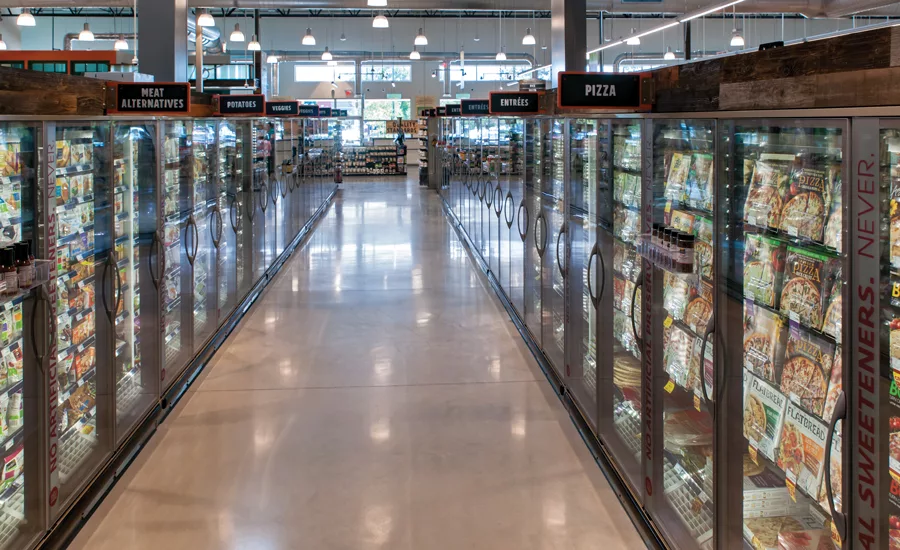
FROZEN FOODS: The frozen food aisles in modern supermarkets are marvels of technology. Photo courtesy of Zero Zone, Inc.
Do you hate it when your favorite supermarket — the one where you shop at weekly — goes through a renovation and moves everything around? Or how about when you move to a new area and you’re forced to navigate a different supermarket? You may find yourself wandering back and forth across the store in search of those elusive items on your list that you just can’t find.
Well, if change on that level of the supermarket experience can be difficult, imagine how life is for supermarket operators who’ve been at landfall of the perfect storm of refrigerant changes and increasingly stringent equipment efficiency regulations. Many converted their chlorofluorocarbon (CFC) and hydrochlorofluorocarbon (HCFC) refrigeration systems to hydrofluorocarbon (HFC) systems only to see HFCs targeted for a phaseout. Now, they’re hearing about natural refrigerants, distributed refrigeration, and cascade systems. It’s a great opportunity for HVACR contractors to step in and be heroes to these beleaguered clients. To that end, here are some trends to keep an eye on and potentially discuss with your supermarket customers.
AN UNCERTAIN PATH
There is some confusion in the food retail industry about the future path for refrigerants and refrigeration systems, according to Andres Lacassie, director, retail product portfolio, Hussmann Corp. He said the confusion stems from a large installed base of existing HFC refrigeration systems in North America; the U.S. Environmental Protection Agency (EPA) delisting R-404A for use in new multiplex supermarket systems as early as January 2017; and a huge focus on energy efficiency and refrigerant global-warming potential (GWP) by the government, consumers, retailers, and manufacturers around the world. As a result, food retailers are faced with some difficult decisions regarding their existing and new stores.
To add to the confusion, there are several possible refrigeration system alternatives, depending on the goals and objectives of the food retail business, Lacassie noted.
“New synthetic refrigerants and HFC/hydrofluoroolefin [HFO] refrigerant blends designed to replace R-404A have lower GWPs and work more efficiently with centralized parallel and distributed systems,” he said. “These alternatives offer similar operating performances as HFCs and are often compatible with existing systems in retail stores’ portfolios. Distributed refrigeration systems, meanwhile, put the load closer to the source, thereby minimizing installation and construction costs and possible refrigerant leaks.
“There has been interest in moving toward CO2 secondary, cascade, and transcritical systems because of their low GWPs, but these systems are often more costly to operate and service than their lower-HFC-refrigerant-charge counterparts,” Lacassie added. “A third option gaining traction across the industry is micro-distributed systems utilizing hydrocarbon [HC] or ultra-low-GWP HFO refrigerants that minimize refrigerant leaks by charging, testing, and sealing refrigeration systems at their points of manufacture. Just like other solutions, there are pros and cons to this approach, as well.”
According to Lacassie, ultimately, there are three driving points of consideration for supermarket clients in making a final system decision: total cost of ownership versus first cost, the idea that there’s no such thing as a one-size-fits-all solution, and the fact that refrigerant choice cannot be separated from the choice of system architecture.
Looking for quick answers on air conditioning, heating and refrigeration topics? Try Ask ACHR NEWS, our new smart AI search tool. Ask ACHR NEWS
Looking ahead, Lacassie noted that under the current regulatory environment, the only thing that appears certain about the future of supermarket refrigeration is the downward pressure on GWP.
For example, if the California Air Resources Board (CARB) passes its proposal to allow only refrigerants with GWPs of less than 150, the only viable refrigerants for supermarkets and convenience stores in California will be natural refrigerants, such as CO2, ammonia, propane, or ultra-low-GWP synthetic refrigerants and refrigerant blends. This means the food retail industry will require a variety of refrigeration system architectures.
“At Hussmann, we recommend food retailers work with industry resources, suppliers, and partners to analyze the options and consider the potential impact each may have on their businesses,” Lacassie said. “There needs to be conversation, analysis, collaboration, and understanding between suppliers, manufacturers, and retailers as to the next steps and the right processes to move forward with. It is imperative that HVACR contractors not only understand the impact of industry regulations and refrigeration system options, but also be ready to advise, support, service, and install systems with new refrigerants.”
A MOVE TO CO2 AND HCs
Although there are some pioneers in the supermarket sector that are experimenting with ammonia systems, Caleb Nelson, vice president, business development, Azane Inc., said he thinks, in the U.S., the first move away from HFCs will be to CO2, either cascaded with a low-GWP HFC or in a transcritical system.
“We’re also seeing a pretty good spike in interest in HCs in supermarkets,” Nelson said. “So I think it’s going to be a situation where we’re not going to see a silver bullet, and there’s going to be a few different options that become feasible.”
The system choices of the future will also be climate-dependent, Nelson noted. Retailers in hotter climates who want to go natural are likely to be looking more seriously at propane and ammonia rather than CO2.
Nelson added that outside of retail, there’s an in-between sector of wineries, breweries, and other synthetic refrigeration users that are going to be looking at ammonia because of its efficiency and applicability to larger-tonnage systems over transcritical systems, which physically cap out on compressor and pipe size due to CO2’s high pressures.
Nelson concluded it will take time to understand all the factors that will play into deciding how big of a market share ammonia will have in HFC markets.
“I think it’s clear it will have a market, but how big of a market will depend on how efficiently CO2 systems can be proven to perform in hot climates and what the cost and complexity of those systems might be,” he said. “Another factor will be the legislation that gets passed to disincentivise synthetic refrigerants.”
CO2 for low-temperature systems is a no-brainer for the future of the supermarket industry, said Joe Sanchez, engineering manager, Bitzer US Inc. However, the choice between CO2 cascade, CO2 as a brine, and CO2 transcritical booster systems is still a decision, especially among users in hotter climates.
“Transcritical CO2 will play an important role in supermarkets in cold climates, and in the warmer climates, maybe transcritical technology will continue to evolve and make it efficient,” Sanchez said. “But, either way, I think ammonia and CO2 could certainly be viable long-term options.”
REGULATIONS DRIVE CHANGE
Carl J. Petersen, marketing and advertising manager, Zero Zone Inc., said everyone in the supermarket business is concerned with energy conservation and cost reduction.
“The new Department of Energy [DOE] regulations have prompted all industry manufacturers to make energy improvements in their refrigerated display case designs,” Petersen said. “Although food retailers are not responsible for complying with the new DOE regulations, the product mix that case manufacturers will be able to offer them will change.
“Zero Zone takes this responsibility seriously and has already taken steps to go even further than the regulations mandate,” Petersen added. “Zero Zone products, which have always been energy efficient, will now be even more so in 2017. For example, I am happy to report that the Zero Zone Crystal™ Merchandiser line of coolers and freezers has already met the 2017 DOE energy regulations and required no modifications.”
Imminent changes in acceptable refrigerants are also on the horizon, Petersen noted. The EPA refrigerant regulations taking effect in 2017 are complex and require clarification for retailers to apply them successfully. Some of the terms used in the regulations can be confusing. For instance, the EPA defines a new system as one that is changed by adding additional cases, compressors, and refrigerant that were not supported by the original compressor system. Conversely, the EPA considers a retrofit to be a change in refrigerant, not a change in equipment.
“A good understanding of these definitions and the concept of when a system becomes operational are essential to retailer compliance of these new regulations,” Petersen said. “Timing of system changes is critical, for instance, in regard to when soon-to-be-banned R-404A or R-507A refrigerants can or cannot be used or if and when they must be replaced.”
To help retailers comprehend the scope of the new EPA refrigerant regulations, Zero Zone has authored a white paper on the subject, available in the Literature drop-down at http://bit.ly/ZeroZoneLit. Petersen said Zero Zone engineering and sales representatives are also on hand to advise retailers and help compare refrigerants based on energy efficiency, GWP, cost, and other variables.
Finally, Petersen noted an increasing number of supermarket professionals are experimenting with natural refrigerants, including CO2 and ammonia.
“Use of these refrigerants requires additional contractor education in order to set up and run these systems correctly,” Petersen said. “More contractors and installers are coming up to speed on this training, but it is imperative that all HVACR contractors become experts in these new types of systems in order to meet growing customer demand.”
TAKING A DISTRIBUTED APPROACH
Keith Baughman, training manager, Danfoss, said ever-increasing demands for higher energy efficiency and lower-GWP refrigerants are causing the supermarket industry to begin transitioning away from a traditional centralized approach to refrigeration. Instead, refrigerated cases are being controlled using a decentralized — or distributed—approach. This method relies on individual case controllers placed on each refrigerated case.
Case controllers and matching electronic expansion valves (EEVs) are designed to provide a single point of control for all aspects of a refrigerated unit. Settings are programmed directly into the case controller, giving operators the ability to manage EEVs and control lights, fans, defrost, and anti-sweat heaters. All information about the case is shared with the system manager for remote or local viewing of the operation.
“The increasing cost of energy, along with the number of experienced technicians, has improved the return on investment and reduced payback time associated with case controllers,” said Braughman. “Because the controllers contribute to lower energy consumption, they also support a growing interest in reducing carbon emissions and embracing green technologies.”
According to Danfoss, case controllers help reduce energy consumption because they continuously measure superheat and precisely match the refrigerant load within the system. The controllers’ intelligent defrost control also offers significant energy savings.
“Store owners also appreciate the case controllers’ ability to integrate with the control system while meeting the needs of the modern supermarket,” Braughman said. “The controller communication network provides the comfort of having a fully monitored refrigeration system 24/7, ensuring optimum food safety and quality.”
The bottom line: Change is always a constant, especially in the HVACR industry. And nowhere is that more evident than in your local supermarket.
SIDEBAR: NEW DISPLAY CASES MAY REQUIRE AN IMPROVED OPERATING ENVIRONMENT
With the new U.S. Department of Energy (DOE) regulations taking effect in 2017, display case manufacturers are making mandatory changes to their refrigerated cases that will ultimately require improvements to the store conditions in which cases operate, said Carl J. Petersen, marketing and advertising manager, Zero Zone Inc.
All manufacturers test their cases according to ANSI/ASHRAE Standard 72, “Method of Testing Commercial Refrigerators and Freezers.” Testing takes place in environmentally controlled test chambers in which the ambient temperature is held at 75°F and the humidity is held at 55 percent. Any ambient store temperature or humidity that exceeds these levels is likely to result in poor case performance, exhibited by door fogging, frost formation inside the case, or leaking of condensation onto store floors.
“Due to the DOE’s restraints on adding heat to the cases, simple adjustments to door heaters will no longer alleviate that condensation or frosting issue when the new cases are placed in store conditions that exceed ANSI/ASHRAE Standard 72 parameters,” Petersen said. “Although store operators have been aware of the importance of this concept for several years, maintaining optimum store conditions is even more critical as the redesigned cases are commissioned in stores.”
This is especially important in stores in the southern U.S., where higher store temperatures and higher humidity levels are typically the norm.
“Retailers should be aware of this and make modifications to their stores in order to be ahead of the curve and prepared for the newer, more energy-efficient cases, regardless of manufacturer,” Petersen advised.
Publication date: 9/5/2016
Want more HVAC industry news and information? Join The NEWS on Facebook, Twitter, and LinkedIn today!
Looking for a reprint of this article?
From high-res PDFs to custom plaques, order your copy today!