Responding to Angry Customers
Contractor share tips to stay cool when customers get hot

LISTEN UP: When dealing with an angry customer, the general consensus among experienced HVAC contractors is always the same: start by listening.
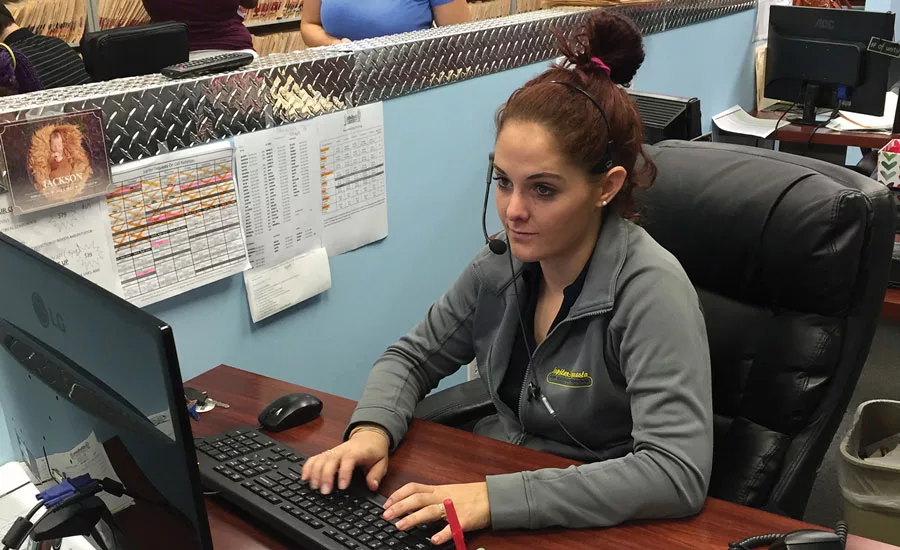
IN THE CUSTOMER’S SHOES: At Jupiter-Tequesta Air Conditioning, Plumbing, and Electric Inc. in Jupiter, Florida, employees are trained to consider the customer’s perspective. Shown here, Devan Eginton, customer service representative, answers the phone.
The phone rings, and suddenly your good day at the office goes down the tubes as an angry customer starts shouting in your ear. How do you react?
HVAC contractors who’ve been in the business for a while say the most important thing to remember is not to take it personally. But, as Michael Rosenberg, president of Rosenberg Indoor Comfort in San Antonio, pointed out, that can be hard to do.
“I do get upset when a client is not happy, and I sometimes take it personally, because it is my business,” Rosenberg admitted. However, he explained he never loses his cool in front of customers, and he trains his field personnel to never become confrontational.
While some folks are harder to please than others, HVAC contractors say there are proven practices that can help prevent a tense situation from escalating. And, with the right tactics, you can even turn an angry customer into a happy, satisfied one.
LISTEN UP
The general consensus among experienced contractors is the first step to defusing a tense situation with an angry customer is always the same: start by listening.
According to Will Winchester, service manager for Poudre Valley Air in Fort Collins, Colorado: “When a mad customer calls, the best thing to do is just listen. Let them get it off their chest first, no matter how long they go on.”
While they are venting, Winchester said, “Take notes to better prepare your answer when you finally get to talk.”
Looking for quick answers on air conditioning, heating and refrigeration topics? Try Ask ACHR NEWS, our new smart AI search tool. Ask ACHR NEWS
He added that, unfortunately, it’s true that people say things over the phone they would never say in a face-to-face situation. But, no matter what he hears, he remains calm and collected. Winchester has the benefit of age and experience to help him keep his cool, since he’s been in the industry for 28 years. But, it’s also possible to train office staff and field techs to first listen to the customer’s concerns.
“Our strategy is to just listen to their complaint first, apologize, and then get all the facts together,” Rosenberg said.
No matter the situation, the best thing to do is listen, said Keith Bryan, director of operations, home services, Lee Co. in Franklin, Tennessee. Plus, he shared his tips for active listening, a communication technique that is often used in counseling and therapy.
“Let them explain or vent their frustrations fully before you respond. Empathize with them about their experience and apologize,” Bryan said. “Repeat [back to the customer] the high points about what they said to verify your understanding.”
Another way to improve your listening skills is to consider the customer’s perspective, said Matthew Kuntz, vice president of Jupiter-Tequesta Air Conditioning, Plumbing, and Inc. in Jupiter, Florida.
“We always put ourselves in the client’s situation,” Kuntz said. “Getting heated or arguing with a client just does not work.”
Eric Knaak, vice president and general manager at Isaac Heating & Air Conditioning in Rochester, New York, added it’s also good practice to record all calls for training and verification purposes.
“It allows leadership an opportunity to listen to a call and determine if we did something to create the situation or if we are dealing with an unreasonable client,” he explained.
GET TO THE SOURCE
When you take the time to listen first, the source of the client’s frustration often becomes clear. Winchester said he’s learned that when people are riled up, it often has to do with money.
“I find that people get mad over many different things, but the No. 1 thing always seems to have something to do with money,” he said.
Rosenberg also frequently addresses frustrations due to money. His company handles these concerns differently, depending on the situation.
“Once we determine if it is our fault or not, we make the decision whether to concede anything to them. Sometimes, we’re in the right, but the amount to concede is very little, so we concede it anyway to keep the client happy and keep them from spreading bad feelings about us,” Rosenberg said. “If it’s a large sum of money, then we have to explain our side to them and compromise, if possible, or ask for the total amount.”
Bryan added that another frequent cause of frustration is miscommunication.
“Most of the really angry customers have stemmed from a breakdown in communication,” he said. “Sometimes the husband and wife do not communicate effectively. Or the company, or employees within the company, do not communicate effectively with the client.”
Knaak agreed that tense customer situations are often the result of miscommunication.
“My experience has been that most situations where a client is upset have something to do with communications, either from us to the client or the client to us,” he said.
After listening and analyzing the customer’s frustration, smart contractors say a speedy solution is the best way to prevent a problem from snowballing.
THE SOONER, THE BETTER
Different contractors have different approaches to solving customer concerns, but they all agree the quicker the response, the better.
For Kuntz, that means taking care of the issue within 48 hours.
“We approach every client the same way — quickly and fairly,” he said. “We try to get the situation solved within 48 hours so the client does not have to think of the problem over and over.”
Plus, Kuntz explained that the company approach for handling angry customers comes from the top down.
“Our managers are trained to deal with problems by our general manager,” he said. “Technicians are always instructed to use their manager to help make the client happy, if necessary.”
Knaak encourages techs to promptly get their supervisors involved when angry customers become unruly. He also prefers to handle such situations as quickly as possible.
“Don’t let it sit overnight if it can be avoided, because with time, and without resolution, it only gets more difficult to come to an understanding,” he said.
To prevent potentially volatile situations from getting out of control, Winchester’s techs are trained to walk away from the situation and call him immediately.
“I do not want any of my techs arguing with customers,” he said. “Even if it’s just a small thing, they know to call me.”
According to Bryan, Lee Co. has a different approach. They try to maintain a technician’s relationship with the client without pulling in a manager. The idea, he explained, is to turn the tech into the customer’s liaison.
“This helps to reduce the amount of times the customer has to call in and complain to a manger to resolve an issue,” he said, adding, “There is a little latitude extended to the technicians to empower them to help with making clients happy.”
WALK AWAY
But, when people refuse to calm down or be placated, a different protocol is enacted to prevent a potentially volatile situation from escalating to violence. The advice in these instances is simple: get out of there fast. Thankfully, contractors report that scenarios where technicians feel unsafe or threatened are extremely rare.
In more than 20 years, Bryan said he’s only had to deal with two of these situations, and in both cases the client seemed to be under the influence of drugs or alcohol.
“In both circumstances, I called the client while the technician was there,” he said. “Rather than argue with them or get the authorities involved, I chose to just instruct technicians to leave quietly.”
Knaak said that if his technicians feel unsafe, they are to “leave the home, go to their vehicle, and call for assistance. If they feel they are in danger, they are advised to simply drive away.”
He added, “We will get authorities involved and retrieve the tools later.”
Although Kuntz has never had any experiences with violent customers, he said, “If any of our team members are in any kind of danger, we would consider refunding their money and ending the relationship.”
Obviously, these circumstances are extreme, but sometimes there are less volatile situations that still result in ending a relationship with a customer. However, firing a customer is not a common occurrence.
Kuntz said his company has only fired a couple of customers in 34 years, and it’s ultimately a decision that is made by the general manager and vice president.
According to Bryan, the majority of Lee Co.’s customers are understanding and appreciative.
“Sometimes, however, after you examine the situation, you find that no matter what you did, the customer wasn’t going to be happy. They just wanted something for nothing and are not the type of client we are looking for,” he said. “I would rather spend time looking over our loyal client base, finding ways to thank them and improve our delivery than waste time trying to save the relationship with someone who is never going to be happy.”
Winchester said he has made the call to fire clients and mark them as “do not service” in the company’s system.
“When and how I make this decision is different every time,” he said. “Some people are just too difficult to deal with.”
But, Winchester added, “This is rare. Once people know you will take care of them, but you’re not going to take their abuse or let them beat up on the techs or office staff, they will usually start behaving.”
TOTAL TURNAROUND
In fact, experienced contractors say sticking to your values and upholding customer service make it more likely you’ll make someone into a lifetime customer than a do-not-service account.
“We’ve turned around clients in the past who were once unhappy for some reason or another,” Rosenberg said. “This has turned into them continuing to use us and refer us to their friends and family.”
In fact, Winchester said he views every bad call as a bonus.
“You need to remember, if a customer calls you, then they probably want to do business with you. It’s the ones who don’t call that you will never hear from again. Take the challenge and make the best of it,” he encouraged. “There is no better feeling than to turn an upset customer into a customer for life. If you are prepared, don’t take it personally. Explain yourself in a well-mannered way that makes sense, and you will almost always win.”
Publication date: 2/15/2016
Want more HVAC industry news and information? Join The NEWS on Facebook, Twitter, and LinkedIn today!
Looking for a reprint of this article?
From high-res PDFs to custom plaques, order your copy today!