Contractor Pro Unitary Trends Series
Ducted HVAC Remains Dominant Even as Ductless Adoption Climbs
November 18, 2025
Contractor Pro Unitary Trends Series
Ducted HVAC Remains Dominant Even as Ductless Adoption Climbs
November 18, 2025BIG PICTURE: For both residential and light commercial HVAC, ducted systems still make up the majority of the market.


When it comes to system choice, ducted platforms continue to be a huge chunk of the market share, underscoring how deeply legacy ductwork is still influencing today’s replacement-heavy environment. According to a new unitary study from myCLEARopinion Insights Hub for ACHR NEWS, 65% of residential work and 73% of light commercial, on average, is ducted, compared to 35% of residential and 27% of light commercial going ductless. The study also shows that full-system replacement remains the path of least resistance for most customers when it comes to performance guarantees and rebates.
To Duct, or Not to Duct
While ductless continues to make steady gains, the newest data shows ducted platforms are still dominant, but this all depends on application. For many residential customers, the decision to stay with ducted is pretty obvious, according to David Rames, senior product manager at Midea, and this finding isn’t much of a surprise for anyone in the field.
“Ducted systems remain dominant largely because most existing homes and buildings were built with ductwork, so contractors naturally continue to focus on replacements and upgrades within those configurations,” Rames said. “With that said, contractors need to be more diligent in seeking out ductless opportunities not served well from a ducted installation perspective.”
But Rames also cautioned against viewing the situation as “ducted versus ducted,” but rather as improving efficiency and installation flexibility within both platforms, leading to more sales opportunities the competition may not be prepared for.
“Manufacturers that simplify system Installation complexity and commissioning will win more share as contractors look to speed up installs and reduce callbacks,” Rames said.
Over at Fujitsu, Dennis Stinson, vice president of sales, noted the American HVAC market has historically been driven by ducted systems, with ductless products making strides in share and usage.
“The market is adopting and moving with a greater emphasis towards inverter drive ducted systems, and these will be pillars of product platforms and support moving forward,” Stinson said.
Light Commercial Business Overview
On average, light commercial business continues to be more installation-focused than service and mainly ducted. An average of about half of light commercial HVAC equipment sold is in the form of full systems.

Click chart to enlarge
(Courtesy of myCLEARopinion Insights Hub)
Residential Business Overview
On average, residential business is slightly more installation-focused than service, and the majority of work continues to be ducted. An average of nearly half of residential HVAC equipment sold is in the form of full systems.
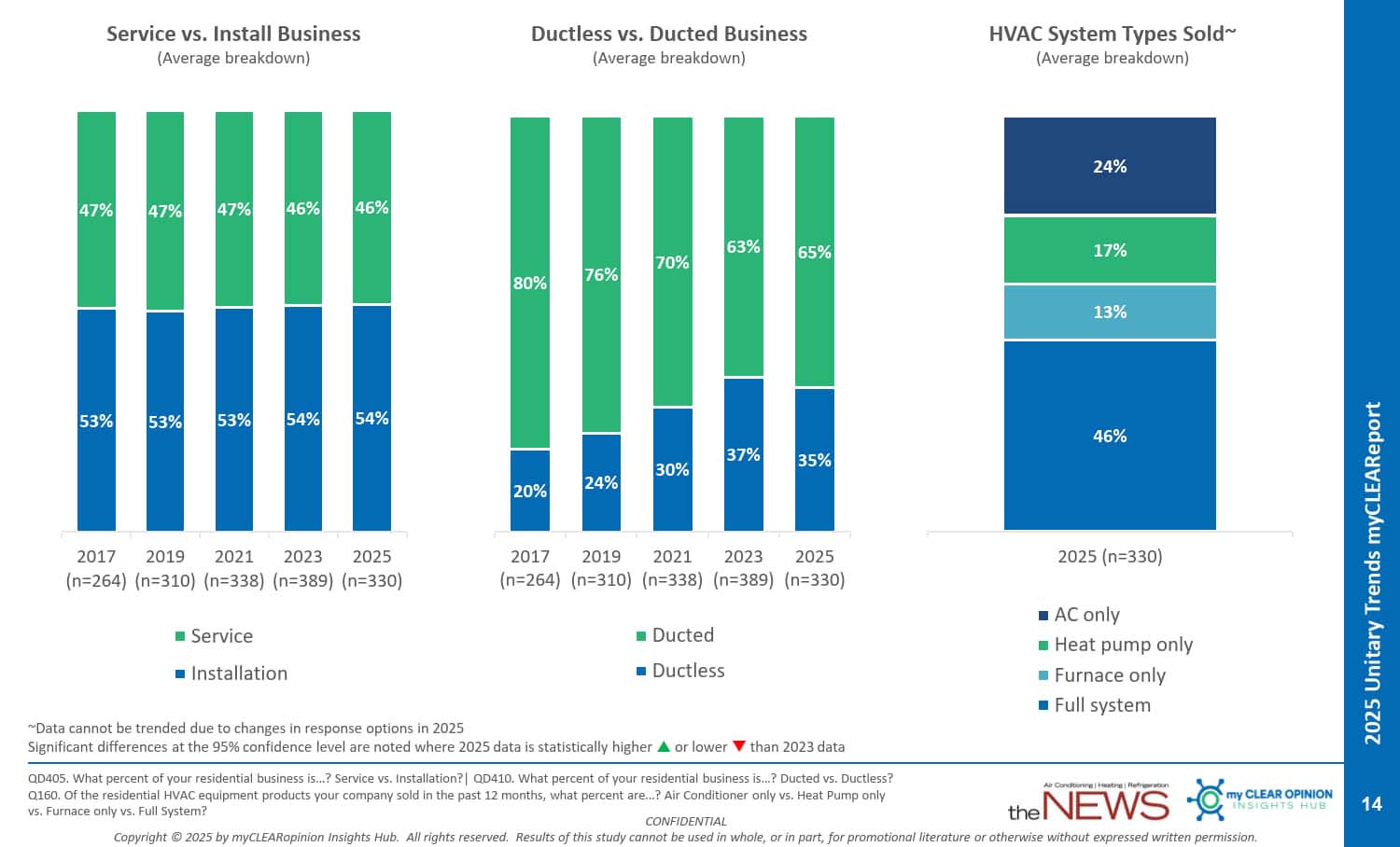
Click chart to enlarge
(Courtesy of myCLEARopinion Insights Hub)
The Whole Kit-and-Kaboodle
Full systems remain 46% of residential and 53% of light-commercial sales, even at a time when many are pinching pennies and opting for repairs. So what’s keeping full-system packages at the center of the market?
Looking for quick answers on air conditioning, heating and refrigeration topics? Try Ask ACHR NEWS, our new smart AI search tool. Ask ACHR NEWS
Looking for a reprint of this article?
From high-res PDFs to custom plaques, order your copy today!

FULL SYSTEK: When it comes to replacements, full-system packages give contractors more control over available rebates/incentives, performance guarantees, and easier communication with homeowners (Courtesy of Midea)
“Full-system replacement is supported by the advancement in equipment and performance, along with the coinciding incentives to lean into more efficient equipment,” Stinson noted. “Manufacturers support those efforts, along with strong dealer support, will continue to experience above share results.”
Rames postulated that full-system packages give contractors more control over available rebates/incentives, performance guarantees, and easier communication with homeowners (i.e., one brand, one warranty, one set of specs).
Here, manufacturers and contractors have the opportunity to proposal-to-install conversion and first-time-fix performance.
“Contractors close more full-system jobs when they can clearly demonstrate value,” Rames said. “Tools that simplify quoting, highlight efficiency and comfort advantages, while integrating financing, making that process smoother and more consistent.”
Training and connected diagnostics also play a big role, Rames added, especially when installers can verify performance in real time to ensure every system is set up right the first time. Communicating systems need to be full systems (ODU, IDU, and wall control).
The takeaway here for the sales team is pretty straightforward — if the first quote isn’t a matched system, performance and program dollars are likely being left on the table.
Light Commercial Business Mix
Average light commercial HVAC business mix has remained relatively unchanged from 2017, with new construction being the main light commercial category.

Click chart to enlarge
(Courtesy of myCLEARopinion Insights Hub)
Residential Business Mix
Based on today’s average residential business mix, most work continues to be led by residential replacement, followed by residential service/repair and residential new construction.

Click chart to enlarge
(Courtesy of myCLEARopinion Insights Hub)
Where Trends Go From Here
Dealing with uncertainty isn’t anything new for the HVAC industry, but this stretch has proven itself to be fairly consequential on multiple fronts.
At a high level, Rames expects heat pump adoption to continue to accelerate in both residential and light commercial as contractors respond to policy incentives and regional electrification goals.
“Ductless growth is likely strongest in add-on, retrofit, and multifamily applications, where partial or space-specific upgrades make sense,” Rames said.
Economic factors and regional climate policies will shape the mix more than technology alone, Rames added, so for manufacturers, flexibility will be key moving forward.
“Platforms that support hybrid or dual-fuel configurations will best align with how contractors are bridging today’s gas and electric mix,” Rames said. “For the time being, fossil fuels have become a viable option again.”
For Stinson, his view is that the market is moving intentionally toward inverter-driven ducted products, which is being driven by the replacement market.
“Incentives, tariffs, and most recently channel inventory will influence that market,” Stinson said.