Contractor Pro Geothermal Series
Outsourcing Geothermal Drilling is Tough When Drillers are Scarce
May 28, 2025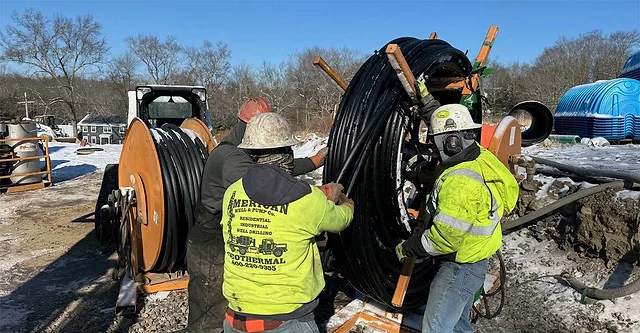
Contractor Pro Geothermal Series
Outsourcing Geothermal Drilling is Tough When Drillers are Scarce
May 28, 2025BULK ORDER: A strategic partnership with a driller could mean hiring a subcontractor to drill 35 or 40 holes over the course of a year, versus chasing down a driller as jobs arise. (Courtesy of American Well & Pump)


Drilling the borefield is a key part of any geothermal HVAC project. For the 70% of HVAC contractors who outsource some or all of their drilling, it can also be one of the hardest — largely because finding a driller to do the work can be a challenge.
According to a new study by myClearOpinion Insights Hub on behalf of ACHR NEWS, powered by Climate Control Group, when HVAC contractors who outsource geothermal drilling were asked about ease of finding a driller, only 2 in 5 said it was easy. Put another way, more than half said it was not.

Click chart to enlarge
When HVAC contractors who outsource geothermal drilling were asked about ease of finding a driller, only 2 in 5 said it was easy. Put another way, more than half said it was not. (Staff image / Data courtesy of myClearOpinion Insights Hub)
Why is it so hard to find drillers?
Jeffrey Williams, president at Spafford & Sons Water Wells in Vermont, has a simple answer: It’s the economics.
The Driller Shortage
Williams has been in the industry for 45 years. His company has 15 people and three drilling rigs, and he gets hired as a subcontractor for geo projects pretty regularly. Generally, it makes up at least 25% of their work.
Problem is, there just aren’t enough drillers to go around, and the drillers that are out there are often working on other, more lucrative projects.
Because that’s the challenge with geothermal HVAC: It’s a set-it-and-forget-it technology, which is great for the customer but also means there’s no recurring revenue built in 15, 20, 25 years down the road for the driller.
“Most of us are not going to see the rebuilding or repair on these systems that we do on residential water wells and commercial pump systems,” Williams explained. “We have pump crews, and we need to keep those crews busy. We need to be able to have those crews available for service work. And when our drill rigs are tied up in a geothermal bore field, we are really giving up future service on that operation.”
Looking for quick answers on air conditioning, heating and refrigeration topics? Try Ask ACHR NEWS, our new smart AI search tool. Ask ACHR NEWS
Looking for a reprint of this article?
From high-res PDFs to custom plaques, order your copy today!
And because of the high upfront cost of geothermal, he said, drillers are always getting pushed to do it for less. (On top of that, the same labor shortage that’s hitting HVAC and the skilled trades is impacting the drilling industry as well.)
“Some of it probably is because [HVAC contractors] don't dare to price the project at a point where they're profitable,” he said. “There's always a money crunch, and some guys just don't tolerate that very well.”
Brock Yordy, co-founder of Geothermal Drillers Association, seconded that assessment.
“The challenge is, predominantly our drilling industry is drilling for other things,” he explained. They're water well drillers, or they're geotechnical and environmental drillers, and their typical customers might be homeowners who haven’t had water in a week.
“So it’s hard to get a driller to come in and do it at such a low rate, when they can go drill a water well and have a customer for the next 25 years.”
Partnering Up
There’s a way for HVAC contractors to overcome that hurdle, and that’s to be friends with a driller.
“It’s finding a drilling contractor and making them a strategic partner,” Yordy said. “Go to them and say, ‘Yes, I have 4 or 5 holes here, but here is how many ground-source heat pumps I want to put in this year,’ or ‘These are the ones that are targeted in your region,’ depending on how big they are, and ask, ‘Would you want to get into a strategic partnership that says you drill 35 or 40 holes for me over the year?’”

PARTNER UP: The surest way for HVAC contractors to make sure they have a driller available for geothermal projects is to form a strategic partnership with drillers locally. (Courtesy of Spafford & Sons Water Wells)
Williams works closely with several local HVAC contractors, and he recommends that approach.
“It’s pretty easy to partner up with anybody that's good at it,” he said. “They need to send profitable work our way and work in a solid partnership with a drilling company, and then the possibilities of getting more done are going to be greatly enhanced.”
Driller selection, said Joe Parsons, senior marketing sustainability manager at Climate Control Group, is easily one of the top three topics when deciding to ‘go geo.’
“Prioritize drilling companies with proven experience in geothermal projects, appropriate licensing, and a strong understanding of local regulations and site conditions,” he said. “Clear communication about project lead times, scope, and expected duration ensures alignment with both the driller and the client, helping to set realistic expectations and avoid delays. Look for drillers who provide transparent contracts, maintain safety standards, and are responsive to questions throughout the project.”
A good driller partner will have the same core qualities as a legacy HVAC company, Yordy said.
“It seems so simple to say, yet I think we get desperate because we're looking so hard for drilling,” he said. “I want my partner to have the same level of professional presence I have — that they're going to treat the yard the same way I would treat the basement or the attic, or our customers, and understand that drilling is disruptive, so it's going to be exponentially noisier. It's going to create waste, it's going to create dust, it's going to alienate the neighbors around us. Ask questions about how you are going to be a good neighbor.”
On-Staff Drillers: Pros and Cons
Among contractors in the ACHR NEWS study, 30% have a driller on staff, 45% outsource all their drilling, and 25% have a driller on staff but still outsource some of the work. Nearly half of contractors without a driller on staff said they’d consider hiring one if/when geothermal HVAC makes up a larger portion of their work, while 39% said hiring a driller is not part of the plan.

Click chart to enlarge
Most HVAC contractors who install geothermal outsource some or all of their drilling work. (Staff image / Data courtesy of myClearOpinion Insights Hub)
That squares with Parsons’ experience.
“HVAC contractors typically avoid hiring a driller on staff due to the high cost of specialized labor, fluctuating demand for geothermal projects, and the significant investment required in drilling equipment and training,” he said. “Hiring a driller in-house gives contractors more control and faster response times, but requires significant investment in equipment, training, and ongoing costs. Outsourcing drilling offers flexibility and lower fixed costs while providing access to specialized expertise, though it can lead to scheduling challenges and less internal knowledge retention.”
If outsourcing becomes a bottleneck or cost-prohibitive, he added, this could trigger a cost-benefit analysis.
Whether the numbers make sense depends on how much geothermal work the contractor is taking on. Hiring a driller is one salary, Yordy said, but next comes a team of 2, 3, 4 people to do that install, “and then the big right hook that comes out of nowhere is that drill rigs start at a half a million dollars, and support equipment is another million dollars.”

Click chart to enlarge
Among contractors who outsource their drilling, percentage of geo work is the biggest factor in whether or not they hire a driller on staff. (Staff image / Data courtesy of myClearOpinion Insights Hub)
In some cases, it might make perfect sense.
“If you're an HVAC company that already is diversified into septics or has their own mini excavators and does all of the outside work, investing in a driller who can also help with that type of work, and purchasing a rig, seems like a value proposition,” Yordy said.
Having a driller on staff can speed up lead time and win jobs — especially retrofits — from customers who otherwise might opt out of geothermal altogether, he said. Picture the options available to a homeowner whose conventional system is out.
“They’re thinking, ‘I can get an air-source heat pump system right now, or in six weeks, I can have a geothermal loop system put in and a ground-source heat pump,’ but it's October, and it's kind of cold at night,” he said. That customer might pass on geo. “But when you have the vertically integrated system, you can sell the service, and you can control your cost.”
Lead Time & Duration
In the study, 40% of contractors said the typical lead time on drilling-related activities in a residential geothermal HVAC installation project is 1-2 weeks, while 32% said 3-4 weeks. For commercial installations, 3-4 weeks is more typical.
Drilling itself typically takes 1-2 days (46%) or 3-5 days (38%) in residential installations, while 3-5 days is more common (40%) on commercial projects, although some (26%) finish in as little as 1-2 days.
Most respondents said delays in a project due to drilling-related issues aren’t common. Only 14% said they ran into them “frequently,” and just 3% “almost always.”
“Lead times depend,” Williams said when asked the same question. “We have one division where the lead time is out probably two months, and the other division up north, we have gone through our work in fairly short order — we've done a good job at being efficient, so our lead time is probably two to three weeks.”




.webp?height=300&t=1783699250&width=300 "LA Heating_Craning moving new hvac condensing unit onto roof (2).jpg")