ACHR News
search
Ask ACHR NEWS AI
cart
facebook twitter instagram linkedin youtube
  • Sign In
  • Subscribe
  • Sign Out
  • My Account
ACHR News
  • NEWS
    • Breaking News
    • New HVAC Products
    • Featured Products
    • Manufacturer Reports
    • HVAC Data
    • Legislation
    • ACHR NEWS Centennial
  • RESIDENTIAL
    • Air Conditioners
    • Furnaces
    • Residential Heat Pumps
    • Ductless
    • Residential IAQ
    • Testing, Monitoring, Tools
    • Components & Accessories
  • COMMERCIAL
    • Air Handlers
    • Rooftop Units
    • Chillers and Cooling Towers
    • Commercial Heat Pumps
    • Boilers and Hydronics
    • VRF/Ductless
    • Commercial IAQ
  • REFRIGERATION
    • Refrigerants
    • Refrigerant Regulations
    • Leak Management
  • CONTRACTOR PRO
    • Geothermal
    • Homeowner Study
    • VRF and VRV Ductless
    • Unitary Trends
  • EDUCATION
    • Training and Education
    • Business Management
    • Service and Maintenance
    • Continuing Education
    • Market Research >
      • HVAC Brand Awareness Report
      • VRV, VRF, VRVZ Report
      • Unitary Trends Report
      • Water Heat Professionals Report
    • Webinars
    • Sponsor Insights
    • eProducts Info
    • White Papers
  • EVENTS
    • HVAC Contractor Forum
    • Industry Events and Webinars
  • MEDIA
    • Videos
    • AHR Expo 2025 Videos
    • Podcasts >
      • ACHR News Podcast
      • HARDI Podcasts
      • AHR Expo Podcasts
      • ACCA Podcasts
    • Interactive Spotlights
    • Quizzes
    • eBooks
    • HVAC Talkback
  • HVAC GROUP
    • ACHR NEWS >
      • Current Issue
      • Digital Edition
      • Subscribe
    • Distribution Trends
    • SNIPS NEWS >
      • Join SNIPS NEWS
    • Engineered Systems News >
      • Join ES News
    • HVACR Directory
    • Contests
    • Newsletters
    • Contact
    • Advertise
    • My Account
NewsTechnicalComponents & AccessoriesCompressors

How to Measure Net Oil Pressure

Many larger refrigeration and air conditioning systems have oil pumps
By John Tomczyk
Refrigeration and air conditioning compressors.

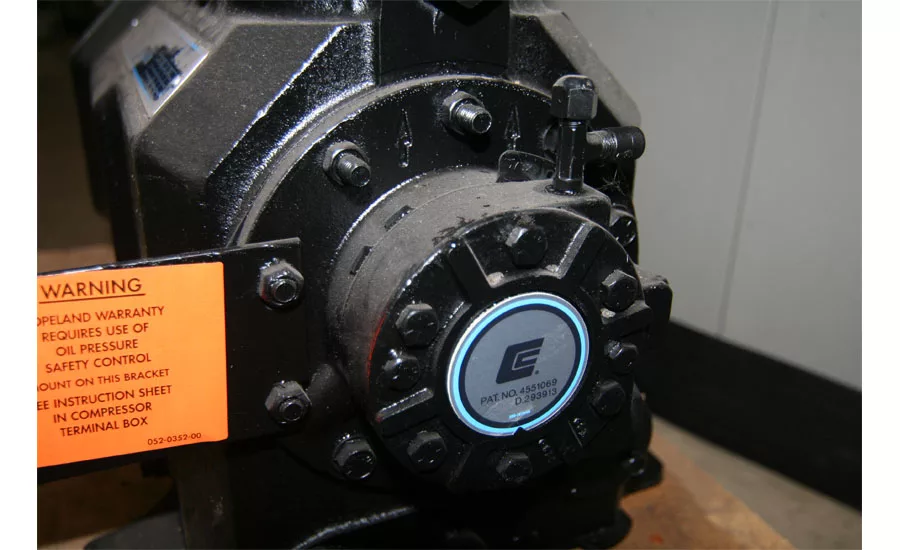
FIGURE 1 - PUMP LOCATION: Refrigeration and air conditioning compressors with forced oiling systems contain an oil pump located at the end of the compressor’s crankshaft. (Photo courtesy of Ferris State University)

November 24, 2021
✕
Image in modal.

Many larger refrigeration and air conditioning compressors — usually over 5 horsepower — have forced oiling systems. These compressors contain an oil pump located at the end of the compressor’s crankshaft (see Figure 1, top). The crankshaft is actually connected to the oil pump and supplies power, which turns the oil pump. The oil pump is keyed into the compressor’s crankshaft.

Oil pumps force oil through drilled holes or oil galleys in the crankshaft and deliver it to bearings and connecting rods. The oil then drops to the crankcase to be filtered and picked up again by the oil pump. Smaller compressors usually have some sort of splash-type oiling system. These systems may have an oil scoop that scoops and flings the oil throughout the crankcase, causing an oil fog as the crankshaft rotates.


Net Oil Pressure

Oil pumps can be of the gear or eccentric type. Gear-type oil pumps usually have a star gear that actually squeezes the oil to a higher pressure. The added pressure that the star gear puts into the oil can be referred to as the net oil pressure. Remember that the oil pump picks up the oil from the compressor’s crankcase (under crankcase pressure), adds pressure to the oil, and then delivers the oil into drilled holes or galleys in the crankshaft to be delivered to bearings and connecting rods.

Eccentric-type oil pumps use an eccentric type of mechanism to also squeeze the oil to a smaller and smaller volume, which adds pressure to the oil. Again, this squeezing action by the eccentric adds pressure to the oil, and this added pressure is referred to as net oil pressure.

When dealing with compressors that employ an oil pump, many service technicians confuse net oil pressure with oil pump discharge pressure. It is of the utmost importance that service technicians understand the difference between these two pressures when servicing compressors with oil pumps.

As mentioned earlier, the oil pump’s rotating gear or eccentric adds a certain pressure to the oil pumped through the crankshaft. This pressure is considered net oil pressure. Net oil pressure is not the pressure that can be measured at the discharge of the oil pump. The oil pump picks up oil (at crankcase pressure) from the compressor’s crankcase through a screen or filter. The oil pump discharge port’s pressure includes both crankcase pressure and oil pump gear pressure it adds to the oil. This is why net oil pressure cannot be measured directly with a gauge. A gauge at the oil pump’s discharge port would register a combination of crankcase pressure and oil pump gear pressure. The technician must realize this and subtract the crankcase pressure from the oil pump discharge port’s pressure to get the net oil pressure, as shown in the below equation:

(Oil pump discharge pressure) - (Crankcase pressure) = (Net oil pressure)

Net oil pressure is simply the pressure put behind the oil from the oil pump’s star gear or eccentric. For example, if the oil pump discharge pressure is 65 psig and the crankcase pressure is 15 psig, what would be the net oil pressure? The solution is to simply subtract the crankcase pressure from the oil pump discharge pressure to get net oil pressure:

(65 psi) - (15 psi) = 50 psi net oil pressure

Looking for quick answers on air conditioning, heating and refrigeration topics? Try Ask ACHR NEWS, our new smart AI search tool. Ask ACHR NEWS →

This means the oil pump’s star gear or eccentric is actually putting 50 psi of pressure into the oil when delivering it into the crankshaft’s drilled passages. This is why oil safety controllers are called differential-type controllers: They sense the difference between oil pump discharge pressure and crankcase pressure. These controllers have a capillary tube or pressure transducer connected to the discharge of the oil pump and the crankcase in order to sense the difference of pressures or net oil pressure (see Figure 2, below).

Figure Two: Oil Safety Controller.

FIGURE 2 - PRESSURE DIFFERENCE: Oil safety controllers have a capillary tube or pressure transducer connected to the discharge of the oil pump and the crankcase in order to sense net oil pressure. (Image courtesy of Ferris State University)

Net oil pressures usually range from 20 to 40 psi and vary from compressor to compressor. Most oil pressure safety controllers will shut down the compressor if the net oil pressure falls below 10 psi. Variables that affect the net oil pressure include:

  • Bearing clearance;
  • Viscosity of the oil;
  • Temperature of the oil; and
  • Compressor size.

Larger compressors need more net oil pressure, because they have more surface areas to lubricate. The oil pumps must also pump and carry the oil greater distances within the larger compressor. Also, as the oil gets hotter and its viscosity drops, the net oil pressure will also usually drop. As a compressor wears, its tolerances will become greater and easier for the oil to escape through its clearances.


Oil Safety Controller

The oil safety controller has a 2-minute time delay, which helps prevent nuisance trips. There are often times when the crankcase may have liquid refrigerant in it from an imperfect system. The 2-minute delay gives the crankcase time to clear any unwanted refrigerant during periods when refrigerant migration and/or flooding has occurred. It also avoids shutdowns during short fluctuations in net oil pressure on startups. Some of the causes why an oil safety controller may shut down a compressor include the following:

  • Wrong oil in the compressor;
  • Worn bearings or connecting rods;
  • Excessively hot oil (low viscosity);
  • Oil pump malfunction;
  • Low oil level in crankcase;
  • Old compressor (3-phase reversal);
  • Broken oil line or blown gasket;
  • Clogged oil screen or strainer; and
  • Oil pressure safety controller malfunction.

Before servicing any refrigeration or air conditioning systems that contain an oil pump, technicians should make sure they understand the difference between net oil pressure and oil pump discharge pressure.

KEYWORDS: air conditioning systems compressor technology FROSTlines pumps refrigeration systems

Share This Story

Looking for a reprint of this article?
From high-res PDFs to custom plaques, order your copy today!


John Tomczyk is HVACR professor emeritus, Ferris State University, Big Rapids, Michigan, and coauthor of Refrigeration & Air Conditioning Technology, published by Cengage Learning. Contact him at tomczykjohn@gmail.com.

Recommended Content

JOIN TODAY
To unlock your recommendations.

Already have an account? Sign In

  • HVAC-enrollment

    The Trades Are Back: HVACR Programs See Nearly 30% Enrollment Spike

    A new wave of future technicians is entering the pipeline.  
    News
    By: Matt Jachman
  • 2025 Top 40 Under 40

    2025 Top 40 Under 40 HVACR Professionals List

    The 11th annual Top 40 Under 40 list highlights those...
    HVAC Residential Market
    By: Hannah Belloli-Oster
  • LG Ductless Mini-Split Systems

    The 9 Types of Heat Pumps

    As the U.S. moves toward electrification, heat pumps are...
    Heat Pumps
    By: Joanna R. Turpin
Subscription Center
  • Create an Account
  • Start a Subscription
  • Manage My Account
  • Sign Up for Newsletters
  • Visit Customer Service
  • Update Preferences

More Videos

Sponsored Content

Sponsored Content is a special paid section where industry companies provide high quality, objective, non-commercial content around topics of interest to The News audience. All Sponsored Content is supplied by the advertising company and any opinions expressed in this article are those of the author and not necessarily reflect the views of The News or its parent company, BNP Media. Interested in participating in our Sponsored Content section? Contact your local rep!

close
  • An illustration shows a house with a geothermal heating system. Pipes are depicted running underground.
    Sponsored byClimateMaster

    Residential Tax Credits Are Ending, But Demand Continues

  • Piggy Bank
    Sponsored byWatercress Financial

    Energy Prices, Inflation, and HVAC: What Today’s Homeowners Care About

  • Refrigerated Food
    Sponsored bySolstice Advanced Materials

    R-455A Refrigeration: A Cold Storage Solution for the Future

Popular Stories

price-raising-practices.jpg

Rising Costs Force Contractors to Take a Harder Look at Pricing

New-HVAC-Equipment.jpg

Amended Complaint Filed in HVAC Price-Fixing Lawsuit

DOE-sign.jpg

HVAC Groups Support DOE’s Rulemaking to Cut Energy Efficiency Mandates

Data-Center-Inspection.jpg

Can HVAC Train Enough Technicians for the Data Center Boom?

HARDI lolgo navy

HARDI Distributors' Sales Down Nearly 5% in May

View The ACHR NEWS
Centennial Anniversary Timeline

The ACHR News Timeline Chart
Submit a Letter
Submit a letter to our editors.

Events

November 6, 2025

Next-Gen Data Center Cooling: HVAC Innovation and Real-World Solutions

On Demand As AI workloads and high-density computing push traditional cooling methods to their limits, the data center industry is accelerating the adoption of next-generation HVAC technologies.

July 22, 2026

Designing VRF Systems Using A2L Refrigerant

In this session, we will cover how to design VRF systems for the U.S. market using new A2L refrigerants. These systems provide an advanced zoning solution by using inverter technology to deliver precise heating and cooling control across multiple zones and spaces.

View All Submit An Event

Poll

Summer Staff

Are you fully staffed for the summer season?
View Results Poll Archive

Products

BNI Mechanical/Electrical Square Foot Costbook, 2026 Edition

BNI Mechanical/Electrical Square Foot Costbook, 2026 Edition

See More Products
Designing Systems Using A2L Refrigerant - Free Webinar - 7/22/2026

Related Articles

  • The Professor: Oil Pumps and Net Oil Pressure

    See More
  • The Professor: Net Oil Pressure

    See More
  • Net Oil Pressure Vs. Discharge Pressure

    See More

Related Products

See More Products
  • front cover only.jpg

    How to Market Your HVAC Business

  • pewtpm.png

    Pressure Enthalpy Without Tears Manual

  • Manual Q.jpg

    Manual Q - Low Pressure, Low Velocity Duct System Design

See More Products

Related Directories

  • measureQuick®

    measureQuick is an application that technicians use to display measurements from arrayed smart tools, run equipment diagnostics, view just-in-time education and resources, generate easy-to-read homeowner-facing PDF reports and more.
  • Howe Corp.

    Howe manufactures flake ice making equipment for use with virtually any refrigerant including natural such as R-744, and R-717, Ice storage bins, Condensing units for our ice flakers.
×

Sign Up. Stay Informed.

The #1 trusted source for the HVACR industry since 1926

SUBSCRIBE
  • RESOURCES
    • Advertise
    • Contact Us
    • Advisory Board
    • Classifieds
    • Submit a Letter
    • Directories
    • Store
  • ACCOUNT CENTER
    • Create an Account
    • Start a Subscription
    • Manage My Account
    • Sign Up for Newsletters
    • Visit Customer Service
    • Update Preferences
  • SERVICES
    • Marketing Services
    • Reprints
    • Market Research
    • List Rental
    • Survey/Respondent Access
  • STAY CONNECTED
    • LinkedIn
    • Facebook
    • Instagram
    • YouTube
    • X (Twitter)
  • PRIVACY
    • PRIVACY POLICY
    • TERMS & CONDITIONS
    • DO NOT SELL MY PERSONAL INFORMATION
    • PRIVACY REQUEST
    • ACCESSIBILITY

Copyright ©2026. All Rights Reserved BNP Media, Inc. and BNP Media II, LLC.

Design, CMS, Hosting & Web Development :: ePublishing