The First 10 Minutes Are Critical in an Ammonia Release
Knowing what not to do is just as important as knowing what to do
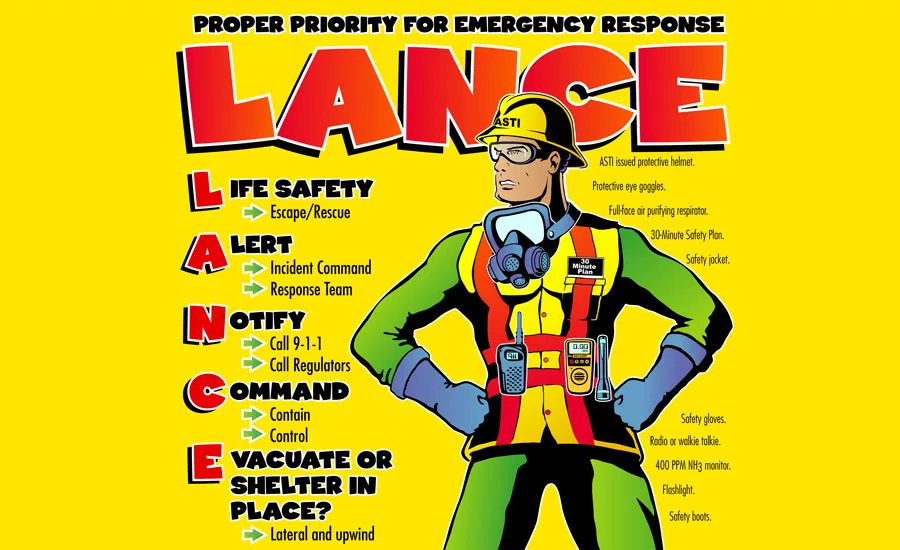
LANCE AND SIMPLE: Remember these mnemonics to help you prioritize your actions in the event of an ammonia release: first LANCE, then SIMPLE. GRAPHICS COURTESY OF THE AMMONIA SAFETY & TRAINING INSTITUTE
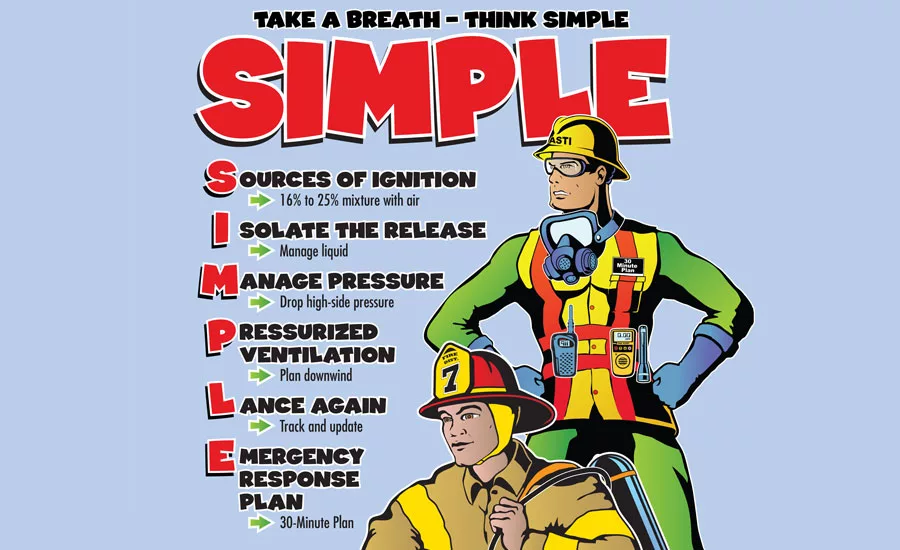
LANCE AND SIMPLE: Remember these mnemonics to help you prioritize your actions in the event of an ammonia release: first LANCE, then SIMPLE. GRAPHICS COURTESY OF THE AMMONIA SAFETY & TRAINING INSTITUTE
The steps taken in the first 30 minutes of a leak at an ammonia refrigeration facility can make the difference between containment and catastrophe, according to Rex Brown, former chairman of the board of Alta Refrigeration.
Ammonia is at its most dangerous state when it is a high-pressure liquid at ambient temperature, so Brown stressed the importance of immediately reducing and minimizing all heat loads that can evaporate liquid ammonia, using the system’s compressors to control the pressures, and moving the liquid ammonia out of the plant, in that order.
“When you evaporate ammonia it raises the system’s pressures,” he said. “Then you have to turn around and recondense that evaporated ammonia. This adds more heat load to the condenser and further raises the pressures. The compressors are the best tools you have to control the pressures in the system.
“When you stop putting heat into the refrigeration system, the condenser has to reject less heat, and the pressures go down automatically,” Brown added. “It’s very simple and yet people sometimes can’t see the forest for the trees and make it more complicated than it needs to be.”
The end goal, he noted, is to reduce the release rate, transfer the ammonia out of the evaporators, and collect it in the insulated vessels in the equipment room as quickly as possible. There it can be cooled down to minus 28°F, at which point it will become dormant.
“The initial response is a combination of being book-smart and street-wise,” Brown said. “The goal is to stop the release of refrigerant out of the system. Interrupting the internal flow of the refrigerant within the system by reducing pressures is often the best and most effective approach to quickly reduce the release rate. Knowing what not to do is often as important as knowing what to do. Do not shut down any compressors unless it is apparent a compressor is about to self-destruct or deflagration concentrations are about to occur in the machine room.”
TAKE THESE STEPS
Brown said a few steps, taken quickly, can help reduce the release rate by reducing the system’s heat load and bringing down its pressures in an emergency.
Looking for quick answers on air conditioning, heating and refrigeration topics? Try Ask ACHR NEWS, our new smart AI search tool. Ask ACHR NEWS
The first thing to do is to eliminate heat input. This means stopping all evaporator and pump motors associated with low-side coils or heat exchangers.
“All of your heat load won’t immediately go away, but this step allows the compressors to start cooling off the liquid ammonia in the evaporators,” Brown noted.
Next, set the compressor capacity controls to maintain a system pressure of about 1 psi. Brown cautioned not to take the system down into vacuum because, depending on the location of the leak, you risk sucking air into the system. That air would be immediately transferred by the compressors into the condensers and could create high pressures on the high side of the system.
“Eliminating the heat load and stabilizing the compressor capacity controls gives you some breathing room to identify the location of the leak and assess the situation,” he said.
In the refrigerated area, disable all the evaporators, and:
- Turn off all fan and pump motors;
- Close the hot gas defrost valves;
- Close the liquid valves; and
- Open the suction valves (if possible).
“Basically, you want to lower the pressure in all the evaporators,” Brown explained. “If it’s in a refrigerated area, you want to get those pressures down to zero psi. Even if there’s still residual liquid in the coils in a refrigerated space, if you get it down to zero psi, you don’t have a leak anymore.”
In the machine room, isolate all refrigerant lines supplied to plant:
- Turn on all condenser fans and pumps;
- Isolate the main hot gas defrost line;
- Isolate all high-pressure liquid lines. (Note: Be aware not to trap liquid between the main isolating valve at the engine room and the evaporator valves);
- Drain all liquid lines to insulated vessels;
- Stop all refrigerant pumps;
- Stop any other motors associated with the low side; and
- Set compressor suction control to 1 psig.
Brown added that throughout all of these steps, ammonia is constantly being removed from the evaporators in the plant.
“If the plant is properly designed and the refrigerant lines slope from the furthest evaporator back to the machine room, when you stop the pumps and any motors associated with the low side of the system, it is possible to drain all the liquid lines from the plant back into the machine room just by reducing the system pressure to zero psi,” Brown noted.
If the release is in the machinery room, make sure to turn on all the exhaust fans.
“I always like to have 100 percent redundancy on the exhaust fans,” Brown said. “Then, if you have a true emergency, you can always run twice the cfm.”
Brown suggested looking at your plant and determining how you can apply these principles to get the situation under control in the first 10 minutes and minimize the risk of a large ammonia release.
“The whole idea is to recover as much liquid ammonia as you can in the initial process,” he said. “Use the compressors because they’re the most effective tools you have. Once you minimize the heat load, you have all the available capacity from the compressors that can be used to cool down the refrigerant so you can store it. Reduce the system pressures, cool off the liquid ammonia, transfer it into those insulated vessels, and then you can go in and identify and repair the leak.”
REMEMBER THESE LETTERS
The Ammonia Safety Training Institute (ASTI) has devised two mnemonics to help in the initial response to ammonia leak.
Scott Melton, ASTI training coordinator, shared them with The NEWS.
The first is LANCE.
L = Life safety. This always comes first;
A = Alert. Alert people in your facility we have a problem;
N = Notification. Notify the proper authorities that you need help;
C = Contain and command. Take control of the situation; and
E = Evacuate and/or shelter in place.
Then, move on to SIMPLE.
S is for source of ignition. Is the ammonia level high enough to ignite, and is there a source of ignition? If so, work quickly to determine how to shut down the leak and reduce the level.
I and M are for isolate and manage pressure. “What you do here depends on your system and event, because every release and every shutdown is site-specific and leak-specific,” Melton said. “Your moment in time is going to determine your actions.”
P is for positive ventilation.
L is for life safety. It was the first step in LANCE and bears repeating here because none of the other steps matter if life safety isn’t being taken care of.
E is for your emergency response plan, which every facility should have.
Melton encouraged anyone running an ammonia refrigeration facility to perform thorough pre-emergency readiness planning. This means involving everyone on the team in preparedness planning so they know what to do and why they’re doing it. He also suggested creating a step-by-step emergency playbook.
“In this industry, we have good shutdown procedures and very capable people to implement those procedures, but it can be difficult to think clearly in an emergency situation,” he said. “Simple playbooks and checklists can help guide responders in an emergency.”
Publication date: 7/3/2017
Want more HVAC industry news and information? Join The NEWS on Facebook, Twitter, and LinkedIn today!
Looking for a reprint of this article?
From high-res PDFs to custom plaques, order your copy today!


