Linking Up the Cold Chain
Global Cold Chain Alliance co-locates its inaugural expo with FMI Connect
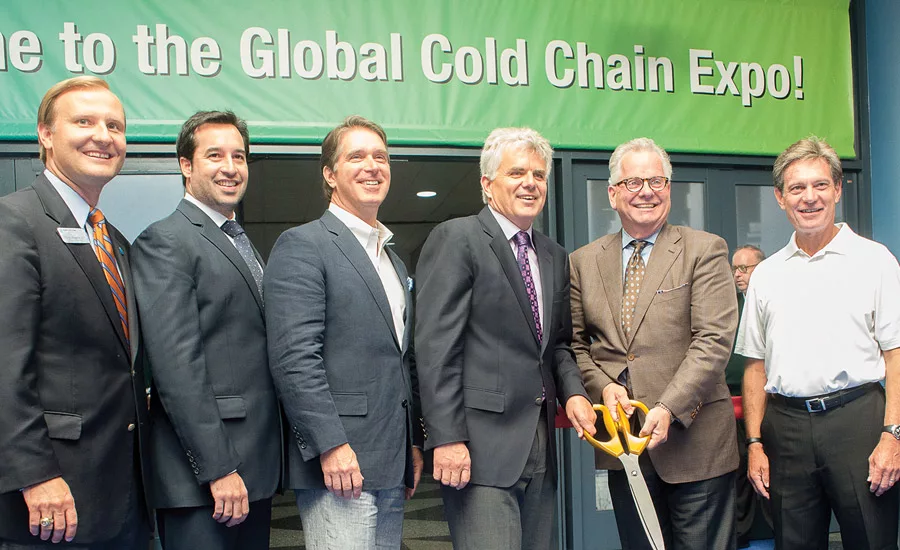
RIBBON CUTTING: Preparing to cut the ribbon on the inaugural Global Cold Chain Expo are (from left to right): Corey Rosenbusch, GCCA; Fabio Fonseca, World Food Logistics Organization; Brian King, International Association for Cold Storage Construction; Eben James, International Association of Refrigerated Warehouses; Tony Freytag, United Fresh Produce Association (United Fresh); and Matt Luckas, International Refrigerated Transport Association.
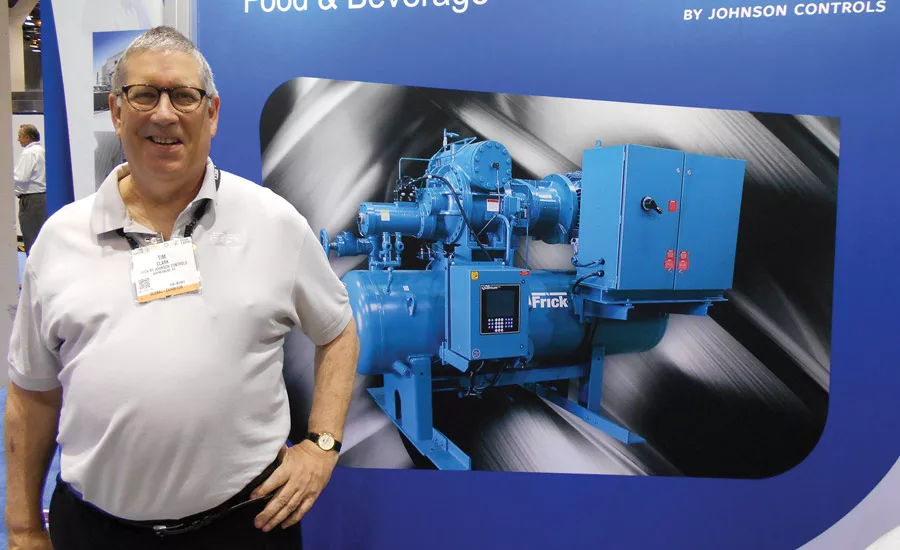
TIP OF THE CAP: Tim Clark, director, engineered control solutions, North American industrial refrigeration, Johnson Controls Inc., said only the best refrigeration contractors are surviving in this era of shrinking margins.
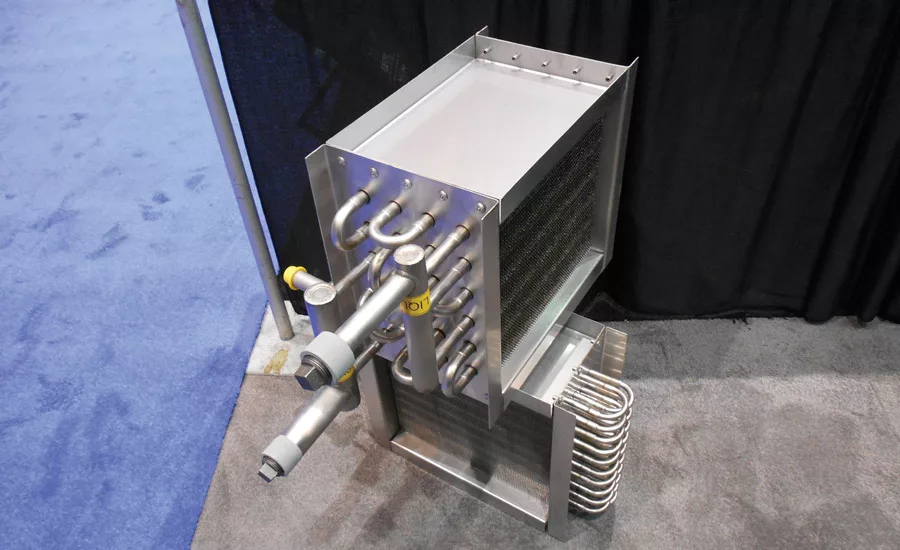
HIGH-PRESSURE COILS: Colmac Coil Mfg. Inc. displayed its all-welded, stainless-steel coils. The coil on the bottom, designed for CO2 systems, can handle a pressure of 2,000 psi.
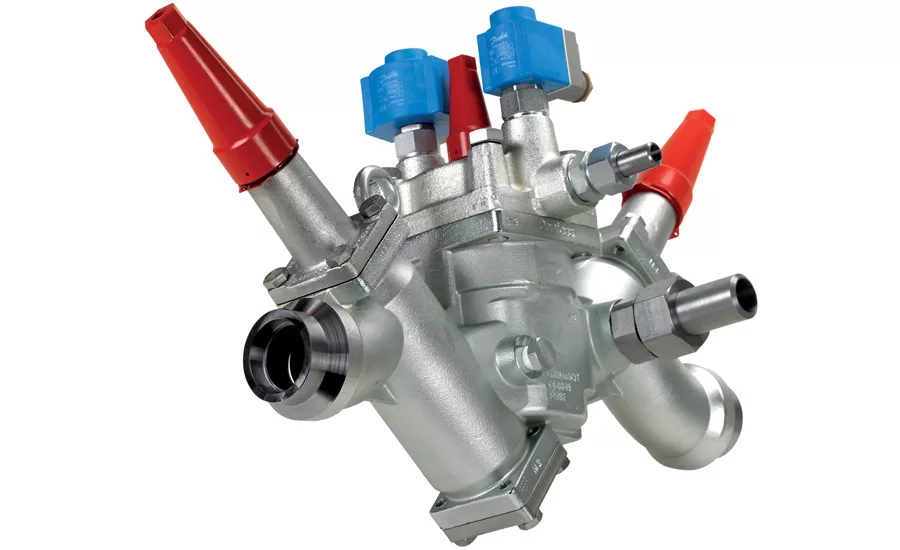
COMPACT VALVE: The Danfoss ICF Flexline valve was introduced at this year’s inaugural Cold Chain Expo.
The cold chain — the temperature-controlled supply chain that’s required to help ensure the safety and extended shelf life of products, such as produce, frozen food, meat, and seafood — is vital to human health. Increasing regulations — most notably the Food and Drug Administration’s Food Safety Modernization Act — have brought a renewed focus to food safety and the crucial role refrigeration plays in it.
That growing importance was highlighted in June as the Global Cold Chain Alliance (GCCA) for the first time held its expo as a separate entity co-located with the Food Marketing Institute’s (FMI’s) Connect Expo and the United Fresh show.
“It’s very exciting to be in our inaugural year and to bring together all the cold chain suppliers in one location,” said Corey Rosenbusch, president and CEO, GCCA. “The cold chain is a growing industry and by co-locating with FMI and United Fresh, we have 14,000 people under one roof. It’s a great opportunity to highlight the cold-chain industry and the importance it plays in keeping food safe.”
Rosenbusch added that although GCCA members have primarily used ammonia refrigeration systems in their large-scale distribution centers, the industry is preparing for change.
“Refrigerant types are shifting quite a bit,” Rosenbusch told The NEWS. “Ammonia is under very strict regulations from the Occupational Safety and Health Administration [OSHA] so there’s a great deal of interest right now in moving to other types of systems, such as low-charge ammonia systems, cascade systems, or those that use natural refrigerants, such as CO2. We know that change is coming, and we’re preparing for it.”
LOW-CHARGE TREND
Jeremy Olberding, vice president of sales, Colmac Coil Mfg. Inc., said ammonia will remain the refrigerant of choice for cold-storage warehouses, but believes smaller systems will begin embracing lower-charge refrigerants.
“The trend this year is definitely low-charge ammonia,” he said. “We’ll still be using ammonia as a refrigerant but trying to get a lower inventory. There are a number of ways to do it — we’re seeing mainly direct-expansion systems or liquid overfeeds using a reduced recirc rate.”
Looking for quick answers on air conditioning, heating and refrigeration topics? Try Ask ACHR NEWS, our new smart AI search tool. Ask ACHR NEWS
Olberding also predicted that packaged ammonia equipment will become more popular.
At the event, Colmac reps displayed the company’s welded stainless steel coils for CO2 systems. The coils feature small-diameter, high-pressure tubes that Olberding said offer higher-pressure capabilities than standard copper construction.
“If it’s going to be ammonia, it’s going to be low-charge,” said Caleb Nelson, vice president, business development, Azane Inc.
That doesn’t mean people are going to be doing retrofits on existing industrial refrigeration plants, but low-charge will be the choice for new construction or to add capacity.
“On the industrial refrigeration side, everyone is hearing talk about the U.S. Environmental Protection Agency [EPA] and Occupational Safety and Health Administration [OSHA] upping their regulations and increasing fines related to safety issues with systems that contain more than 10,000 pounds of ammonia,” Nelson told The NEWS. “That’s kind of the kicker for those looking to reduce charge.”
For new facilities, low-charge systems are being discussed to see how they stack up in terms of costs and efficiency, and they are often good options for expansions, Nelson added.
“Where an existing central room is tapped out, or if it’s old and the owners really don’t want to tweak it, they’re definitely looking for low-charge solutions to add capacity,” he said.
Low-charge ammonia also is being used to replace hydrofluorocarbon (HFC) systems, Nelson said.
“In California, some of the proposed HFC phaseout legislation has many people examining their options, and low-charge ammonia is definitely on the table since it meets the state’s proposed requirement to be under 150 GWP [global warming potential] for refrigeration and 750 GWP for air conditioning,” he said. “There are not many approved options that meet that criteria outside of a natural refrigerant like ammonia.”
Tim Clark, director, engineered control solutions, North American industrial refrigeration, Johnson Controls Inc., agreed that given the current OSHA standards regarding ammonia, there’s a trend to push for something different, but I don’t think there’s a great solution right now other than ammonia for these same applications, he said.
“There is some focus on smaller-charge systems and cascade systems, in which you have a small charge of ammonia mated to a brine or CO2 system that’s distributed throughout a facility,” Clark said. “But you pay a cost in efficiency in those systems, and my impression is efficiency is still very important. So, despite increasingly stringent standards, we’ll see ammonia around for a long time.”
Frick by Johnson Controls displayed its Quantum Unity System Controller, which Clark explained is an evolution of the company’s Quantum HD microcontroller that’s particularly well-suited to the retrofit refrigerated warehouse market.
“The Quantum Unity System Controller combines machine room control, vessel control, and condenser control all on the same panel,” Clark said. “We also offer centralized evaporator control, and we can handle distributed control of evaporator systems, as well. Each distributed panel can handle three evaporator systems or room systems, and the system on one controller can handle 10 panels, so if we then offer a second evaporator controller on the system, we can control up to 60 units on the same system.”
Clark concluded with a tip of his cap to refrigeration contractors who, often with little fanfare, are making the cold chain work domestically and globally.
“I think refrigeration contractors are in a really tough environment of shrinking margins, and it’s very competitive,” he said. “Fewer contractors are specializing in capital projects; they’re doing a lot more service. Only the best are surviving these days.”
REGULATORY PUSH TO NATURALS
Heatcraft Worldwide Refrigeration is introducing systems that use natural refrigerants in addition to its traditional HFC product offerings because that’s the direction the regulatory agencies, such as the EPA and the California Air Resources Board, are pushing the industry, according to Mark Dutton, senior manager of product management.
“Our suspicion is that the regulatory agencies are driving toward the use of naturals with GWPs of less than 150,” Dutton said. “When it comes to HFCs — even low-GWP HFCs — what we’re seeing in the refrigerant regulations is a shorter cycle between when a refrigerant is listed as acceptable to when it is delisted in certain applications. For example, the R-407 Series refrigerants have only been on the market a couple of years, and the EPA is already proposing to delist them in the near future. The regulatory agencies continue to change the refrigerant landscape, and that’s a trend that hits close to home.”
Marc-André Lesmerises, president of Carnot Refrigeration, believes the refrigerant of the future will be carbon dioxide.
“We believe in CO2’s characteristics,” Lesmerises said. “We have more than 100 CO2 refrigeration systems in operation in Canada, and we see the benefit of transcritical CO2 in a large number of applications.”
According to Lesmerises, CO2 systems, when compared to ammonia systems, require less material for installation and offer a reduction in life cycle energy consumption. CO2 systems with multiple compressors also offer good redundancy, he added.
“CO2 systems offer material savings, less labor costs to install, and ongoing operational savings,” Lesmerises said. “Over time, those three things — material, labor, and energy — will always continue to grow in cost. So saving on all three of those with a CO2 system just becomes better and better over time.”
Lesmerises acknowledged but dismissed concerns over the high pressure at which CO2 systems operate.
“It’s a high-pressure system, but there’s a relief system and the components are built to handle even higher pressures, so we feel really comfortable with it,” he said.
STAY FLEXIBLE
Joe Sanchez, engineering manager, Bitzer US Inc., urged contractors and technicians to stay flexible in this era of ongoing change.
“Don’t become too focused on your specific knowledge and approach. Rather, keep your ear to the ground and look at the entire industry’s perception of what’s going to happen, because many times perception becomes reality,” Sanchez said. “Things are happening quickly. We’re seeing more and more proposals becoming law, and we’re seeing it every year.”
Sanchez added that the joint GCCA/FMI/ United Fresh Expo illustrates a concept he has been talking about for years: a closer alignment of the commercial and industrial refrigeration sectors.
“Bitzer has traditionally been a commercial and industrial supplier, and one of the things we’re seeing change in the industry is ammonia is getting smaller, and that’s really driving it toward more commercial applications,” Sanchez told The NEWS. “CO2, because of its high volumetric cooling capacity, naturally blends the two worlds. So, I talk a lot of this merger of industrial and commercial into an ‘Industrommercial’ Age that we’re moving into, and a conference like this really illustrates that. You’ve got commercial upstairs with FMI and United Fresh and industrial downstairs with GCCA.”
Danfoss celebrated the inaugural Cold Chain Expo by using the show to introduce its new ICF Flexline™ valve types: a DN 50 (2-inch) valve with four modules and a DN 65 (2.5-inch) valve with three modules. According to Danfoss reps, the new and larger ICF valves allow for faster and easier system design and installation, and significantly reduced service and operation costs, due in part to their compact dimensions and minimum number of welds.
Danfoss also featured the ICV (H)A4A, a new control valve with flanges. Reps insist the valve’s modular design extends the lifetime of any existing refrigeration installation while delivering a reduction in cost, energy, and service and maintenance times.
Publication date: 8/22/2016
Want more HVAC industry news and information? Join The NEWS on Facebook, Twitter, and LinkedIn today!
Looking for a reprint of this article?
From high-res PDFs to custom plaques, order your copy today!