Hydronics Zone: Radiant Provides Year-Round Comfort
Radiant cooling opportunities await but they must be done right
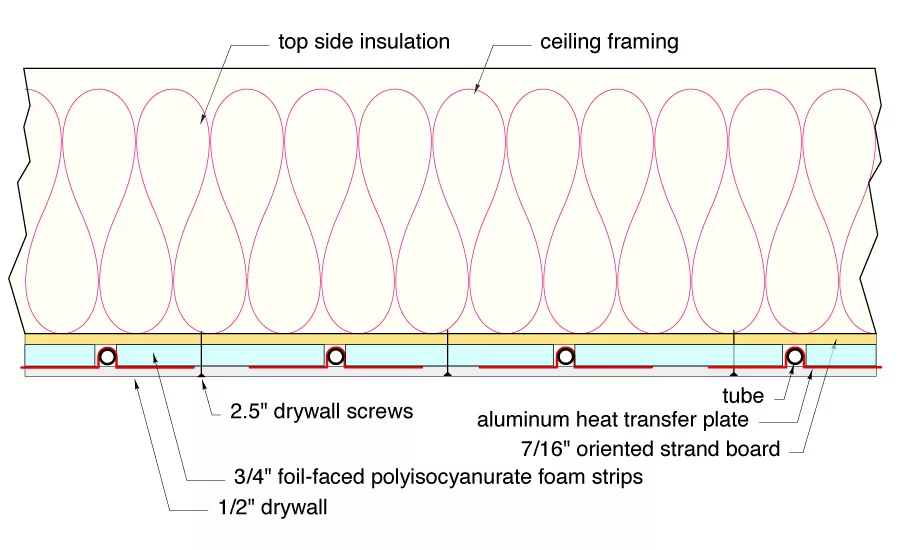
Figure 1
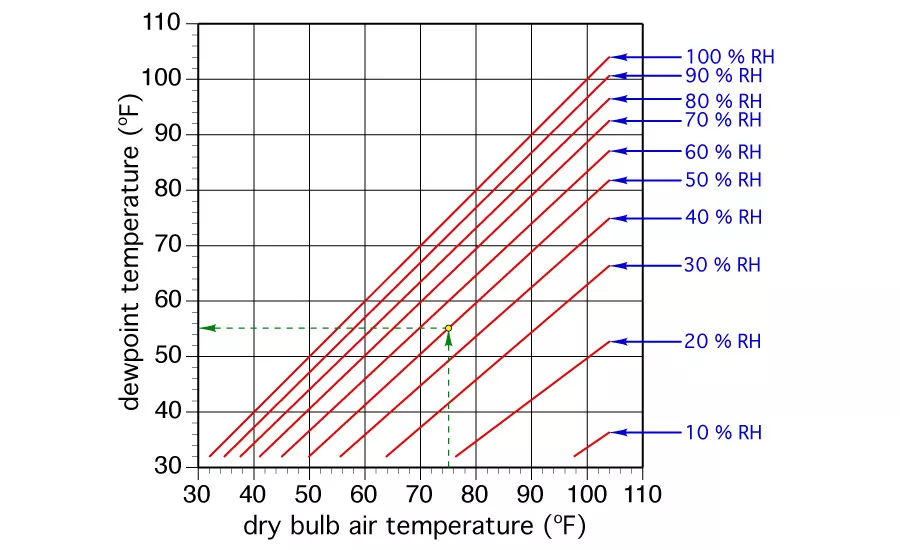
Figure 2
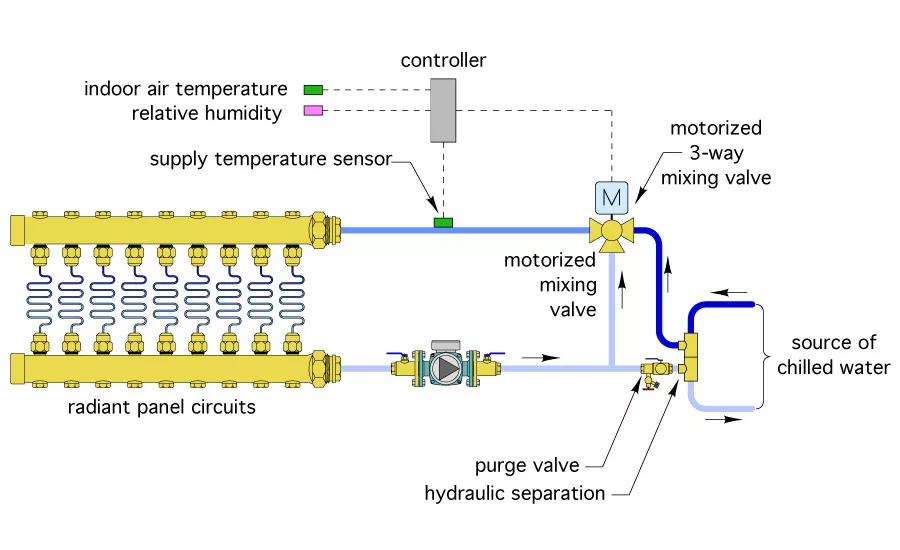
Figure 3
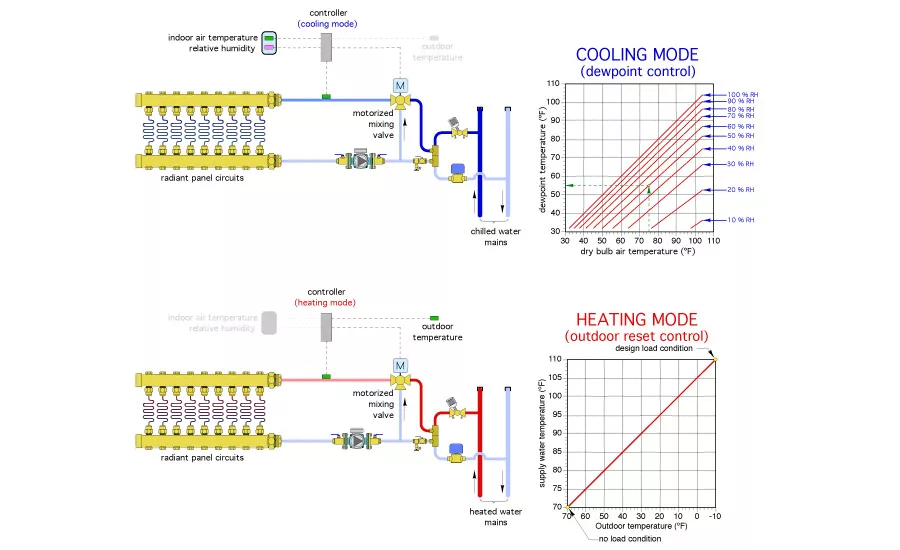
Figure 4
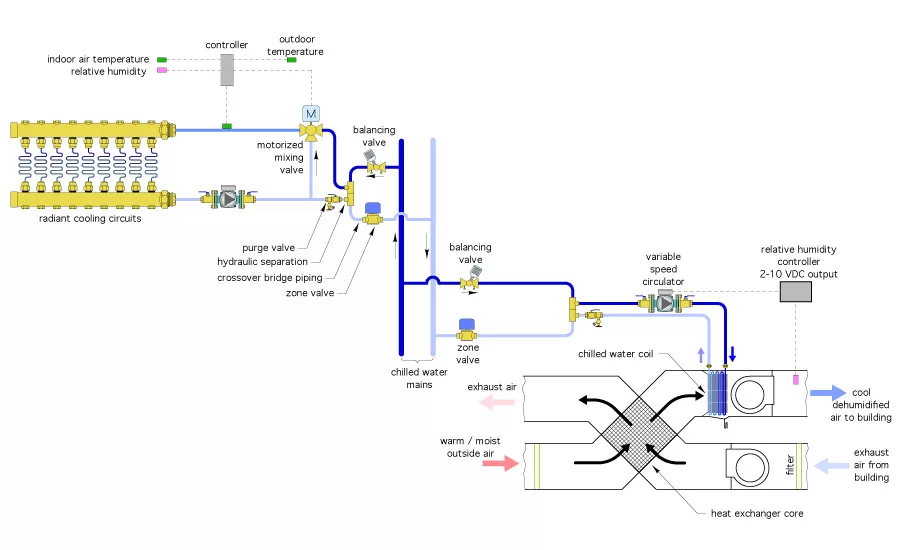
Figure 5
Hydronic radiant panel heating has long been known for providing superior cold weather comfort. Even so, the question that often arises from a potential client, one who is already convinced of the benefits of hydronic heating, is: “What do I do about cooling?”
Answers range depending on budgets, zoning preferences, and the equipment used for the heating portion of the system. One of the lesser-known possibilities, at least presently, is using a radiant panel as a heat absorber for sensible cooling.
The term radiant heating makes most people think about warm floors. Although it’s true there are many excellent applications for radiant floor heating, it’s not the only type of radiant panel that can deliver excellent comfort.
A hydronic radiant ceiling, when properly applied, serves as an excellent low-temperature heat emitter. Some designs, such as the panel shown in Figure 1, can deliver a heat flux of 28 Btuh per square foot when operating at an average circuit water temperature of 110°F. This makes them well-suited for use with heat sources, such as mod/con boilers, solar thermal collectors, and heat pumps.
One of the unique benefits of this type of panel is its low thermal mass, especially in comparison to heated concrete floor slabs. Low thermal mass allows the radiant ceiling panel to quickly respond to changes in factors such as internal heat gain and changes in thermostat settings. When properly constructed, this type of panel should last for decades and will probably outlive several heat sources that will take turns supplying it.
BTU ABSORBER
Radiant ceilings are also ideal surfaces for absorbing heat from living spaces when their surface temperatures are maintained slightly lower than the air and objects in those spaces. This is called radiant cooling. When done correctly, it has the potential to become a viable (and even highly desirable) option in residential and light commercial buildings.
However, radiant ceiling cooling isn’t as simple as just pumping chilled water through tubing embedded in the ceiling. To prevent condensation on or within the panel, the temperature of the chilled water supplied to the ceiling must be maintained about 3° above the current dew point temperature of the room.
Looking for quick answers on air conditioning, heating and refrigeration topics? Try Ask ACHR NEWS, our new smart AI search tool. Ask ACHR NEWS
The dew point temperature depends on the dry bulb temperature of the room air and its relative humidity. It can be determined from a graph, such as the one shown in Figure 2, or read from a psychometric chart.
A change in either the dry bulb temperature or relative humidity will change the dew point temperature and, thus, require a change in the chilled water temperature supplied to the radiant ceiling panel. Furthermore, different areas of a building can have different dew point temperatures at the same time. For example, a vestibule in which the exterior door is frequently opened on a hot, humid day will likely have a higher dew point temperature compared with an interior space with minimal sources of moisture. Buildings with such spaces should be divided into zones and the chilled water temperature to each zone needs to be independently controlled.
One of the simplest ways to adjust the chilled water temperature supplied to a radiant panel is by using a three-way, motorized mixing valve. This could be the same type of valve that might regulate the temperature of warm water supplied to the radiant ceiling panel during heating mode. During cooling-mode operation, this valve mixes chilled water, supplied from some source, with slightly warmer water returning from the radiant panel.
The controller operating the three-way valve must sense the dry bulb temperature and relative humidity within the building space served by the radiant panel. It would use this information to continuously calculate the current dew point temperature of that space. It would then compare this temperature to that of the chilled water temperature being supplied from the outlet of the mixing valve to the panel. The controller’s objective is to maintain the supply water temperature to the panel circuits 3° above the dew point temperature.
Figure 3 shows how this controller would connect with the mixing valve and associated chilled water distribution piping.
This is the same piping arrangement one might use to control the temperature of warm water supplied to the radiant panel circuits for heating. The only difference is the control logic used to adjust the mixing valve. For cooling, it would be the previously discussed dew point control. For heating, it would be outdoor reset control, in which the water temperature supplied to the panel increases as the outdoor temperature decreases.
So, wouldn’t it make sense to have a single electronic controller that includes both of these operating algorithms? This would allow the same panel that provides excellent thermal comfort in winter to also provide sensible cooling in summer. The concept is shown in Figure 4.
PREVENTING CONDENSATION
Because condensation must be avoided, radiant panels can only provide sensible cooling (e.g., lowering the air’s dry bulb temperature). Proper system design also must address latent cooling (e.g., lowering the moisture content of the air). The latent cooling load can only be handled by a device that allows condensation to form within it and properly disposed of that condensate. Most systems use an air handler for this purpose.
In buildings with mechanical ventilation, it is usually possible to combine the airflow requirements for latent cooling with the airflow required for ventilation. To improve overall energy efficiency, a heat recovery unit also can be incorporated into the air-handling system. This unit scavenges some of the cooling effect in the outgoing airstream and uses it to precool incoming warm outside air. The concept is shown in Figure 5.
This assembly also includes a multiple tube row chilled water coil that is very effective in dehumidifying the air passing through it. The goal is to dry the air supplied to the space to a condition that allows it to absorb sufficient moisture from the space to maintain a comfortable relative humidity.
The cooling capacity (and rate of moisture removal) of the air handler shown in Figure 5 is controlled by the flow rate of chilled water through the coil. In this system, that flow is regulated by a variable-speed circulator, which responds to a controller that measures the relative humidity of air in the space being conditioned and compares it to a set point value, such as 50 percent. The controller outputs a signal, such as 2-10 vdc or 4-20 milliamp that is compatible with the speed controller driving the circulator. When the relative humidity starts to rise above the set point, the circulator speeds up to increase the capacity of the coil and vice versa.
The air-handler system also could be used for ventilation in winter. In cold climates, the circuit through the cooling coil, which could be used to warm incoming ventilation air in winter, would need to be protected by antifreeze.
CONTROLS CONUNDRUM
If you like what we’ve just discussed and you want to design this into an upcoming project, you’re going to have a challenge creating the control requirements. Although it’s possible you could locate several different control components and weave them together to achieve the necessary functions, this is going to be tedious and expensive. It would be much easier if you could just buy a unitary controller that managed all these tasks.
Indeed, the lack of an off-the-shelf controller for this type of integrated heating, cooling, and ventilation system is currently holding the market for smaller-scale radiant cooling systems at bay. I would love to see a manufacturer develop and offer such a controller in the North American market. The availability of such a controller would enable those who already install radiant heating systems to easily expand into radiant cooling. I think it’s the only piece missing from the “puzzle” at present.
One longstanding criticism of residential hydronics has been its perceived inability to provide cooling. Here’s an opportunity to help end that perception by offering not only the ability to provide cooling, but to do so using state-of-the-art methods that improve comfort, leverage modern devices such as heat pumps, and significantly reduce the distribution energy required to cool the building. It’s also a great way to merge the best attributes of modern hydronics technology with air-side subsystems for ventilation and latent cooling.
So, for the manufacturers reading this, please consider building this controller. It’s an opportunity to deliver a truly new and unique product that could significantly expand the possibilities of modern hydronics technology.
Publication date: 8/15/2016
Want more HVAC industry news and information? Join The NEWS on Facebook, Twitter, and LinkedIn today!
Looking for a reprint of this article?
From high-res PDFs to custom plaques, order your copy today!