HVAC System Life Cycles: How Long Should It Last?
Contractors creatively address high expectations from homeowners

REPAIR OR REPLACE: Contractors across the country agree it’s difficult to provide customers with a specific life expectancy for their HVAC equipment as many variables, including climate, weather discrepancies, living habits, and system maintenance, play a role.
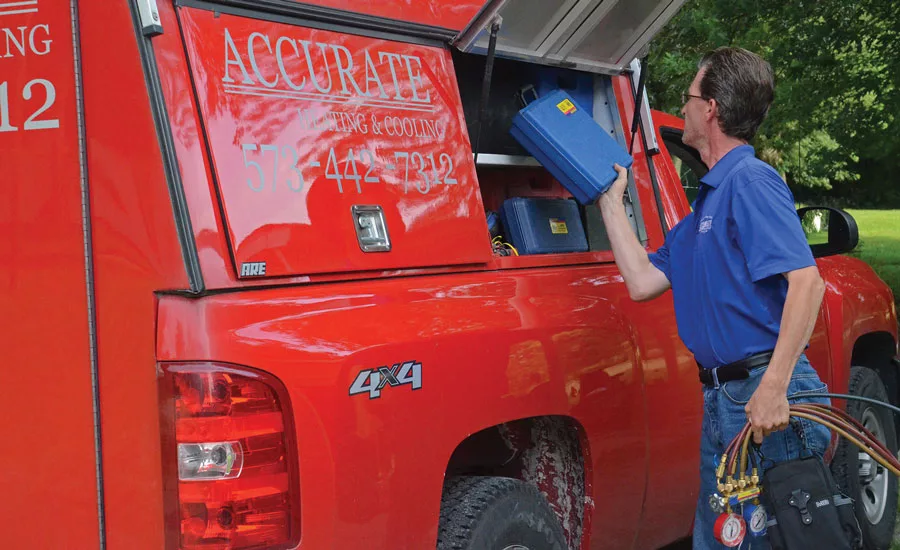
PROPER MAINTENANCE: The number of hours a piece of equipment runs per day, its proximity to corrosive contaminants, and how well the unit has been maintained are all important factors that determine its longevity and durability. Photo courtesy of KOMUnews
One of the most enduring questions in all of HVAC contracting is: When should a customer repair aging equipment, and when should one replace the entire system?
Read how long HVAC Systems really should last in our newer article on the subject.
Advancements in technology have extended the life cycle of virtually every product in the industry while at the same time are creating a need to replace equipment more frequently in order to take advantage of the most efficient offerings in the marketplace.
As efficiencies increase, operational costs decrease, and the general population becomes more aware of the importance of HVAC equipment, a growing discrepancy has emerged between the life expectancy of equipment according to contractors and the expectations of customers.
HOW LONG SHOULD A SYSTEM LAST?
According to Nick Rohan, CEO of RESSAC Climate Control Technologies in Glendale, California, there are a great many factors that go into projecting how long a system should last. “It varies based on run-time hours per day, proximity to corrosive contaminants, how well the equipment has been maintained, whether any major repairs or retrofits have been made, and whether the equipment services mission-critical spaces and can’t afford to break,” he said. “Based on these variables, we see a lifetime range of 10-30 years with 20 years being the average.”
There are also differences depending on exactly which piece of equipment is being discussed.
“As a consumer and professional, I expect furnaces to last 20 years,” said Tom Beaulieu, president of Bay Area Services Inc. in Green Bay, Wisconsin. “Air conditioning units, because they are outdoors and subject to the extremes of the weather, typically have shorter life expectancies of 15 years. My definition of ‘end of life’ for any appliance is when the unit has been in operation for more than two-thirds of its expected life and needs repairs that exceed 25 percent of the full replacement cost. Additionally, if repair parts are no longer available or some component, such as refrigerant, has or will become obsolete, the system most likely will need to be replaced. If there is something new and great that offers a feature that is appealing to me, I may tend to consider replacing the old product earlier.”
Robin Boyd, technical service advisor, U.S. Supply Co. in West Conshohocken, Pennsylvania, also believes a properly installed and sized heat pump/cooling system with minimal maintenance should last 15-20 years. In his opinion, gas furnaces should last even longer.
Looking for quick answers on air conditioning, heating and refrigeration topics? Try Ask ACHR NEWS, our new smart AI search tool. Ask ACHR NEWS
“Gas furnaces that are properly sized and installed with minimal maintenance [should last] 20-30 years,” he said. “Oversized equipment is going to fail sooner. The application, sizing, and maintenance are all major factors for how long a system is going to last. There are many other factors, as well. Occupant behavior has an effect, as well. Are they frequently opening the door to the outside or is the thermostat constantly being changed? Environmental issues, such as salt air near coastlines or the amount of volatile organic compounds (VOCs) introduced to the indoor air via air fresheners, personal hygiene products, scented laundry products, etc., all play a role.”
Carter Stanfield, director of the air conditioning technology department at Athens Technical College in Athens, Georgia, and author of “Fundamentals of HVAC/R,” agreed with Boyd that oversized equipment is going to fail sooner than its properly sized counterparts.
“A lot of that comes from the on-off cycling,” he said. “For air conditioning, the start-up period is the hardest period for the compressor. Lubrication is not as good at first, and some oil gets pumped out and takes a while to return. Initial current inrush is high for all motors other than the newer electronically controlled ones where the controls prevent this. For furnaces, the temperature extremes between off and on cause expansion and contraction of the heat exchanger, which places more stress on it. So, I would tend to look more at cycling [starting and stopping] as a factor that could shorten a system’s life. Proper sizing is critical due to its effect on cycling. Units with newer staging and modulating controls may last longer because of this — if their electronics hold up. HVACR systems are harsh environments for electronics.”
GOING COASTAL
While determining a baseline life expectancy for systems is hard enough in its own right, the issue is compounded even further when location is taken into consideration.
“In our coastal/subtropical environment, we see a much shorter life span due to the variety of chemicals from saltwater, sulfur, and chemicals used when our residential communities were tomato fields and orange groves,” said Jim Britton, vice president and general manager of Wield One Hour Air Conditioning and Heating in Naples, Florida. “We tend to see eight to 14 years, depending on where the home sits and how well the system is maintained. We must also factor in that we cool for 2,800-3,000 hours a year and the miles add up quickly. Unfortunately, for us, a great deal of our customers are from up North and they have the same expectations for their a/c systems down here.”
Those expectations in Northern states and Canada are certainly much longer than many in the Southern U.S. D. Brian Baker, president of Custom Vac Limited in Winnipeg, Canada, said he has many clients with original high-efficiency furnaces that are 30-33 years old and air conditioners that are 30-40 years old or older.
“But, we see many furnaces and air conditioners that are seven to 10 years old and shot,” he said. “The utility uses a life expectancy of 16-20 years. Our clients can proudly say theirs is almost double that. Doing it right always pays.”
“I would agree on the air conditioning side with the 15- to 20-year life cycle outside of coastal environments and high run-time hour situations,” said Jim Johnson, owner of Technical Training Associates in Green Valley, Arizona. “When it comes to furnaces alone, I’ve encountered properly maintained fuel-burning equipment here in Arizona that is 10 or even 15 years beyond the 20-year life span. And, other than the fact that they are far behind the curve efficiency-wise, many are still performing properly. “
Aaron Nadrowski, operations manager and lead trainer at Heatwave Heating & Cooling in Amherst, New York, said he worked for many years along the Gulf Coast in Texas and would see a/c units last from five to 12 years depending on their proximity to the water.
“The salty atmosphere destroys everything,” he said. “Now, I am back in the Western New York area, and the average equipment life span here is about 20 years, though I would recommend a changeout after 15 years due to energy consumption. Floor-model boilers tend to last longer. Regarding wall-hung high-efficiency boilers, I’d suggest purchasing a good one that will last 15 years.”
DISCUSSING THE DISCONNECT
Even if contractors give customers an honest assessment of how long a piece of equipment can be expected to reasonably last, many are going to push those limits to the max. Differences also exist between different generations of customers.
“Folks older than 45 tend to think things should last longer,” said Beaulieu. “This group would say 20 and 15 years, just as I did. Consumers under 35 are more accustomed to buying things more often. This group would expect furnaces and air conditioning units to last 12-15 years. For those between 35 and 50, it depends on how they were raised. The more conservative group has longer life expectations. The older group tends to take better care of things and expects them to serve their needs longer. The younger group tends to take things for granted until they no longer function and then use credit to replace them.”
George Oakes, sales representative with North Central Fabricators LLC in Braham, Minnesota, believes customers generally feel like a system will last 10 years longer than the factory warranty calls for. “As heating contractors, we will install and reinstall the parts to keep it running,” he said. “And, yes, we explain the value of buying new instead of putting money into such an old piece of equipment during every visit. Still, only the equipment owner has the true answer to how long equipment will last.”
For Jeff Beyer, president of Beyer Mechanical in San Antonio, seeing efficiencies change so much over the last eight years has pushed his company toward selling the utility bill, equipment warranties, and maintenance agreements.
Beaulieu believes consistent maintenance has a substantial impact on a piece of equipment’s life cycle. And, when it comes to maintenance, he believes quality always trumps quantity.
“There is so much outright fraud going on in this area in our industry,” he said. “Proper and complete testing and checking could easily increase the life expectancy by 25 percent or more.”
Beyer compared it all to keeping a vehicle on the road for years at a time.
“Keeping things clean and charged will always prolong the life of the equipment, just like it would for your car,” he said. “Car owners choose their mechanics carefully, and they should do the same when it comes to their HVAC equipment.”
SIDEBAR: MANUFACTURERS WEIGH IN
While customers and contractors may at times have differing opinions on how long a system should work to its full capabilities, manufacturers have clear expectations.
“Mitsubishi Electric has one of the best warranties in the HVAC industry,” said Michelle Robb, director of residential marketing, Mitsubishi Electric US Cooling & Heating Division. “When installed by a certified Diamond Contractor™, a residential single-family home’s system’s parts are warranted for 12 years. Additionally, the filters in our wall-mounted indoor units are washable, reusable, and built to last up to 20 years. It’s Mitsubishi Electric’s impeccable quality that enables homeowners to enjoy their systems with greater longevity.”
Shawn Laskowski, vice president of product management and marketing, residential HVAC, Trane, said the company does extensive field and simulated environmental testing on all equipment and has rigorous run-cycle requirements for its suppliers. In addition, Trane ensures the equipment meets or exceeds its warranty in all available climate markets under normal operating conditions, which can be dramatically different due to climate and environmental surroundings.
Tim Litton, director of marketing communications, WaterFurnace Intl. Inc., said that because geothermal heat pumps aren’t exposed to the stress of combustion nor the rigors of outdoor environments, they have some of the longest lifespans in the HVAC industry. “According to one ASHRAE study, the average life of a geothermal heat pump is slightly more than 24 years,” said Litton. “Additionally, most of our products are offered with some type of soft start capability, which further reduces stress on compressors, fans, and electrical components.”
Publication date: 7/11/2016
Want more HVAC industry news and information? Join The NEWS on Facebook, Twitter, and LinkedIn today!
Looking for a reprint of this article?
From high-res PDFs to custom plaques, order your copy today!