Btu Buddy 155: Sweating Windows
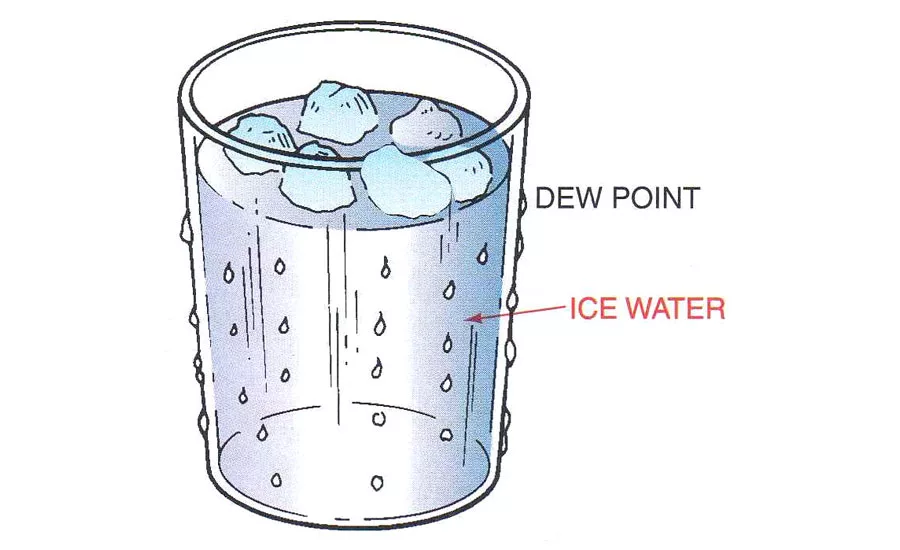
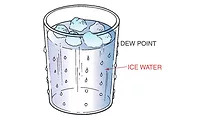
FIGURE 1. This is an example of how moisture condenses out of the air to a cold surface. The surface can be anything that is below the dew point temperature of the air. (Figures are from Refrigeration & Air Conditioning Technology, 7th Edition, by William Whitman, William Johnson, John Tomczyk and Eugene Silberstein published by Delmar Cengage Learning.) (©Delmar Cengage Learning.)
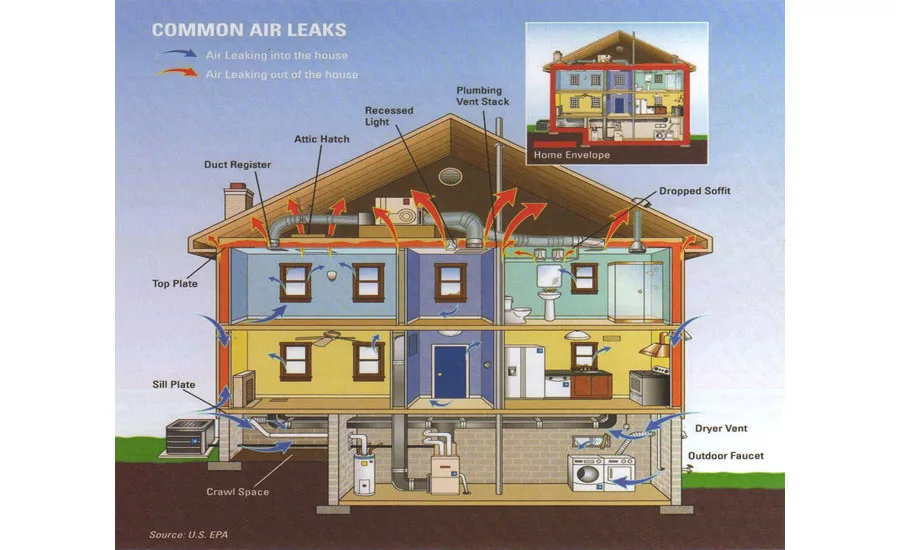
FIGURE 2. This illustration shows many ways that infiltration air can enter a home. (©Delmar Cengage Learning.)
Bob is a service technician who is well trained and nationally certified. However, he has sometimes suffered from the same confusion that all technicians occasionally do — the facts that he gathers may or may not point to the obvious cause of the problem or the best solution. But Bob has had something that no one else has. He recalled his long-time HVACR mentor and imagines him accompanying him as “Btu Buddy,” someone who reminded him to take time to stop and think before rushing to judgment, helping keep him on the right track, even with facts that are confusing.
Now, Bob’s company has promoted him to help train a new employee, right out of a school specializing in HVAC, just like Bob was. Bob is now Tim’s Btu Buddy. Tim is anxious to travel with Bob. Tim realizes that he is right out of school, with the theory and lab work that he accomplished in school, but still needs help. He knows that he worked with many of the components of the systems in the school, under ideal conditions with good light and air conditioning. Now it is into the field, sometimes under the house with poor lighting, or out on the rooftop in the sun, where the real action is. He is naturally and normally reluctant, but he has Bob to help guide him.
Bob and Tim were driving to a service call where the customer’s complaint was that her home’s windows were sweating excessively. Tim asked, “What could be some of the reasons that a customer’s windows would be sweating?”
Bob said, “The reason that windows sweat is because the temperature of the window surface on the inside is below the dew point temperature of the air inside the house (Figure 1). It is very cold outside, so the dew point of the window surface would be rather cold today. Most people have storm windows today which is another set of windows between the outside air and the inside air. This is usually enough to prevent window sweating. However, the home could be generating more moisture inside than normal for some reason. Excess moisture inside the house often comes from several people taking showers, which releases large amounts of moisture. Sometimes, excess moisture can come from women cooking large amounts of food in open pots on the stove. I have seen clothes dryer vents that were not venting to the outside of the house. We have to either lower the dew point temperature of the air in the house or prevent the indoor air from reaching the low dew point of the window surfaces. Let’s go to the job and see what the case is.”
When they got to the job they talked to the customer who said, “My windows have often sweated a little bit but never like this. I am afraid that my window sills are going to rot if I don’t keep this moisture off of them.”
Bob and Tim went to the basement where the furnace was located. Bob said, “We should first make sure the furnace is venting like it should and not releasing products of combustion into the house. Products of combustion contain a lot of moisture and I have seen vents loose under a house with these products of combustion rising up through the house and causing excess moisture. That’s not good for a couple of reasons: 1) the excess moisture; and 2) the products of combustion could possibly have carbon monoxide in them.”
They examined the furnace and the flue system and it seemed to be venting well outside the house. They stepped outside the house and looked up at the vent while the furnace was running and they could see the condensation in the products of combustion. Bob said, “That’s a good sign that the furnace is venting correctly.”
Looking for quick answers on air conditioning, heating and refrigeration topics? Try Ask ACHR NEWS, our new smart AI search tool. Ask ACHR NEWS
They carefully examined one of the windows that was sweating, and Tim said, “This window has no storm window over it.”
Bob said, “You are right. None of the rest of the windows have storm windows either. This is a fairly old house; it looks to have been built in the 1960s. I doubt that the house is well insulated or sealed.”
Tim asked, “How would you seal an old house like this and how would you insulate an older house?”
Bob said, “The painters, when they paint a house like this, should generously use a caulking gun and a putty knife. The painters get to examine the entire structure where the wood meets the brick or where wood meets the window framing. The sealing of the house is pretty well left up to painters. They should examine the entire structure as they make their way around. Then they should take the action of applying sealing compounds where they’re needed.
“Insulating and old house like this is a special case. Insulating companies are equipped to insulate almost any structure. With an old structure like this, they would drill holes all the way around the outside or inside of the house and force insulation into the walls. They would seal the holes before it was painted. Using these techniques, they can bring a house up to modern-day standard insulation levels.
“However, this doesn’t account for the storm windows not being on the house. Let’s go talk to the housewife.”
They talked to her and asked her how long it had been since the house had been painted and why the storm windows were removed. There was evidence that they used to be there.
She explained, “The painters said that the storm windows were in such bad shape that they were tearing up when they took them down to paint the windows. We decided not to have them replaced at this time for financial reasons. The windows in this house don’t seem to be a standard size and storm windows would have to be manufactured to fit. That seemed like a big expense.”
Bob said, “I think you will have to replace those storm windows to prevent this problem from happening. It is obvious from looking at the windows that there is too much moisture in the air in this house. Parts of this house have a crawlspace while you do have the small furnace room below ground. Tim and I are going to walk outside and look at the way the soil grades to the house.”
The housewife then asked, “What about a dehumidifier?”
Bob said, “A dehumidifier would help but would not cure the problem unless you had more than one. That would be like putting a Band-Aid on the problem. It would also be expensive operating two dehumidifiers. The more practical approach would be to cure the problem. We’re going to find a cure for it.”
Bob and Tim walked outside and walked around the house and Bob explained to Tim, “This house is at the bottom of a small hill. The ground on the back side of the house is graded towards the house. We have had a very rainy winter and the soil is saturated with water. I’m going to bet that the underside of this house is wet from moisture in the ground moving down that hill and under the house. Let’s go look.”
They put on their coveralls and went under the house in the crawlspace portion. Tim said when he looked under the house, “It looks dry under there to me.”
They began to crawl under the house and when they got towards the back side of the house where the hill was, Tim said, “Look at my knees. They are wet when I crawl under the house. The soil looks dry on top but when you press it there is moisture below.”
Bob said, “The reason the soil is dry on top is that moisture has evaporated and is rising up under the house. As it rises it will go right on up through the floor into the rest of the structure. We have two problems here, not just one. The storm windows have been removed and should be replaced and the underside of this house should have heavy plastic sheeting placed over the soil up to the foundation. That will reduce the amount of moisture evaporating under the house and the storm windows will prevent the windows from sweating.”
Bob and Tim went and explained all of this to the homeowner and told her that the storm windows and plastic sheeting on the crawlspace floor were essential. Bob explained that the windows would all rot out within about two seasons of this kind of moisture and it would then be a matter of replacing the entire wooden frame of the window. He also explained to her that this was not considered a service call and that while they were there they were going to go ahead and service her furnace and filters because they had to charge her anyway.
When they were finished with their service of the gas furnace and system they went and spoke again with the housewife.
She said, “I spoke with my husband by phone while you were doing the service work and he said we will get right on this and get it done. Thanks for the good advice and the service call. Can you explain to me how the moisture that is in the house is going to get out of the house after the windows are repaired and the plastic sheeting is spread?”
Bob explained, “About 30 percent of the air in a home changes out every hour (Figure 2). When you stop the moisture from flowing into the structure, from the points that we discovered, infiltration will enter the house as cold air in the wintertime. The cold air is probably fairly moisture laden when it enters the structure, but when it is heated by the air inside the house it expands and drops the humidity. The humidity is calculated by how many grains of moisture are in the air compared to how many grains it can hold at 100 percent humidity. The moist air probably enters at about 60 percent humidity and then expands and goes down to about 30 percent humidity. Over the period of a few hours it will reduce the humidity level in the house and things will be good.”
As they were riding to the next job, Tim said, “That was good thinking to go ahead and do a service call on her system while we were there. Up to that point we had been a help but almost anybody could have given her that advice. The service call made the call worthwhile to the customer. I predict she will call back and use our company for future service work and recommend us to other customers.”
Bob agreed and said, “It is always good to give full value to a customer and make them aware of what you’re doing. They call that PR or public relations. When the customer likes you and what you do, they will use you for all future work and not change companies.”
Publication date: 2/22/2016
Want more HVAC industry news and information? Join The NEWS on Facebook, Twitter, and LinkedIn today!
Looking for a reprint of this article?
From high-res PDFs to custom plaques, order your copy today!