Duct Dynasty: Four Essential Static Pressure Readings for Diagnostics
Troubleshooting common HVAC system pressure problems
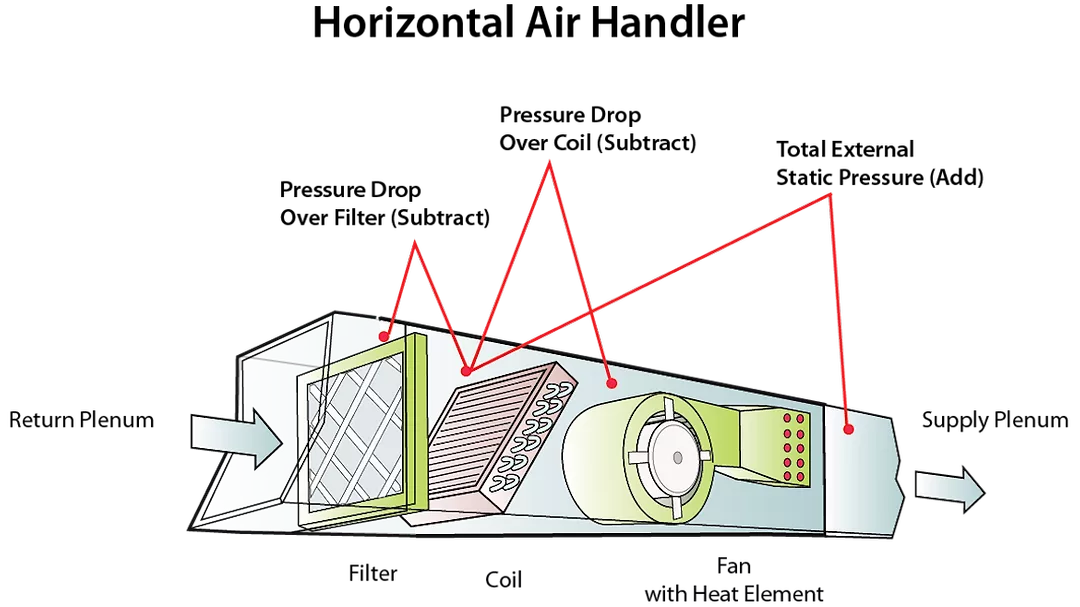
AN ACCURATE ASSESSMENT: Pressure reading locations will vary from a gas furnace to an air handler. Many air handlers include the pressure drop of the internal coil in the total external static pressure rating. (Courtesy of David Richardson)
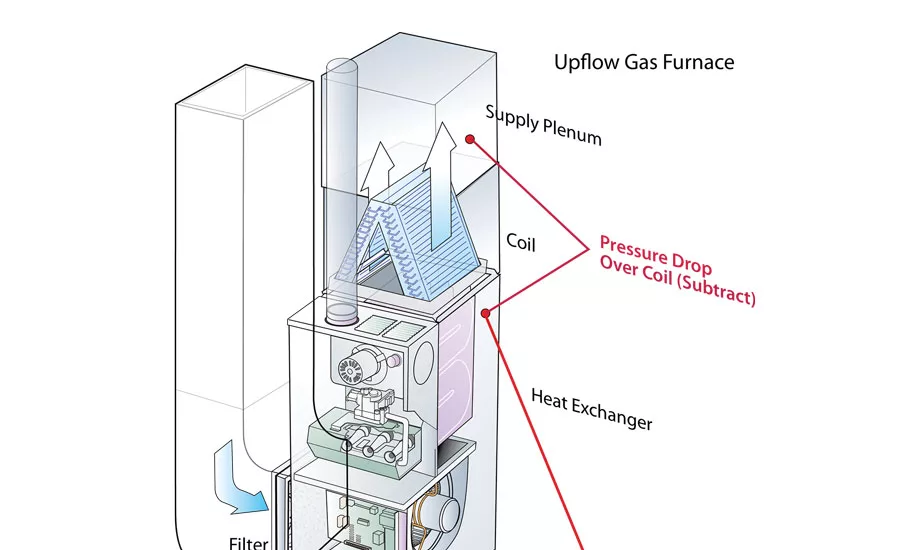
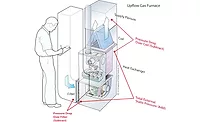
BEFORE AND AFTER: Pressure readings from four locations are necessary to begin tracking down airflow issues. On an upflow gas furnace, these pressure readings are obtained before the filter, after the filter, before the coil, and after the coil.
Diagnosing airflow problems in an HVAC system can be a frustrating and intimidating task. When airflow problems arise without a defined troubleshooting approach, you’ll likely end up guessing at the cause. Sometimes you’re left wondering if you are on the right track and if your fix really worked.
Real airflow troubleshooting begins with hunting down static pressure problems. To accurately diagnose airflow issues created by excessive static pressure, you’ll need four essential readings to pinpoint the problem in most systems. Let’s look at the four pressure readings you’ll need to measure and apply when diagnosing airflow problems.
TOTAL EXTERNAL STATIC PRESSURE
Total external static pressure is the first pair of readings you’ll need to obtain. Two 3/8-inch test ports need to be drilled to measure a system’s pressures. It’s important to inspect before drilling any holes. You don’t want to drill into a circuit board, drain pan, or any refrigeration tubing. A drill bit sheath (a 4-inch tube slipped over the drill bit) adds an extra layer of protection.
Most systems require you to drill a test hole (static pressure test site) where air enters and leaves the air moving equipment. To measure total external static pressure, test pressure at these two locations.
To determine total external static pressure, first measure pressure on the supply side of the equipment. When recording this pressure, it is commonly referenced with a (+) symbol and measured at the discharge of the equipment. You’ll also need to measure pressure on the return side of the equipment, referenced with a (-) symbol.
Add these two readings together to find total external static pressure. Anytime you add these positive and negative pressures together, disregard the + and – symbols. They only indicate which side of the fan, or what type of pressure, was measured. Both readings are absolute pressures the fan needs to overcome.
INTERPRETING TOTAL EXTERNAL STATIC PRESSURE
Compare your measured total external static pressure with the equipment’s rated static pressure. This is typically located on the equipment nameplate. The typical fan in a residential application is rated for a maximum pressure of 0.5 inch of water column (wc). Most fans can’t deliver the needed airflow for heating or cooling operation when measured pressure exceeds this rating.
Looking for quick answers on air conditioning, heating and refrigeration topics? Try Ask ACHR NEWS, our new smart AI search tool. Ask ACHR NEWS
To know for sure what your fan airflow is, you can plot fan airflow using the manufacturer’s blower performance charts. This is done using the measured total external static pressure, the current fan speed setting, and then plotting airflow, which is on the manufacturer’s blower performance chart. You won’t have to guess how much airflow the fan is moving when you successfully complete this test.
If total external static pressure is excessive, the result is low fan airflow, which is a sign it’s time to find the source of the airflow restriction. You’ll do this by testing filter and coil pressure drops and duct system pressures. These readings hold the answer to finding an airflow restriction. When you find the highest pressure or pressure drop, you’ll likely have found the source of your airflow problem.
FILTER PRESSURE DROP
Measuring filter pressure drop allows you to determine if the filter you’re using is too restrictive. The potential exists for a restrictive air filter to degrade system efficiency by 40 percent or more. The only way you can be assured this isn’t happening to your system is to measure.
Depending on location, the filter might be in a rack at the equipment or it could be mounted in a filter grille. To measure filter pressure drop, you’ll need to measure static pressure entering and leaving the filter. Subtract the entering pressure from the leaving pressure to determine filter pressure drop.
Ideally, filter pressure drop should not exceed 20 percent of the fan’s maximum rated static pressure. With the average fan in a residential application rated for a maximum pressure of 0.5 inch of wc, filter pressure drop should not exceed 0.1 inch of water column (20 percent x 0.5 = 0.1).
If filter pressure drop exceeds 0.1 inch of wc, some changes in the system may be needed for it to work properly. You may need to increase the surface area of the filter or use a less restrictive filter media to lower filter pressure drop.
COIL PRESSURE DROP
Measuring the pressure drop over an indoor coil is similar to measuring the pressure drop of an air filter. Many technicians have pulled apart coil cabinets to inspect them for a restricted coil when all that’s needed are two pressure measurements and a quick calculation.
To measure coil pressure drop, you’ll need to measure the static pressure entering and leaving the coil. Subtract the leaving pressure from the entering pressure to determine coil pressure drop.
Ideally, coil pressure drop should not exceed 40 percent of the fan’s maximum rated static pressure. Based on the average 0.5-inch-wc-rated residential fan, coil pressure drop shouldn’t exceed 0.2 inch of wc (40 percent x 0.5 = 0.2).
When coil pressure drop exceeds 0.2 inch of wc, don’t be too quick to condemn the coil as being dirty. Some newer indoor coils today are very restrictive to airflow and could have pressure drops exceeding 0.2-0.3 inch or more while being perfectly clean.
If you’re in doubt, you can always compare the actual coil pressure drop against the manufacturer’s coil pressure drop data. See how close your readings compare to the rated coil pressure drop. If they aren’t close, this can indicate the coil is truly restricted in some way.
Common causes of excessive coil pressure drops are coils that are dirty or too small for the air-handling equipment they are mounted in. Undersized coils are very common in heating-dominated climates where there is a high heating load and minimal cooling load. Damaged fins can also cause excessive restriction.
DUCT SYSTEM PRESSURES
Duct system pressures will be the final measurements you’ll need when diagnosing an airflow problem. These pressures can indicate restrictions in the supply or return duct systems themselves.
The pressure in return and supply ducts should not exceed 20 percent of the fan’s rated capacity. This is the same value used in gauging the pressure drop of an air filter. On a fan rated at 0.5 inch of wc, you wouldn’t want to see any more pressure than 0.1 inch of wc in your supply and return duct pressure reading.
When pressures exceed 0.1-inch wc in either the supply or return duct, it’s a sign there is a restriction in that side of the duct system. Further investigation will be needed to uncover the location of the restriction. Possible restriction points in the duct system can range from poor fittings and undersized ducting to loose internal duct liner.
PUTTING IT ALL TOGETHER
It’s important to measure all of the pressures we’ve looked at when diagnosing airflow issues, as they are tied directly together. While this look at four essential static pressure readings is a broad overview, there’s much more that can be said on the subject. I would encourage you to become a student of static pressure testing and the opportunities it creates for you.
Publication date: 1/25/2016
Want more HVAC industry news and information? Join The NEWS on Facebook, Twitter, and LinkedIn today!
Looking for a reprint of this article?
From high-res PDFs to custom plaques, order your copy today!