Refrigerant Recovery: Technology and Tips
The Right Tools and Advice from Experts Make This Essential Process Easy
Recovering refrigerant from HVAC and refrigeration systems is an important day-to-day task for HVACR technicians. With the recently announced the U.S. Environmental Protection Agency (EPA) phasedown of R-22, this process will only grow more valuable.
Here’s a look at some of the latest tools that help make this important job easy, along with tips from the recovery equipment manufacturers on how to efficiently and safely recover refrigerant.
Essential Equipment
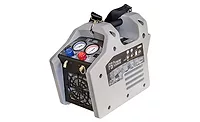
The Inficon Vortex Dual refrigerant recovery machine offers rapid recovery of all common refrigerants, even in hot ambient conditions. The unit features a microchannel condenser that helps reduce discharge pressures and a 1-hp dual-piston compressor. Other features include two-valve operation, gauges designed to be easily readable for both suction and tank pressure, and a self-purge capability without the need to change hoses. The Vortex Dual is covered by a three-year over-the-counter replacement warranty.
Bob Belvick, service tools product manager, Inficon, noted a refrigerant recovery machine is an essential tool in every technician’s toolbox, and knowing how to optimize the use of this tool can save time and money. He offered these tips:
• Don’t start recovery with both valves open. To optimize speeds, keep the manifold closed on the vapor side until most of the recovery is finished. Liquid recovery speeds on most machines are up to 10 times faster than recovering only vapor, so save the vapor for last;
• Remove all restrictions, such as Schrader-style valve cores. These types of restrictions can significantly reduce the flow of refrigerant, thereby slowing recovery speeds; and
• Use high-quality, modern equipment. “There’s a reason ‘they don’t make them like they used to,’” Belvick said. “Recovery machines have come a long way since the early days of recovery. Many new machines offer dual pistons (for twice the pumping power), large motors, and better condensers for more efficient recovery rates in hot ambient temperatures.”
The Refrigerant Mizer™ Model RS-503/13-C3 very-high-pressure refrigerant recovery system from Redi-Controls Inc. is designed to recover very-high-pressure refrigerants typically found in cascade systems and environmental chambers. The Air-Conditioning, Heating, and Refrigeration Institute (AHRI)-certified unit is capable of recovering R-503, -13, -23, and -508B (SUVA-95). According to Redi-Controls, it’s fully automatic, totally self-contained, recovers in-
to a standard DOT-3AA cylinder, and is non-ambient temperature sensitive. The Model RS-503/13-C3 is microprocessor-controlled, can recover up to 25 inches of mercury (Hg), and operates on standard 120 VAC. It doesn’t require an ice bath or pneumatic air to operate.
Looking for quick answers on air conditioning, heating and refrigeration topics? Try Ask ACHR NEWS, our new smart AI search tool. Ask ACHR NEWS
Mark Key, vice president of sales and marketing, Redi-Controls, reminded technicians that recovery units are certified for the types of refrigerants they are meant to recover. A unit certified for recovery of R-12 or -134a is not suitable for recovering -503, -13, -23, or SUVA-95.
“Using a recovery unit that is not AHRI-certified for the type of refrigerant being serviced is a violation of EPA regulations,” Key said, adding it’s also very dangerous to use a recovery unit not built to handle very-high-pressure refrigerants.
“Technicians have been injured when using a system that was not designed to handle the pressures associated with these types of refrigerants,” Key said. “I’ve heard of a number of cases of severe-injury accidents when equipment AHRI-certified for R-12 recovery was used to recover the high-pressure R-503 refrigerant. It’s important to note manufacturers will not warranty units that are not used within their stated guidelines. Manufacturers de-
velop these guidelines for the safety of the operators. Don’t risk injury; don’t risk violating EPA regulations, which are associated with large fines; don’t risk damaging equipment; and don’t risk losing valuable refrigerant. ”
The Enviro-Duo from Refco Mfg. Ltd. features one-knob operation and an oil-less, air-cooled, two-piston compressor. It recovers all chlorofluorocarbon (CFC), hydrochlorofluorocarbon (HCFC), and hydrofluorocarbon (HFC) refrigerants. Other features include oil-filled manifolds and 80 percent overfill protection. The unit was recently updated to make it safe for use with class 2A mildly flammable refrigerants, and a version with a built-in oil separator is also available.
Sheb Powell, business development, Refco Mfg. Ltd., is a proponent of simple operation (hence the Enviro-Duo’s single knob design). He also recommended technicians look for a recovery unit that features an automatic shut-off and glycerin-filled gauges.
“A low-pressure auto cut-off switch on the intake side of the recovery machine automatically shuts the machine down when the refrigerant is fully recovered from the system,” Powell explained. “This allows service technicians to do other things while the machine is working, such as getting their tools and replacement parts ready for the system repair.”
He added that glycerin-filled gauges will dampen any needle flutter and provide more accurate readings. “In addition, glycerin-filled gauges are inherently self-lubricating, so they should last longer in this tough application,” he said.
RefTec Intl. Systems LLC offers the Cheetah refrigerant recovery unit for recovering low- and medium-pressure refrigerants from chillers. The water-cooled system incorporates a 2-hp motor, high-cfm vacuum pump, 7/8-inch piping, and a low number of 90-degree bends to achieve fast throughput. Other features include an onboard suction accumulator, high- and low-pressure switches, an oil separator, and thermal overload protection. The unit’s certified gas list includes R-11, -113, -123, -114, and -245fa.
Tim Naylor, vice president of sales and marketing, RefTec, said technicians who are performing low-pressure refrigerant recovery from chillers can achieve optimum performance from the Cheetah by using it in conjunction with the company’s mini-purge unit.
“During the recovery process, a technician may encounter high head pressure because the Cheetah recovers refrigerant so quickly,” Naylor said. “To alleviate this issue, we recommend using our mini-purge unit on the recovery cylinder or tank during the process. The mini-purge pulls vapor from the tank, condenses it, purges out the non-condensibles, and drops cold liquid back into the recovery cylinder, which subcools the entire cylinder.”
The YJ-LTE™ refrigerant recovery system from Ritchie Engineering Co. Inc., Yellow Jacket Products Division, is capable of vapor, liquid, and push/pull recovery of R-12, -22, -134a, -407C, -410A, -500, -502, and other Class III, IV, and V refrigerants. Features include a ½-hp, twin-cylinder, oil-less compressor; a direct-drive fan; a built-in high-side pressure gauge; and a built-in purge circuit designed to allow for easy cleaning at the end of the job with no extra tanks or vacuum pumps required. A single gauge shows tank pressure during recovery and recovery unit internal pressure during purge. A sealed compressor crankcase is designed to minimize refrigerant loss over the life of the compressor.
“Safety is always an important consideration when recovering refrigerant,” said Mike Lanners, vice president of domestic sales and marketing, Ritchie Engineering. “One of the most important aspects of safety in recovery is having the right equipment for the type of refrigerant being recovered, starting with a good pair of safety goggles and a good pair of gloves to prevent frostbite.
“In addition to making sure they’re using a recovery unit certified for the refrigerant being recovered, technicians should make sure their manifold gauges are rated for the refrigerant pressure they’re working with, check the condition of their hoses prior to use, and always use the shortest hose possible for a given job,” he said.
Finally, Ritchie Engineering reminds technicians to pay attention to the recovery tanks they’re using.
“When recovering R-410A, you need to use a U.S. DOT-400 recovery tank,” said Lanners. “A standard DOT 350 will not safely handle the high pressures of R-410A. So, be sure you have the right tank for the job and that you do not fill it beyond 80 percent capacity — a DOT regulation. Another DOT regulation requires a recertification of the tank every five years, so be sure to check the date on your tank to see if a recertification is due.”
The RG3 portable refrigerant recovery machine from Robinair, a Bosch Automotive Service Solutions brand, is designed for residential and appliance-sized refrigerant recovery. The compact, lightweight (18-pound) unit features an oil-less compressor, a cross-flow layout of the fan, and a condenser that Robinair says creates shorter cycle times, and a high-pressure safety shut-off switch that deactivates the machine if pressure rises above 550 psi. It is capable of recovering both liquid and vapor and works with all common CFC, HFC, and HCFC refrigerants.
According to Tim Wagaman, product manager, Robinair, it’s a good time to be a technician performing refrigerant recovery. “Recovery equipment has evolved from very complex, heavy, and slow devices to very user-friendly, light, and fast machinery,” he said.
Wagaman offered these tips to technicians when selecting refrigerant recovery equipment:
• Pay attention to condenser size. “A larger condenser will keep the tank temperature cool, which will speed up the recovery process,” Wagaman said;
• Look for a large fan that will provide good airflow, keep the compressor cool, and help condensing in high-ambient conditions;
• Look for a small, lightweight unit;
• When comparing performance numbers, remember vapor recovery is nearly 80 percent of the recovery process. “It’s very important to use a recovery machine with a high vapor recovery rate,” Wagaman said.
“Liquid recovery is 20-25 percent of the recovery process. A refrigerant unit with the ability to recover liquid will speed up the first [liquid] part of the recovery process;”
• Look for a purge feature. This allows the unit to be used with multiple refrigerant applications and eliminates cross-contamination;
• Make sure the unit has the capability to handle high-pressure refrigerants such as R-410A;
• Make sure the unit has a good warranty; and
• Look for a unit that is easy to work on and has readily available parts. Most units can be field-serviced, which helps avoid downtime.
Publication date: 4/6/2015
Want more HVAC industry news and information? Join The NEWS on Facebook, Twitter, and LinkedIn today!
Looking for a reprint of this article?
From high-res PDFs to custom plaques, order your copy today!