ACHR News
search
Ask ACHR NEWS AI
cart
facebook twitter instagram linkedin youtube
  • Sign In
  • Subscribe
  • Sign Out
  • My Account
ACHR News
  • NEWS
    • Breaking News
    • New HVAC Products
    • Featured Products
    • Manufacturer Reports
    • HVAC Data
    • Legislation
    • ACHR NEWS Centennial
  • RESIDENTIAL
    • Air Conditioners
    • Furnaces
    • Residential Heat Pumps
    • Ductless
    • Residential IAQ
    • Testing, Monitoring, Tools
    • Components & Accessories
  • COMMERCIAL
    • Air Handlers
    • Rooftop Units
    • Chillers and Cooling Towers
    • Commercial Heat Pumps
    • Boilers and Hydronics
    • VRF/Ductless
    • Commercial IAQ
  • REFRIGERATION
    • Refrigerants
    • Refrigerant Regulations
    • Leak Management
  • CONTRACTOR PRO
    • Geothermal
    • Homeowner Study
    • VRF and VRV Ductless
    • Unitary Trends
  • EDUCATION
    • Training and Education
    • Business Management
    • Service and Maintenance
    • Continuing Education
    • Market Research >
      • HVAC Brand Awareness Report
      • VRV, VRF, VRVZ Report
      • Unitary Trends Report
      • Water Heat Professionals Report
    • Webinars
    • Sponsor Insights
    • eProducts Info
    • White Papers
  • EVENTS
    • HVAC Contractor Forum
    • Industry Events and Webinars
  • MEDIA
    • Videos
    • AHR Expo 2025 Videos
    • Podcasts >
      • ACHR News Podcast
      • HARDI Podcasts
      • AHR Expo Podcasts
      • ACCA Podcasts
    • Interactive Spotlights
    • Quizzes
    • eBooks
    • HVAC Talkback
  • HVAC GROUP
    • ACHR NEWS >
      • Current Issue
      • Digital Edition
      • Subscribe
    • Distribution Trends
    • SNIPS NEWS >
      • Join SNIPS NEWS
    • Engineered Systems News >
      • Join ES News
    • HVACR Directory
    • Contests
    • Newsletters
    • Contact
    • Advertise
    • My Account
HVAC Commercial MarketBoilers and Hydronics

Expansion Tank Pressurization

Improper Air-side Pressurization ‘Wastes’ some of the Internal Volume

By John Siegenthaler, PE
July 28, 2014

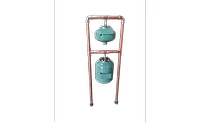
All closed-loop hydronic systems require an air space to absorb the increased volume of water as it warms during system operation. In most hydronic systems, this task is handled by an expansion tank. In most modern hydronic systems, it’s handled by a diaphragm-type expansion tank.

The intended benefit of a diaphragm-type expansion tank is that it can be pre-pressurized with air before it is installed. The air is held captive in the space between the steel tank shell and flexible rubber diaphragm (Shown in Figure 1).

Having the proper air-side pre-pressurization prevents system water from entering the expansion tank, until the water begins expanding due to heating. This benefit cannot be achieved using a non-diaphragm-type “standard” expansion tank. Because the air pressure in a standard expansion tank is zero when the fill process begins, water flows into the tank until the air is pressurized to match the static water pressure in the system.

In some systems, this initial inflow could fill half the tank’s volume and occurs before the water is heated. This is undesirable because it reduces the tank’s ability to accept the additional water volume when it’s heated.

Unfortunately, improper air-side pre-pressurization also “wastes” some of the internal volume of a diaphragm-type expansion tank. During initial filling, if the air-side pressure is less than the static water pressure at the tank’s entrance, some water will force its way into the tank until the air-side pressure balances the water-side pressure. This situation, illustrated in Figure 2, reduces the tank’s available acceptance volume.

Calculate It

It’s not hard to get the air-side pre-pressurization correct. First, determine the height of the system’s highest piping location above the expansion tank connection (Shown in Figure 3).

Next, determine what static water pressure you want at the top of the system when the circulator is off. I suggest 3-5 psi static pressure at the top. This allows float-type air vents, mounted at the top of the system, to eject any air that accumulates within them. It also helps suppress boiling if the system operates at higher water temperatures. Once you have these values, just plug them into Formula 1 (below) to calculate the proper air-side pre-pressurization.

Looking for quick answers on air conditioning, heating and refrigeration topics? Try Ask ACHR NEWS, our new smart AI search tool. Ask ACHR NEWS →

Pa = H(Dc/144) + 5

In Formula 1, use the following values:

• Pa = air-side pressurization of the tank (psi)

• H = distance from inlet of expansion tank to top of system (ft.)

• Dc = density of the fluid at its initial (cold) temperature (lb./ft.3)

• 5 = assumed 5 psi at top of system (this can be changed to other values)

Water, at a typical cold-fill temperature of 60°F, has a density of 62.4 pounds per cubic foot. A 40 percent solution of propylene glycol antifreeze has a density of 64.90 pounds per cubic foot at 60°. For other fluids, look up their densities at the expected cold-fill temperature.

Measure It

Once this air-side pressure is calculated, use an accurate 0-30 psi pressure gauge to check the air pressure in the tank. Ideally, you should do this before installing the tank in the system. However, you can check the air pressure after the tank has been connected to the piping, provided that no water has been added to the system. If you’re lucky, the air-side pressure will match the value calculated using Formula 1. If not, add or release air from the tank, just like adjusting the pressure in a tire, until you get the calculated pressure.

Assuming you do this correctly, the air pressure in the tank will match the water pressure at the tank’s connection. When the system is filled with fluid and the pressure at the top of the system is at the value appearing at the end of Formula 1 (e.g., 5 psi or whatever other pressure you set) the diaphragm will fully expand against the shell of the tank (Shown in Figure 4).

This preserves the full tank shell volume to absorb the increased volume of water once it’s heated.

This is how diaphragm-type expansion tanks are supposed to work. Verifying the expansion tank has the proper air-side pre-pressurization is something every hydronic heating pro should be doing on every installation.

Publication date: 7/28/2014

Want more HVAC industry news and information? Join The NEWS on Facebook, Twitter, and LinkedIn today!

KEYWORDS: hydronics hydronics zone

Share This Story

Looking for a reprint of this article?
From high-res PDFs to custom plaques, order your copy today!


John Siegenthaler, P.E.
Principal of Appropriate Designs
john@hydronicpros.com

The third edition of his book, Modern Hydronic Heating,
is now available. For details, visit www.hydronicpros.com.
 

Recommended Content

JOIN TODAY
To unlock your recommendations.

Already have an account? Sign In

  • HVAC-enrollment

    The Trades Are Back: HVACR Programs See Nearly 30% Enrollment Spike

    A new wave of future technicians is entering the pipeline.  
    News
    By: Matt Jachman
  • 2025 Top 40 Under 40

    2025 Top 40 Under 40 HVACR Professionals List

    The 11th annual Top 40 Under 40 list highlights those...
    HVAC Commercial Market
    By: Hannah Belloli-Oster
  • LG Ductless Mini-Split Systems

    The 9 Types of Heat Pumps

    As the U.S. moves toward electrification, heat pumps are...
    News
    By: Joanna R. Turpin
Subscription Center
  • Create an Account
  • Start a Subscription
  • Manage My Account
  • Sign Up for Newsletters
  • Visit Customer Service
  • Update Preferences

More Videos

Sponsored Content

Sponsored Content is a special paid section where industry companies provide high quality, objective, non-commercial content around topics of interest to The News audience. All Sponsored Content is supplied by the advertising company and any opinions expressed in this article are those of the author and not necessarily reflect the views of The News or its parent company, BNP Media. Interested in participating in our Sponsored Content section? Contact your local rep!

close
  • Piggy Bank
    Sponsored byWatercress Financial

    Energy Prices, Inflation, and HVAC: What Today’s Homeowners Care About

  • Refrigerated Food
    Sponsored bySolstice Advanced Materials

    R-455A Refrigeration: A Cold Storage Solution for the Future

  • Airex Rooftop Units
    Sponsored byAirex Manufacturing Inc

    Consolidating Roof Penetrations: A Growing Trend in Multifamily HVAC Design

Popular Stories

HVAC-Price-Increase-graphic

HVAC Price Increase List: June 2026

Trump-Section-232.jpg

Trump Reduces Section 232 Tariffs on HVAC Equipment to 15%

Refrigerants-and-gauge.jpg

HVAC Industry Warns of Counterfeit Refrigerants Entering U.S. Supply Chain

Heat-pump-cutaway.jpg

PFAS Rules and A2L Building Codes Continue to Evolve

Midea-training.jpg

HVAC Workforce Crisis Expands Beyond Technicians to Instructor Shortages

View The ACHR NEWS
Centennial Anniversary Timeline

The ACHR News Timeline Chart
Submit a Letter
Submit a letter to our editors.

Events

November 6, 2025

Next-Gen Data Center Cooling: HVAC Innovation and Real-World Solutions

On Demand As AI workloads and high-density computing push traditional cooling methods to their limits, the data center industry is accelerating the adoption of next-generation HVAC technologies.

June 17, 2026

Decarbonization Without Disruption

This webinar will explore practical HVAC decarbonization strategies that minimize disruption while maximizing long-term performance and ROI.

View All Submit An Event

Poll

Summer Staff

Are you fully staffed for the summer season?
View Results Poll Archive

Products

BNI Mechanical/Electrical Square Foot Costbook, 2026 Edition

BNI Mechanical/Electrical Square Foot Costbook, 2026 Edition

See More Products
Decarbonization Without Disruption - Free Webinar - 6/17/2026

Related Articles

  • Taco Micro Expansion Tank

    Micro Expansion Tank – Taco Comfort Solutions

    See More
  • Taco Flow-Through Exp Tank_092122.png

    Flow-Through Expansion Tank – Taco Comfort Solutions

    See More
  • Sioux Chief Mfg. Co.: Expansion Tank Support Kit

    See More

Related Products

See More Products
  • Understanding TXV Refrigeration Systems: Superheat and Subcooling DVD

See More Products

Related Directories

  • Niles Steel Tank

    Steel tank and ASME code pressure vessel fabricator.
×

Sign Up. Stay Informed.

The #1 trusted source for the HVACR industry since 1926

SUBSCRIBE
  • RESOURCES
    • Advertise
    • Contact Us
    • Advisory Board
    • Classifieds
    • Submit a Letter
    • Directories
    • Store
  • ACCOUNT CENTER
    • Create an Account
    • Start a Subscription
    • Manage My Account
    • Sign Up for Newsletters
    • Visit Customer Service
    • Update Preferences
  • SERVICES
    • Marketing Services
    • Reprints
    • Market Research
    • List Rental
    • Survey/Respondent Access
  • STAY CONNECTED
    • LinkedIn
    • Facebook
    • Instagram
    • YouTube
    • X (Twitter)
  • PRIVACY
    • PRIVACY POLICY
    • TERMS & CONDITIONS
    • DO NOT SELL MY PERSONAL INFORMATION
    • PRIVACY REQUEST
    • ACCESSIBILITY

Copyright ©2026. All Rights Reserved BNP Media, Inc. and BNP Media II, LLC.

Design, CMS, Hosting & Web Development :: ePublishing