Solar Freeze Protection
Why I prefer drainback solar thermal systems

Figure 1: A drainback system requires a circulator (or two in series) that can lift the water from the static water level in the system up and through collector array. This initial lift head is illustrated here.
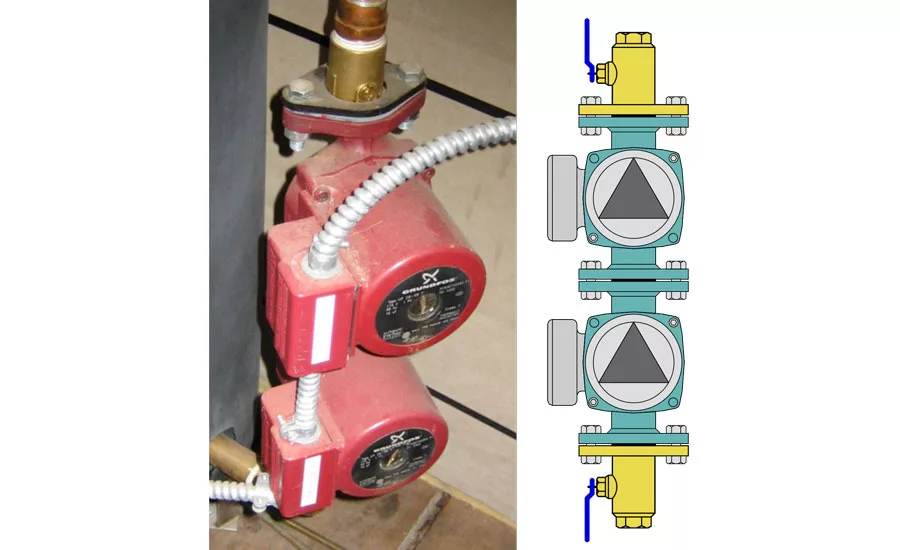
Figure 2: One way to accommodate the initial lift head of a circuit is to put two circulators in series in a close-coupled configuration, as shown here.
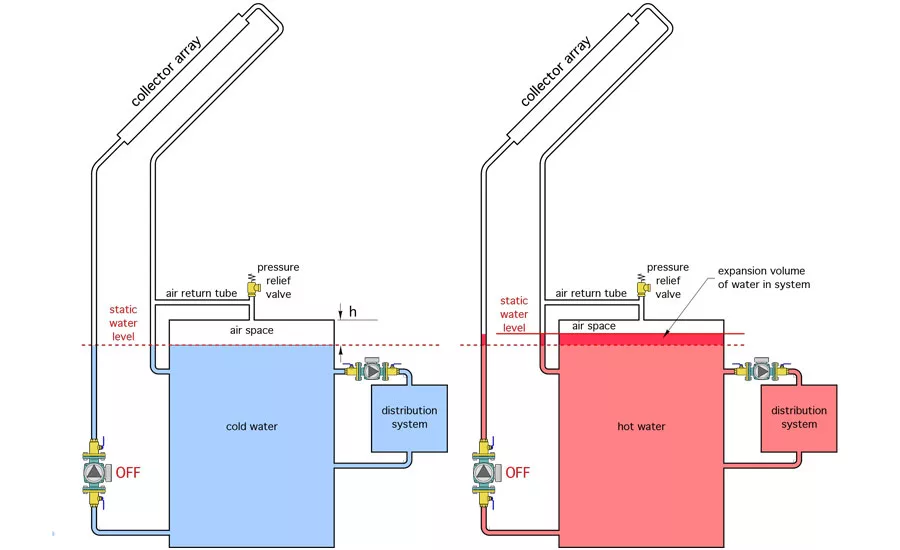
Figure 3: In drainback systems, the air space required to accommodate water draining back from the collector array also can be sized to serve as the expansion volume for the entire system.

Figure 4: When it’s necessary to locate the collector array on the roof of a taller building, a small drainback/expansion tank can be installed within the heated space just below the roof.
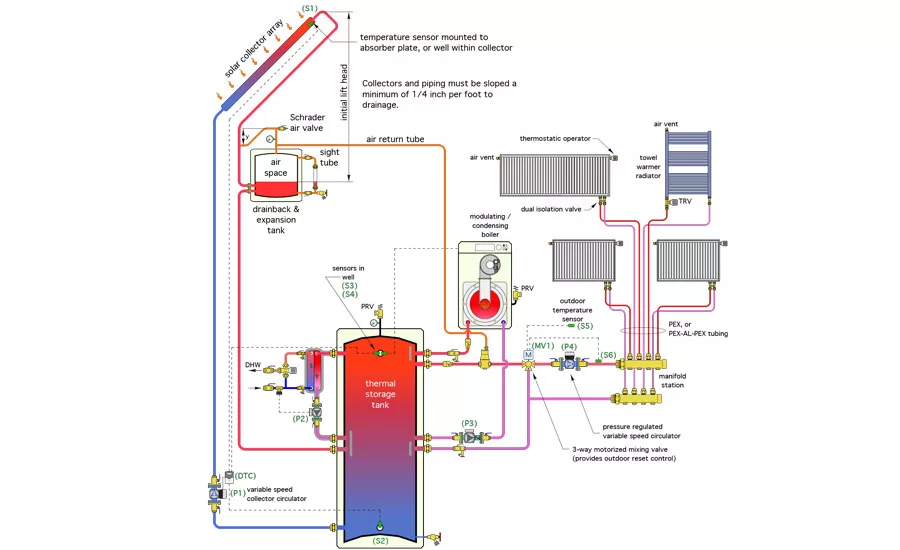
Figure 5: A complete solar thermal combisystem that utilizes many of the components discussed in this article.

Figure 6: A full chapter of this hydronics book is devoted to designing drainback-protected combi-systems.
The solar thermal systems market has essentially settled on two means of freeze protection: antifreeze or drainback systems.
The latter are designed so water, or other fluid within the collector circuit, drains back to an interior storage tank whenever the collector circulator is not operating. A film of water, or tiny droplets of water, may remain in the collectors and piping components after drainback. However, this very small amount of water will not cause damage to the collectors or piping when it freezes.
To ensure proper drainage, all water tubes that are part of the collector’s absorber plate as well as all piping carrying water to and from the collector array, must have a minimum downward pitch of ¼ inch per square foot of horizontal travel.
Tens of thousands of antifreeze-protected solar thermal systems are now in operation around the world. However, the use of antifreeze does bring some “baggage” to the design process.
• Antifreeze, especially the high-temperature-resistant propylene glycols now commonly used for solar thermal applications, adds cost to the system. These formulations of propylene glycol solutions sell for $17-$36 per gallon. The use of deionized water to dilute this antifreeze, where required, will add further cost.
• All glycol-based fluids must be protected against degradation due to high-temperature stagnation conditions in solar collectors. This usually requires additional hardware for heat dumps within antifreeze-protected systems. It adds cost and complexity to the system.
• The glycol-based antifreeze solutions used in solar thermal applications should be tested on a yearly basis to ensure the pH and levels of corrosion inhibitors are correct. If they’re not, the collector loop circuit will require additives to restore the proper chemistry.
Looking for quick answers on air conditioning, heating and refrigeration topics? Try Ask ACHR NEWS, our new smart AI search tool. Ask ACHR NEWS
• The use of antifreeze fluids requires a heat exchanger between the solar collector array and thermal storage tank. This adds to installation cost and creates a “thermal penalty” by forcing the collector array to operate at higher temperatures than would be necessary if no heat exchanger was present. It is not uncommon for such heat exchangers to reduce annual solar energy yield by 3-5 percent.
• Cold antifreeze fluid increases the thermal mass of collectors, which slows the rate at which the absorber plate temperature can increase as solar radiation reaches usable levels. This delays the start of solar energy collection relative to collectors that do not contain fluid. Daily heat collection will be reduced.
• The use of antifreeze in a solar thermal system requires hardware, such as a high-point air vent and isolation valve, purging valves, an additional pressure relief valve, and a dedicated air separator within the collector circuit. Some of this hardware can be eliminated by drainback freeze protection.
MISCONCEPTIONS
A drainback system requires a circulator (or two circulators in series) that can lift the water from the static water level in the system up and through the collector array. This initial lift head is illustrated in Figure 1.
There are several ways to accommodate the initial lift head of the circuit. One is the use of a high-head circulator with a steep pump curve. Another is to put two circulators in series in a close-coupled configuration as shown in Figure 2.
When bolting circulators together in a close-coupled configuration, it’s important to be sure both circulators are moving fluid in the same direction. You’re probably thinking no one is so careless as to not realize this. Unfortunately, I’ve seen those little arrows on the pump volutes pointing in opposite directions at least three times.
It’s possible to just turn on a single high-head circulator or two closely coupled circulators and let them run at full speed for the entire operating cycle. Opponents of drainback systems will argue such an approach uses more electrical energy compared to a fluid-filled circuit operating with an antifreeze solution. That is probably true, but it’s not the end of the story.
It’s also possible to enhance the way circulators in drainback-protected systems operate so that electrical energy use is very similar and perhaps even a bit less than that of a constant-speed circulator in an antifreeze-protected system.
One approach has been used for several decades in drainback systems using two closely coupled circulators. The idea is simple: Design the collector circuit so the piping returning from the collector array quickly fills with fluid each time both circulators turn on. This establishes a siphon in the return piping that effectively cancels out most of the initial lift head required to push water up and through the collector array.
Once this siphon is established, the downstream circulator in the close-coupled pair is turned off. The circulator that remains on continues to move water through the collector circuit where nearly all the head loss is now caused by the friction of water flowing through the piping rather than the lift head. The system continues to operate with only one circulator until the end of the collection cycle. This scenario repeats itself for each subsequent collection cycle. The net effect is the electrical energy used to operate the collector circuit is comparable to that of an antifreeze-protected circuit using a fixed-speed circulator to produce a thermally equivalent flow rate.
It’s also possible to use a variable-speed circulator that operates at full speed to prime the collector circuit, which then reduces speed to maintain flow in the now water-filled circuit. Several products are now available on the North American market that operate based on this principle.
DOUBLE DUTY
Another benefit of drainback systems is that the air space required to accommodate water draining back from the collector array also can be sized to serve as the expansion volume for the entire system (collector array, thermal storage tank, and even the heating distribution system if it’s directly connected to the thermal storage tank). This is true for both open systems and closed pressurized drainback combi-systems. It eliminates the need for a separate expansion tank and an automatic make-up water assembly in the system. Figure 3 shows the idea.
Another misconception regarding drainback systems is they can’t be used in situations where the vertical height difference between the thermal storage tank and the top of the collector array is more than 25 feet. This is not true. When it’s necessary to locate the collector array on the roof of a taller building, a small drainback/expansion tank can be installed within the heated space just below the roof — as shown in Figure 4.
The initial lift head for this system is the difference between the static water level in the small tank and the top of the collector array. This remains true regardless of the distance from this static water level to the low point of the system.
Figure 5 shows a complete solar thermal combi-system that uses some of the details we’ve discussed.
I’m sure many readers will recognize several modern hydronic components within this system, such as panel radiators served by a homerun distribution system, a variable-speed distribution circulator, motorized three-way mixing valve, and a mod/con boiler for supplemental heating. Some of you may also recognize the on-demand domestic water heating subassembly connected to the left side of the thermal storage tank.
The use of modern hydronics technology for the balance of system, in combination with the drainback-protected solar collector array, produces a state-of-the-art system that’s simple, reliable, and efficient.
Before putting all the concepts embedded in Figure 5 into play, designers need to do some number crunching. There are specific methods for determining the volume of the air space required for expansion and drainback, the maximum allowable height of the collector array relative to the static water level in the tank, and the size of the collector array return piping to ensure siphon formation each time the collector circuit goes into operation.
You can find a wide range of number-crunching design information in my new textbook: “Heating with Renewable Energy.” You can see the cover in Figure 6. A full chapter is devoted to designing drainback-protected combi-systems and several complete system examples.
I can attest to the fact that properly installed drainback systems work well. I’ve lived in a house with a drainback combi-system we installed in 1980. There’s not a drop of antifreeze in our system, and it’s endured winter temperatures as low as minus 33ºF. The same water that flows through the solar collectors flows through the radiant floor tubing. The only heat exchanger in the original combi-system was for domestic water heating.
If I were to redesign this system today, using modern hardware, there are some things I would change, but closed-loop drainback freeze protection would not be one of them.
Publication date: 3/20/2017
Want more HVAC industry news and information? Join The NEWS on Facebook, Twitter, and LinkedIn today!
Looking for a reprint of this article?
From high-res PDFs to custom plaques, order your copy today!