School Gets Help After Tornado

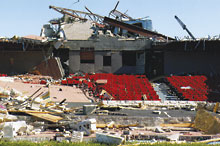
"It was surreal," said Dr. Roy Baker, superintendent of the George W. Norris School District. "Initially, it was difficult to comprehend the magnitude of what had occurred. It looked like photos we've seen of military bombings, with debris and overturned vehicles scattered about a broad area."
The cataclysm, which occurred in only a few minutes on May 22, 2004, would cost $25 million in reconstruction. Major sections of roofs had been torn away, leaving classrooms, auditoriums, and other spaces exposed to weather. Some walls were torn apart. Windows were blown out.
"One hundred percent of the integrity of the roofs was compromised. Water covered every square inch of floor, and it still was raining days after the event," Baker said. Intermittent periods of rain continued through early June.
The three-school campus is on 160 acres 15 miles south of Lincoln. Seventeen hundred students attend Norris High School, Norris Middle School, and Norris Elementary School.
The high school and middle school are in two buildings that share a common roof. The elementary school is housed in a separate building, 50 yards away. The one-story masonry buildings total 260,000 square feet of space.
Recovery Action
Baker knew he needed to act quickly to prevent further damage from water and rain. Also, he needed to ensure that reconstruction of the buildings would be completed in time for the start of classes on Sept. 7.Baker convened the school board members at his home the morning after the event to formulate an action plan. He contacted construction companies that had previously done work for the district. He talked to the district's insurer, Allianz Insurance Co.
An Allianz representative from McClarens Young International impressed upon Baker that fast action was critical in order to save documents and furniture, mitigate the residual effect of water damage inside the buildings, and prevent the formation of mold, mildew, and bacteria.
Looking for quick answers on air conditioning, heating and refrigeration topics? Try Ask ACHR NEWS, our new smart AI search tool. Ask ACHR NEWS
With Baker's concurrence, Allianz immediately contacted Munters Moisture Control Services (MCS), with which it had worked previously in disaster situations. Munters placed drying units and crews on site the second day after the tornado struck.
Restoration Services
Because of the extent of damage to the school campus, a number of restoration services would need to be implemented.Tom McGuire, national catastrophe operations manager and document recovery manager for MCS, was in charge of the recovery operation and implemented a four-pronged approach:
1. Structural drying and stabilization - Desiccant dehumidification units were put in place immediately to dry the air.
2. Content inventory and restoration - All furnishings and equipment were removed to clean and sanitize them.
3. Building sanitizing - The interior surfaces of the buildings were cleaned and sanitized.
4. Document stabilization and restoration - All documents were removed to preserve them from further deterioration and to restore their condition.

Structural Drying
The reconstruction contractors quickly installed temporary roofing and coverings to damaged windows and walls. MCS placed 10 of the company's largest capacity industrial desiccant dehumidification units and some 3,000 feet of temporary ducting to carry dried air into the structures."We worked quickly to get the environment under control utilizing multiple dehumidification units and air ducts," said McGuire. "Optimum indoor drying conditions occur at 20 percent relative humidity and 65 degrees to 70 degrees F with constant airflow over interior surfaces."
According to Munters, desiccants can attract and hold from 10 percent to more than 10,000 percent of their dry weight in water vapor. The essential characteristic of desiccants is low surface vapor pressure. A cool, dry desiccant can attract moisture from the air because its surface vapor pressure is low. When the desiccant becomes wet and hot, creating high surface vapor pressure, it will give off vapor to the surrounding air. Vapor moves from the air to the desiccant and back again depending on the vapor pressure differences.
The industrial dehumidifiers were used to remove moisture and prevent the formation of mold, said McGuire; they also contributed to building stabilization. The dehumidifiers worked in conjunction with cooling units to provide controlled interior environments for the buildings while the HVAC systems were being replaced. The dehumidification procedure continued throughout the reconstruction of the Norris schools.
Content Inventory And Restoration
MCS removed all furnishings and equipment from the damaged areas of the schools. Many soft goods had to be discarded, but hard goods such as desks and chairs were hand cleaned and stored. Smaller items were sorted, cleaned, and stored in 40- by 8- by 8-foot containers and in an undamaged gymnasium."Everything that came out of the school was inventoried, cleaned, and sanitized," said McGuire. "We stored everything and brought it back as they needed it. The labor force for this phase of the project was around 60 people, and it took about 60 days to complete."
Building Sanitizing
Crews removed debris, dirt, mud, and dust from floors to rafters and washed and sanitized all interior surfaces to prevent mold spores from growing."All buildings, from residential to commercial, can experience mold problems. But schools are drawing more attention and scrutiny," said McGuire.
In order to grow, mold requires air, suitable temperatures, relative humidity, and a moist nutrient. "Drying and sanitizing materials that become wet is critical to successfully combat mildew and mold," McGuire said.
Document Restoration
Time is an enemy to successful document recovery. Moisture quickly causes irreparable damage and mold in paper, film, diskettes, microfiche, and other documents. Any delay in the decision to dry the materials can result in permanent loss. Inks can break down, making the text illegible. Dirt and grime can penetrate the paper. Mold and mildew will grow quickly.Drying techniques must be employed as soon as possible to eliminate the moisture fungi use as a food source to grow. Otherwise, the microbiological contamination, and the associated objectionable odors, will continue, making restoration unlikely. Such items must be frozen within 48 hours to abate deterioration and hold them for the drying process.
MCS removed and inventoried from the Norris schools all documents, the majority of which were books. The materials were loaded into eight freezer-equipped truck trailers designed to stabilize the materials. The trucks transported the stabilized materials to MCS' document recovery center in Chicago, where they were blast frozen, dried, cleaned, packed, and returned. Two drying methods were employed, depending on the type of material: desiccant air drying and vacuum freeze-drying.
The frozen documents were placed on racks and shelves in a 6,000-square-foot room. By applying desiccant dehumidification, the room atmosphere was maintained at about 68 degrees and 12 percent humidity. Continually moving dry air in the drying room removed moisture from the documents. According to MCS, desiccant air drying is the best application for files.
Vacuum freeze-drying is the preferred method for documents that may tend to warp or distort during desiccant drying, such as books or journals. In such cases, it is important to save not only the paper, but also the integrity of the binding. Those materials were placed in an airtight chamber into which negative vacuum pressure was induced to turn moisture into a gaseous state.
After documents were dried, they were cleaned. Cleaning re-moves any dirt or grime and, more importantly, fungi spores. In cases when they deal with mold spores, trained staff members wear personal protection equipment and follow standard procedures for spore removal, including the use of High Efficiency Particulate Arrestor (HEPA) vacuum systems.
After cleaning, all documents were assembled into new boxes, labeled according to the inventory, and delivered to the school district as soon as the reconstruction was complete.
Major Challenges
McGuire said the Norris schools work presented many challenges. Foremost among them was the need for speed. All contents and debris had to be removed quickly, before contractors could begin their reconstruction work.The sheer quantity of the materials removed was the largest volume McGuire had witnessed in his 18 years in the industry. Some 800,000 cubic feet of materials were removed, stored, inventoried, cleaned, and returned.
The enormity and speed of the job required retaining as many as 150 temporary workers. Some 20 managers trained and supervised the workers.
To ensure the safety of all personnel while working in proximity to construction crews and their equipment, such as bulldozers, crew leaders conducted briefings each day before work began and tasks were conducted under close supervision. As a result, no major incidents occurred.
Results
Dr. Roy Baker said the schools opened on time Sept. 7, using classrooms that had been renovated along with temporary portable classrooms the district had leased. Reconstruction of remaining classrooms and other parts of the schools was completed by the end of 2004."The task was monumental, but the fact that we were able to meet our tight schedule, open the school on time, and that our great collection of books was saved was miraculous," said Baker. "Without the fine help of Munters MCS, the loss and the costs would have been much higher."
Publication date: 05/02/2005
Looking for a reprint of this article?
From high-res PDFs to custom plaques, order your copy today!


