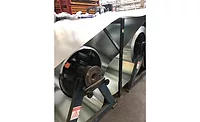
Duct Basics For Hvac Contractors
This and succeeding articles will focus on how you can help your customers:
- Save money;
- Improve comfort;
- Protect health and safety; and
- Improve envelope durability.
The fan gets its air supply through return ducts, which in the best systems are sized properly and installed in every room of the house. To save on installation costs, most homes have one or two return registers located in common areas, such as hallways.
Some homes have no return ducts. Such design shortcuts often result in lower efficiency and higher heating and cooling bills.
ENERGY LOSSES, SAVINGS GAINS
Typical duct systems lose 25% to 40% of the heating-cooling energy put out by the central furnace, heat pump, or air conditioner. Homes with ducts in a protected area, such as a basement, may lose less than this; other types (such as attic ducts in hot, humid climates) often lose more.Duct repairs could be the most important energy improvement measure if the ducts are in the attic. If only half the typical loss of uninsulated and unsealed ducts that are in attics or crawl spaces were saved, it would amount to $160 off the total heating and cooling bill in a typical home. These savings are based on the national average use of natural gas and electricity for central heating and cooling at national average energy cost of 70 cents per therm (natural gas), and 8 cents per kilowatt-hour (kWh, electric). With these savings, the cost to seal and insulate the ducts would most likely be paid for after three years.
These estimates apply to sealing and insulating ducts in an existing home. For new construction, more of the ductwork would be accessible to the installer and the potential savings would be greater; the payback would be less than one year.
Duct systems lose energy in two ways: by conduction of heat through duct walls, and air leakage through small cracks and seams. For simplicity we’ll talk about warm air for heating, but the same information applies to cooling when the air conditioner is on.
CONDUCTION
Duct systems lose energy when warm air inside the ducts heats the duct walls, which in turn heat the cold air outside the ducts. If the ducts are in an attic or vented crawl space that is nearly as cold as the outdoors, this heat is completely lost. If the ducts are in a basement, some of the heat lost from the ducts may be recaptured by warming the basement ceiling enough to reduce the heat lost from the house.Conductive heat losses (and unwanted heat gains in air conditioning) are typically responsible for about half the energy inefficiency in duct systems. Conduction is encouraged by large temperature differences between the inside and outside of the duct, and by large areas of ductwork exposed to these temperature differences. It is inhibited by insulation.
Looking for quick answers on air conditioning, heating and refrigeration topics? Try Ask ACHR NEWS, our new smart AI search tool. Ask ACHR NEWS
Duct leakage, on the other hand, is more subtle and complicated. Air leakage causes most of the health and safety concerns that arise from duct systems.

AIR LEAKAGE
Sometimes air leakage is from accidental holes in the ducts or poorly connected sections; but even if the ducts are sealed, their operation can cause the house itself to leak more air than would otherwise be the case.Air moves from high pressure to low pressure. To get air to move from the supply duct into the room it serves, the air in the duct has to be at a higher pressure than the air in the room. Similarly, to move air from the room into the return duct, the air in that duct has to be at a lower pressure than the air in the room. The registers are the openings through which this air is intended to move. The duct walls provide barriers that prevent air from moving where we don’t want it to go.
The fan of the central furnace creates these pressure differences. When the fan stops, these pressures quickly equalize and the flow of air through the duct stops, too.
Figure 1 shows a duct system that does not leak. The furnace fan produces high pressure in the supply ducts and low pressure in the return ducts. The high-pressure forces warm air from the supply ducts to flow into the rooms; low pressure draws room air back into the return ducts.
Figure 2 shows perhaps the simplest example of duct leakage. The supply ducts leak, but the return ducts are air tight. Even though half of the duct system is good, two bad things happen:
1. Some of the air that was just warmed by the furnace is lost.
2. This air has to be replaced. If it weren’t, the house would soon be pumped down to a vacuum, and we know that doesn’t happen. Outside cold air is drawn into the house through cracks and small holes in the outside walls (usually around doors and windows).

LEAKY RETURN DUCTS
Suppose the supply ducts are tight but the returns leak; the return duct is at a pressure lower than the house or the outside, so cold air from the outside is pulled into this duct. This cold air is heated in the furnace (along with air that came from the house through the return registers). The amount of air delivered to the house by the supply registers is greater than what the return ducts took from the house (the difference being the cold air that leaked into the return ducts).To equalize the flows, heated room air leaks out of the house through the same holes and cracks that, in the previous example, allowed air to leak in. Cold air is pulled in and warm air leaks out. In addition to energy losses, leaky return ducts can create health problems. (More about this later.)
During the cooling season in hot, humid climates, leaky return ducts can be even more of a problem; they can upset the balance between the need for reducing the indoor temperature and the need for reducing humidity. If the ducts are in a relatively cool but humid space, such as a vented crawl space, the air leakage into these ducts will add a lot of moisture to the air in the house, but will not increase its temperature much. The air conditioner will satisfy the thermostat nearly as quickly as in the absence of such leakage, but will leave the house excessively damp.
It should also be noted that joints and penetrations in the air handler cabinet and any add-on filter installations are often major contributors to return-side duct leakage. Since these are the locations of the greatest negative pressure anywhere in the system, even small holes can give rise to significant amounts of leakage.
ZONE PRESSURIZATION
Ducts can cause air leakage in the house even if neither supply nor return ducts leak. Imagine that a home has a return register in one room but no supply, and a supply register in another room but no return. Now close the door between these rooms.The room with the supply duct will have relatively high pressure. The supply duct will try to blow this room up like a balloon. The room with the return will have relatively low pressure. Inside air will leak out from the room on the right, and outside air will leak into the room on the left. This places an added load on the heating equipment.
Most new homes do not have duct returns in each room. The problem can be avoided in rooms with no return register and doors that are often closed by installing an opening covered by a louvered grille in the door or in the adjoining wall. This grille may need to be larger than one would think.
Even when the central furnace fan is off (which is most of the time), leaks in ductwork add to the air leaks in the rest of the house. The cracks in ductwork typically have an area that is 10% to 20% of the leakage area of the house. Over the course of a heating season, energy losses from ducts when the fan is off can be nearly as great as when the fan is on.
PART OF A SYSTEM
Interactions between ductwork and the rest of the building can often produce some surprising effects.Duct energy losses and equipment inefficiencies can work together to give surprisingly low overall system efficiency. When a furnace meeting the current national standards (78% AFUE) is combined with a typical duct system installed in a vented attic or open crawlspace (60% to 75% seasonal efficiency), only about half the heating value of the fuel will make it into the house.
Heat pumps and air conditioners are in the same boat as furnaces, although the calculation is somewhat more involved. Two or more energy losses, each of which might seem not too bad in itself, can add up to a disappointing result.
Ducts interact with the rest of the building in the following ways.
Thermal regain (recovery of lost energy): Most U.S. residential forced-air systems have their ducts in an attic or crawl space that is not conditioned, but which is adjacent to the conditioned space. (Basements containing ducts are sometimes intentionally conditioned, sometimes not.) If this buffer zone is not vented (true of most basements and some crawlspaces), any heat lost from these ducts may warm the zone significantly.
This rise in temperature, compared with what would happen if there were no ducts, retards heat loss from the conditioned space into the buffer zone containing the ducts. It also retards heat conduction through the walls of the ducts themselves (although it does not, of course, retard air leakage). These benefits can soften the energy penalty of the losses. This recovery, called thermal regain, can also occur in cooling.
Equipment efficiency: Energy losses from ducts generally result in a greater load on heating-cooling equipment than would be the case with a perfect duct system, even after any thermal regain has been accounted for. The increased load can raise or lower the efficiency of the heating-cooling equipment.
With single-capacity furnaces and single-speed air conditioners, the impact of ducts on equipment efficiency is usually too small to notice. With variable-capacity equipment (this includes heat pumps with resistance backup coils), an inefficient duct system can seriously degrade the equipment’s average efficiency over an entire season.
Pressure effects: Some of these have already been discussed. Operation of the central air handler fan usually causes the distribution of pressures in the house to change. These pressure changes may affect the rate at which outdoor air infiltrates into the home, generally increasing (though sometimes decreasing) the heating or cooling load. They may also affect the health and safety of occupants.
Duct location, thermal regain: Thermal regain underpins any discussion of where ducts should be located within the home. The higher the thermal regain factor, the better the location.
The best places for ducts are in spaces that are intentionally heated, or that retain lost heat exceptionally well. If ducts are located within the conditioned space, any lost heat or cooling is not really lost (although it may be necessary to rebalance the system to attain proper distribution within the home).
If a basement is intentionally conditioned (generally speaking, if it has registers and is used for family activities), then it should be considered part of the conditioned space, with 100% regain. If the basement walls are insulated, regain will approximate 75%, even if the basement is not intentionally conditioned. Another good place for ducts, at least from a thermal standpoint, is under a slab (but not right at the edges of the slab if it isn’t insulated). But because in-slab ducts are set in concrete, they are probably not a good choice for any but the most knowledgeable and experienced builders.
Ducts in unvented, uninsulated basements and crawl spaces and exterior walls regain about half the heating or cooling value of the thermal losses. While better than nothing, they are not the best choices for new construction. There is some evidence, moreover, that ducts in basements may, as actually installed, leak more than those in crawlspaces and attics, possibly due to a belief that thermal losses from such ducts don’t matter. When ducts are located in a basement, insulating the basement walls rather than the ceiling is recommended because it increases the regain factor and makes the basement warmer in winter.
All other duct locations have regain factors ranging from 30% down to essentially zero, and should be avoided if possible.
Thermosyphoning: To the extent that thermal regain occurs, duct energy losses are reduced. Another effect that depends on duct location can make duct losses worse. This is called thermosyphoning. It usually occurs when the duct system is spread out over more than one level.
Consider what can happen during the heating season. When the fan shuts down, the ducts are full of warm air. As that air loses heat to the outside, it sinks to the lowest level in the system and enters the house through floor registers. To replace this cold air, warm air from the rooms is pulled into the duct system through the ceiling registers, where it then cools down, continuing the thermosyphon loop.
Thermosyphon loops effectively transfer heat from the house to the outside, the opposite of what we want. The flow direction in such loops is also usually in the opposite direction to the normal flow.
In new construction, these loops can be avoided by placing the ducts in the conditioned space, or at least avoiding split-level duct configurations. In existing systems, the effect can be mitigated by adding insulation to ducts that are outside the conditioned space.
Publication date: 01/14/2002
Looking for a reprint of this article?
From high-res PDFs to custom plaques, order your copy today!