HVACR Contractors Deem VRF Technology the Next Big Thing
Contractors tout the technology’s efficiency, effectiveness
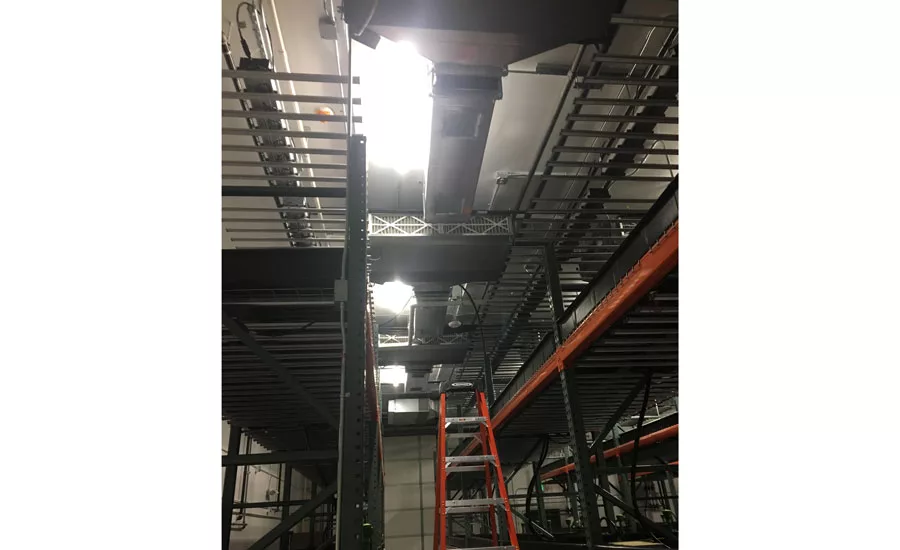
FIELD EXPERIENCE: Joe Bingham, director, Mt. Rose Heating & Air Conditioning Inc. in Reno, Nevada, has been working with VRF for nearly 15 years. Pictured is a row of ceiling cassettes the company recently installed.
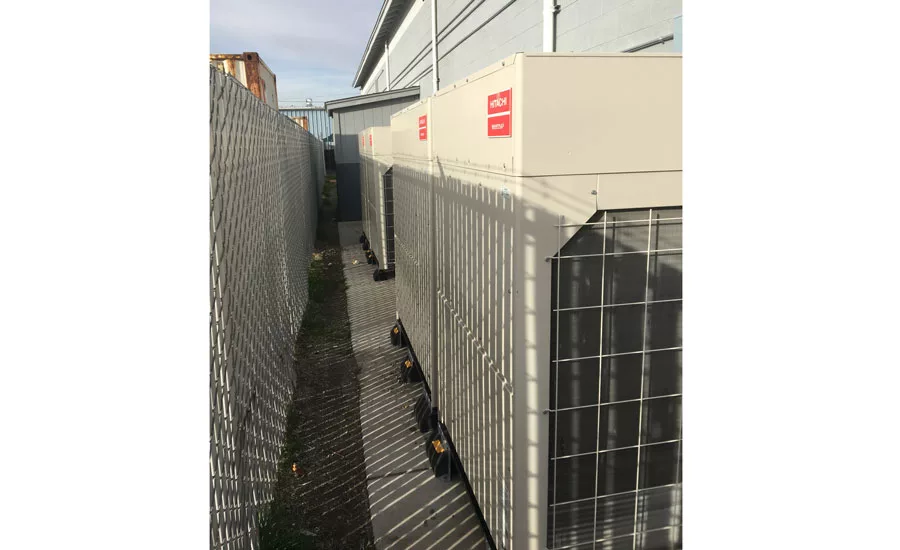
CATERING COMFORT: These Hitachi VRF condensers effectively help to heat and cool a warehouse in Nevada. Hitachi entered the U.S. market via a partnership with Johnson Controls Inc. in the fall of 2015.
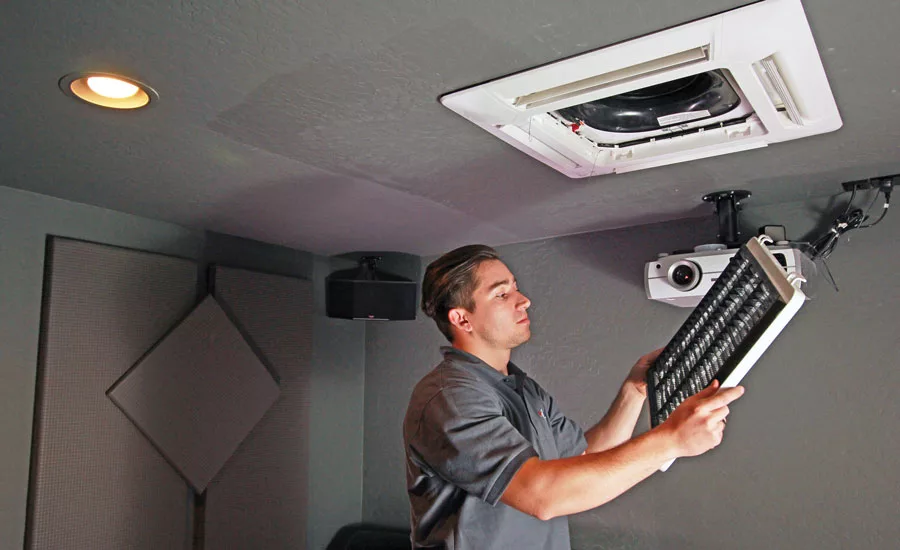
MULTIPLE BENEFITS: VRF systems utilize refrigerant as the only coolant material, inverter compressors that keep the units running efficiently at part-load performance, and several air handlers that can be operated on the same refrigerant loop or circuit.
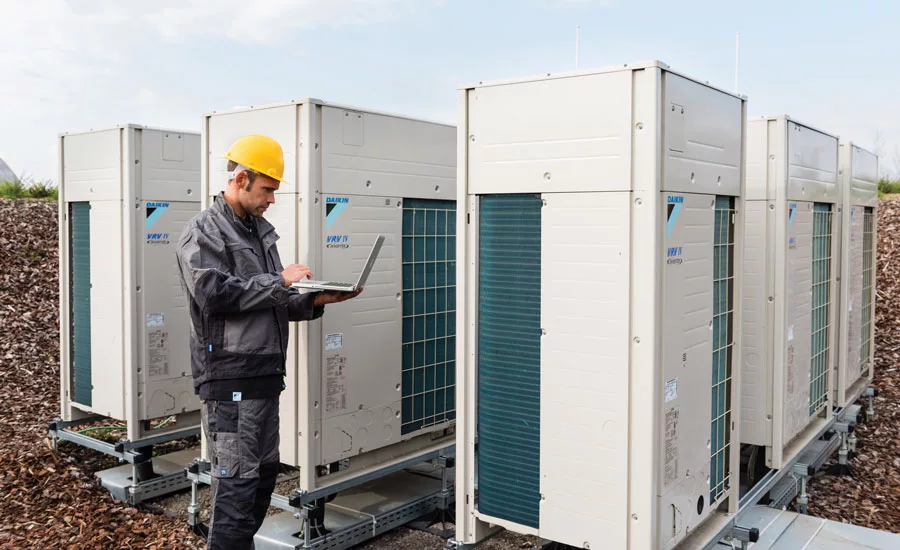
COST EFFICIENT: VRF’s efficiency is incredible, according to David Escobar, COO and BIM manager, Brothers Mechanical Inc., Lorton, Virginia. “I believe it’s the most cost-effective equipment available,” he said.
Whether it’s geothermal technology, inverter compressors, or Internet of Things (IoT)-enabled devices, HVACR contractors are constantly on the lookout for the next big thing. When creating a definitive list of budding HVACR technologies in 2018, variable refrigerant flow (VRF) consistently ranks near the top.
While VRF is a primary heating and cooling choice in Europe, Japan, and China, where many buildings lack ductwork, it’s a relatively new option in the U.S., where ducted systems using direct expansion and chilled water equipment have been the preferred option.
Quickly after being introduced in the U.S., it seems as though VRF has certainly found its niche. A recent report from MarketsandMarkets noted the global VRF market was valued at $11.08 billion in 2015 and is expected to reach $24.09 billion by 2022, which is a compound annual growth rate (CAGR) of 11.4 percent.
HOW IT WORKS
Authors Brian Thornton and Anne Wagner provided a general overview of VRF in their “Variable Refrigerant Flow Systems” report, prepared on behalf of the General Services Administration.
In the document, they note VRF systems are composed of two major parts — a compressor unit and multiple indoor fan coil units. The compressor, often controlled by a variable-speed drive, cools and heats refrigerant connected through piping to condition the building. In most cases, VRF systems are capable of simultaneously cooling and heating separate zones. The heat removed while cooling spaces can be recovered and utilized to heat separate areas and vice versa.
The fan coil can be installed on the ceiling, walls, or floor level within the conditioned space and may also be hidden above the ceiling near the conditioned space and connected via short air ducts.
Required outside air must be delivered to the space through another mechanism, typically a dedicated outside air system (DOAS). DOAS units — specifically energy recovery ventilators (ERVs) — often include energy recovery from the exhaust air to the incoming outside air, which includes pre-cooling and pre-heating, depending on the outside air temperature, as well as dehumidification and humidification capabilities.
Looking for quick answers on air conditioning, heating and refrigeration topics? Try Ask ACHR NEWS, our new smart AI search tool. Ask ACHR NEWS
VRF controls are matched and operated on a proprietary basis and include self-diagnostics, monitoring points, sensors, and the ability to communicate with a wide variety of other building systems.
Additionally, VRF systems utilize refrigerant as the only coolant material, inverter compressors that keep the units running efficiently at part-load performance, and several air handlers that can be operated on the same refrigerant loop or circuit. Finally, the equipment offers room for expansion, which is beneficial in institutional settings that may consider future expansion.
CONTRACTOR TESTIMONIALS
ACCO Engineered Systems in Glendale, California, operates 35 offices in the western U.S. The employee-owned company has completed nearly 700 VRF projects over the last 10-15 years. As the company has grown more familiar with the technology, it is now completing approximately 100 VRF projects each year.
“When we were first getting started, product availability was a major concern,” said Chuck Darway, vice president of ACCO Engineered Systems. “If a compressor wasn’t working, you couldn’t get the parts because distributors simply didn’t stock them. Whether you were on a start-up or a warranty repair, there was a long wait time to obtain the necessary equipment.
“We also had difficulty locating trade technicians who were trained and certified to work on the equipment when we first got started,” Darway continued. “Additionally, we were constantly dealing with leaks because there is a lot of refrigerant piping in these systems. There is always a potential for someone to bend, break, or poke a hole in the piping. When that occurs, you’re challenged to go and find that imperfection, repair it, and then make sure the system has the right amount of charge and is working appropriately.”
Darway deemed design and spec the most important part of a VRF install.
“Because VRF is very complicated, it’s important for our engineering teams to consistently go back through and validate the manufacturer’s requirements from line length to refrigerant charge,” he said. “There are also code requirements that limit the amount of refrigeration that could leak into a given space before asphyxiation concerns. When we’re routing pipe, we have to be aware where that pipe goes, where it ends, and the potential volume that could be dispersed in a given location if that pipe were to leak. Additionally, things change in construction. Walls are added and pipes are rerouted, so we’re constantly going back and validating our calculations to make sure nothing’s changed that could cause a health risk or detriment to the performance of the system.”
Darway called VRF a hot commodity and said contractors should consider getting involved as soon as possible.
“As an industry, we’re always striving to find something that gives our clients another option,” he said. “We’re always looking for more tools to help solve problems as efficiently as possible. VRF is a great addition to our toolbox. It’s not the end-all be-all, but it’s a great solution that’s constantly evolving.
“Early on, all you could get was a 3-ton fan coil,” Darway continued. “Well, that didn’t work for a lot of installations because we needed bigger systems. Now, we’re seeing 5-, 6-, and 8-ton systems, which are providing a bit more depth in the market. As these systems continue to grow and expand, the market will follow.”
Capital City Refrigeration Ltd. in Saanichton, British Columbia, Canada, has been working on small VRF projects for more than 10 years. Tim Sykes, co-owner, Capital City, said the contracting company took on its first major project about four years ago and hasn’t looked back.
“For that first project, we actually built custom air handlers to replace a really specific, older zone system in a heritage building,” said Sykes. “The custom rooftop unit enclosures housed all the ductwork, zoning equipment, and VRF equipment inside. It was quite a unique project that demonstrated the intricacies of VRF.”
Capital City has since completed school retrofits, convenience stores, offices, hotels, and other VRF projects in and around Saanichton.
Sykes said VRF projects are very detail-oriented and require meticulous measurements and precise calculations, which can be challenging for some.
“A lot of times, the engineering firms we work with will perform the load calculations, and if those equations are not correct, the entire application could fail before the installation ever begins,” he said. “These installations take a lot more finesse than standard unitary projects. You have to be aware of the specific procedures and make sure everything’s correct throughout every step of the project.”
To achieve this level of detail, VRF projects require significant planning as well as design and spec work.
“It honestly takes one or two big projects before you, as a contractor, get a feel for the amount of time these projects require,” Sykes said. “On our first project, we were probably 10 percent over on our hours. VRF takes a significant amount of time and planning. And, if you have issues, which you most likely will, addressing those concerns will chew up even more time.”
While VRF is a budding technology, it’s not for everyone, Sykes said.
“You have to have the right capabilities to adequately complete a VRF project,” he said. “Some guys think they have the capabilities to do it, but, perhaps, they’re not as detail-oriented as they need to be. You want to carefully make sure everything’s done properly, otherwise, you’re going to have issues.
“Overall, VRF is good for the industry,” continued Sykes. “It gets the HVACR work away from the mechanical contractors and more into the hands of the HVAC and refrigeration contractors. Some big MEP contractors aren’t carrying VRF expertise, so they rely on the HVAC guys to do it. These systems cost hundreds of thousands of dollars to put in, so it’s imperative you do your homework before getting involved.”
Sykes called VRF the next big evolution in the trade.
“This is absolutely something commercial HVACR contractors should be investing in,” he said. “Guys who aren’t gearing up for it could potentially be missing out.”
David Escobar, COO and BIM manager, Brothers Mechanical Inc., Lorton, Virginia, said company leaders identified the onset of VRF 10 years ago and became an early adopter of the technology at that point. The company has installed more than 200 VRF projects to date.
“About a decade ago, we saw VRF starting to break into the U.S., so we took classes, obtained certifications, and became very familiar with the equipment and philosophies. We also took a few international trips to factories overseas and learned how it was being used there. I believe we were the first company to install VRF in a high-rise building in Washington, D.C.”
Early on, Escobar said everyone struggled with the VRF concept, but that has since changed.
“As humans, we’re generally a little scared of technologies we know very little about,” he said. “Many general contractors had no idea what it was and didn’t want anything to do with it. Additionally, the cost was a big problem early on. Originally, contractors would price it in such a way that they were covered in case they encountered an unknown.”
Escobar said the benefits of VRF are numerous.
“The efficiency is incredible,” he said. “I believe it’s the most cost-effective equipment available. If you balance the square footage of the room, the cost of splits becomes very expensive, and they take up a lot of space. And, with water systems, there are a lot of moving pieces and the potential for water leaks. We’ve had a lot of projects where we’ve been asked to value engineer the HVAC system and a lot of the time we end up using VRF due to its lack of cost and footprint.”
Joe Bingham, director, Mt. Rose Heating & Air Conditioning Inc. in Reno, Nevada, has been in business for 28 years. The company employs approximately 100 individuals and has been working with VRF for nearly 15 years.
“We first started on a small office remodel using Mitsubishi products. The owner wasn’t happy with the existing VAV [variable air volume] air handler, so I said, ‘let’s try one,’” Bingham said. “The last five years, we’ve seen a rush of VRF installations in and around resorts and executive office suites here in Reno.”
Bingham said Mt. Rose is working with VRF on a daily basis and has installed hundreds of VRF systems since first getting involved 15 years ago.
“I’ve heard of other companies having problems dealing with the other trades and the design aspect, but we really haven’t had any issues with those aspects of VRF,” Bingham said. “With the design, we can turn one around in a couple of days, especially if we get some assistance from the manufacturer. You have to make sure you budget enough time, but that isn’t a concern because you have to do that no matter what type of system you’re putting in.”
Bingham said VRF is a highly desirable technology that all commercial contractors should at least have on their radar.
“VRF offers significant energy and cost savings,” he said. “We do our own design build and plan and spec, which is advantageous. It’s easier for us to rely on our guys than other people. The engineers are buying into the technology, and we’re seeing more and more of it. We’ve been happy with the VRF product, and we know our customers are happy with it too.”
Publication date: 2/5/2018
Want more HVAC industry news and information? Join The NEWS on Facebook, Twitter, and LinkedIn today!
Looking for a reprint of this article?
From high-res PDFs to custom plaques, order your copy today!