ACHR News
search
Ask ACHR NEWS AI
cart
facebook twitter instagram linkedin youtube
  • Sign In
  • Subscribe
  • Sign Out
  • My Account
ACHR News
  • NEWS
    • Breaking News
    • New HVAC Products
    • Featured Products
    • Manufacturer Reports
    • HVAC Data
    • Legislation
    • ACHR NEWS Centennial
  • RESIDENTIAL
    • Air Conditioners
    • Furnaces
    • Residential Heat Pumps
    • Ductless
    • Residential IAQ
    • Testing, Monitoring, Tools
    • Components & Accessories
  • COMMERCIAL
    • Air Handlers
    • Rooftop Units
    • Chillers and Cooling Towers
    • Commercial Heat Pumps
    • Boilers and Hydronics
    • VRF/Ductless
    • Commercial IAQ
  • REFRIGERATION
    • Refrigerants
    • Refrigerant Regulations
    • Leak Management
  • CONTRACTOR PRO
    • Geothermal
    • Homeowner Study
    • VRF and VRV Ductless
    • Unitary Trends
  • EDUCATION
    • Training and Education
    • Business Management
    • Service and Maintenance
    • Continuing Education
    • Market Research >
      • HVAC Brand Awareness Report
      • VRV, VRF, VRVZ Report
      • Unitary Trends Report
      • Water Heat Professionals Report
    • Webinars
    • Sponsor Insights
    • eProducts Info
    • White Papers
  • EVENTS
    • HVAC Contractor Forum
    • Industry Events and Webinars
  • MEDIA
    • Videos
    • AHR Expo 2025 Videos
    • Podcasts >
      • ACHR News Podcast
      • HARDI Podcasts
      • AHR Expo Podcasts
      • ACCA Podcasts
    • Interactive Spotlights
    • Quizzes
    • eBooks
    • HVAC Talkback
  • HVAC GROUP
    • ACHR NEWS >
      • Current Issue
      • Digital Edition
      • Subscribe
    • Distribution Trends
    • SNIPS NEWS >
      • Join SNIPS NEWS
    • Engineered Systems News >
      • Join ES News
    • HVACR Directory
    • Contests
    • Newsletters
    • Contact
    • Advertise
    • My Account
RefrigerationRefrigerants

Converting R-22 Systems to R-453A
global warming potential
January 8, 2018

R-453A is a hydrofluo-rocarbon/hydrocarbon (HFC)/(HC) based, non-ozone depleting, low-global warming potential (GWP), direct drop-in replacement refrigerant blend for HCFC-22 (R-22). It can be used to replace R-22 in both air conditioning and refrigeration applications across the temperature ranges where R-22 is commonly used. Refrigeration applications using R-453A can reach down to minus 20°F evaporator temperatures. Applications for R-453A include air conditioning, commercial and industrial refrigeration, chillers, beer cellars, cold storage, refrigerated transport, supermarkets, appliances, dairy chillers, and others.

R-453A is a six-part blend of HFC-125, HFC-32, HFC-134a, HFC-227ea, butane, and isopentane. Butane and isopentane are both pure hydrocarbons (HCs) incorporated into the blend to enhance oil return to the compressor. The blend is listed in the U.S. Environmental Protection Agency’s (EPA’s) Significant New Alternatives Policy (SNAP) program. R-453A has an ASHRAE safety classification of A1, meaning it has low toxicity and is nonflammable.

GLOBAL WARMING: DIRECT AND INDIRECT EFFECTS

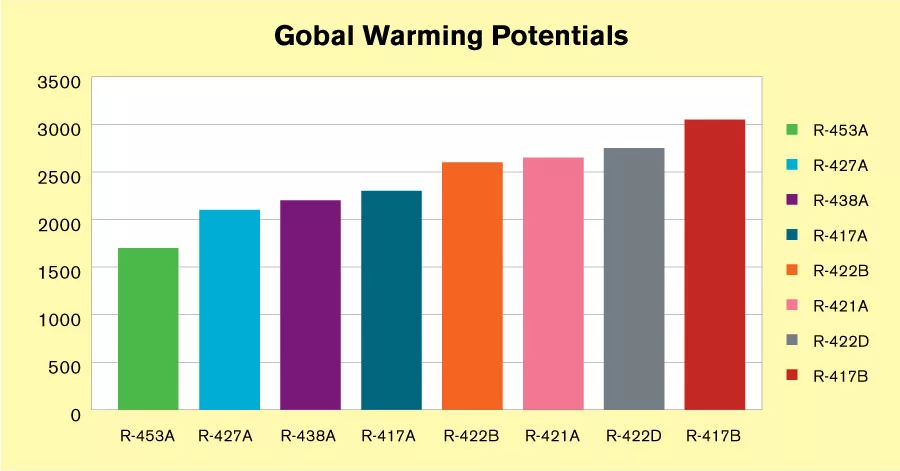
R-453A has a direct GWP of 1,765, and R-22 has a direct GWP of 1,810. A GWP of 1,765 means R-453A traps 1,765 times as much heat per kilogram as CO2 does over a 100-year period. This GWP value measures the direct effect of a refrigerant when it is released into the atmosphere. A leaking refrigeration or air conditioning system is a good example of a direct emission, which has a direct effect on global warming. See Graph 1 for a comparison of R-453A’s GWP and the GWPs of some other popular HFC-based R-22 retrofit refrigerants.

The direct measurement of global warming for a refrigerant gas alone can be a bit misleading, however. If the refrigerant never leaks into the atmosphere and stays confined in the HVACR system, the gas will have no direct effect on global warming. When figuring the total effects of global warming, many factors come into play, including the application the refrigerant is used for, the efficiency of the HVACR system, duration of operation, leakage of refrigerant from the system, and other application-specific variables. These important factors play a major role in determining the direct and indirect effects of global warming.

As an example, if an air conditioning system is a bit undercharged or overcharged, it will run longer to reach the desired indoor temperature set point. Assuming the electricity supplied to the equipment originated from a fossil fuel, the equipment’s inefficiency from the incorrect refrigerant charge caused a longer run time, thus more electricity usage. Longer run times indirectly cause more CO2 to be generated in supplying electricity to the equipment and would be considered an indirect effect of global warming. Conversely, if a system has a higher EER or SEER, the system will use less electricity over time, generating less CO2.

A refrigerant’s thermal dynamic efficiency and physical properties also come into play when measuring the total effects of global warming. R-453A has excellent thermal dynamic performance when used as a refrigerant in refrigeration and air conditioning applications. The blend has similar cooling capacities and a slightly higher coefficient of performance (COP) when compared to R-22. Because of this, it has the benefits of lower energy consumption than R-22. The mass flow rate and compression ratio of R-453A are also very similar to R-22, and R-453A has a slightly lower discharge temperature than R-22. Because of the higher efficiencies of R-453A, it has a somewhat low total equivalent warming impact (TEWI). The TEWI takes into consideration both the direct and indirect effects of global warming as equivalent CO2 emissions. So, even though R-453A has a direct GWP of 1,765, it is counterbalanced by its lower TEWI because of its associated higher efficiencies.

LUBRICANT AND SERVICING

R-453A is compatible with the traditional lubricants and newer synthetic lubricants in the HVACR industry, including mineral oil, alkylbenzene, and polyolester. No oil changes are required when retrofitting an existing R-22 system to R-453A. This allows an existing R-22/mineral oil system to retain its original oil once retrofitted to R-453A, preventing moisture sensitivity problems associated with newer or retrofitted systems incorporating polyolester lubricants.

Looking for quick answers on air conditioning, heating and refrigeration topics? Try Ask ACHR NEWS, our new smart AI search tool. Ask ACHR NEWS →

Because R-453A is a 400-series refrigerant blend, it has fractionation potential and a temperature glide. To avoid blend fractionation, R-453A should be charged into the system as a liquid instead of a vapor. However, if the entire contents of the cylinder are to be used in the charging procedure, vapor charging can be performed. Just be aware that all the refrigerant in the cylinder must be used in charging the same system when vapor charging, otherwise fractionation can occur.

R-453A is a safe refrigerant blend and can be both recovered and reclaimed. Leak detectors used for any HFC-based refrigerant can be used for R-453A. Capillary, fixed orifice, or variable expansion refrigerant metering devices can be retrofitted with R-453A without any lubricant or hardware changes. Also, the same service equipment can be used with R-453A as with R-22.

THE RETROFITTING PROCEDURE

Below is a brief list of retrofit guideline procedures for converting an R-22 system to R-453A.

As with any refrigeration or air conditioning system being retrofitted, always follow the detailed retrofit guidelines from the equipment or refrigerant manufacturer.

  1. Establish baseline data with temperatures, pressures, superheat, and subcooling;
  2. Record compressor oil level and refrigerant charge;
  3. Recover the R-22;
  4. No oil change is needed. However, if polyolester lubricant is used to replace the mineral oil or alkylbenzene lubricant already in the system, replacing the o-ring seals before starting the system is recommended;
  5. Evacuate the system to 200 microns, and charge the system with R-453A to 90 percent of the original R-22 charge;
  6. Start the system, and take a system check. Record pressures, temperatures, superheat, and subcooling. Compare to baseline data. Adjust the thermal expansion valve (TXV), pressure controls, evaporator regulator, and/or condenser controls to maintain desired temperatures;
  7. Check the system charge, and add refrigerant if needed to reach the original charge level;
  8. Carefully monitor the oil level in the compressor. Add or remove more oil if required to maintain the correct level;
  9. In systems with receivers or long and complex piping where oil return to the compressor could be an area of concern, the replacement of up to 25 percent of the oil charge with a polyolester lubricant is recommended;
  10. Check the system for leaks; and
  11. Label the system with the new refrigerant.  

Publication date: 1/8/2018

KEYWORDS: Climate Change and HVACR HFC refrigerants

Share This Story

Looking for a reprint of this article?
From high-res PDFs to custom plaques, order your copy today!


Recommended Content

JOIN TODAY
To unlock your recommendations.

Already have an account? Sign In

  • HVAC-enrollment

    The Trades Are Back: HVACR Programs See Nearly 30% Enrollment Spike

    A new wave of future technicians is entering the pipeline.  
    Training and Education
    By: Matt Jachman
  • 2025 Top 40 Under 40

    2025 Top 40 Under 40 HVACR Professionals List

    The 11th annual Top 40 Under 40 list highlights those...
    HVAC Contracting
    By: Hannah Belloli-Oster
  • LG Ductless Mini-Split Systems

    The 9 Types of Heat Pumps

    As the U.S. moves toward electrification, heat pumps are...
    Heat Pumps
    By: Joanna R. Turpin
Subscription Center
  • Create an Account
  • Start a Subscription
  • Manage My Account
  • Sign Up for Newsletters
  • Visit Customer Service
  • Update Preferences

More Videos

Sponsored Content

Sponsored Content is a special paid section where industry companies provide high quality, objective, non-commercial content around topics of interest to The News audience. All Sponsored Content is supplied by the advertising company and any opinions expressed in this article are those of the author and not necessarily reflect the views of The News or its parent company, BNP Media. Interested in participating in our Sponsored Content section? Contact your local rep!

close
  • Piggy Bank
    Sponsored byWatercress Financial

    Energy Prices, Inflation, and HVAC: What Today’s Homeowners Care About

  • Refrigerated Food
    Sponsored bySolstice Advanced Materials

    R-455A Refrigeration: A Cold Storage Solution for the Future

  • Airex Rooftop Units
    Sponsored byAirex Manufacturing Inc

    Consolidating Roof Penetrations: A Growing Trend in Multifamily HVAC Design

Popular Stories

HVAC-Price-Increase-graphic

HVAC Price Increase List: June 2026

Trump-Section-232.jpg

Trump Reduces Section 232 Tariffs on HVAC Equipment to 15%

ACHR NEWS Editor Chris Gray Presenting HVAC Minute 5-18-2026

HVAC Manufacturers Fight Pricing Lawsuits

R410A-Refrigerant-Cylinder.jpg

Refrigerant Recovery is a Revenue Opportunity

Heat-pump-cutaway.jpg

PFAS Rules and A2L Building Codes Continue to Evolve

View The ACHR NEWS
Centennial Anniversary Timeline

The ACHR News Timeline Chart
Submit a Letter
Submit a letter to our editors.

Events

November 6, 2025

Next-Gen Data Center Cooling: HVAC Innovation and Real-World Solutions

On Demand As AI workloads and high-density computing push traditional cooling methods to their limits, the data center industry is accelerating the adoption of next-generation HVAC technologies.

June 9, 2026

Before You Go All In on AI: Set Up Your Business to Actually Win

In this webinar, we'll walk you through exactly what to get in place before you add AI to your business. You'll leave with a clear picture of where you stand today and a practical action plan to set yourself up for real results.

View All Submit An Event

Poll

Summer Staff

Are you fully staffed for the summer season?
View Results Poll Archive

Products

BNI Mechanical/Electrical Square Foot Costbook, 2026 Edition

BNI Mechanical/Electrical Square Foot Costbook, 2026 Edition

See More Products
A2L Refrigerants - Free Webinar - May 21, 2026

Related Articles

  • April 10, 2012: Free Webinar Discusses 'Should You Be Converting From R-22?'

    See More
  • Feb. 17, 2011: AHRI Directory to Continue to List R-22 Systems

    See More
  • AHRI Directory to Relist R-22 Systems

    See More

Related Products

See More Products
  • ac.png

    Air Conditioning Service Guide R-410A and R-22 Systems 2nd Edition

  • Using Schematic Diagrams to Troubleshoot HVAC/R Electrical Circuits

  • HVAC/R Electrical Troubleshooting: Deciding where to begin DVD

See More Products

Events

View AllSubmit An Event
  • January 14, 2026

    Future-ready HVAC Systems: Transitioning to A2L with New Gas Leak Sensors

    On Demand This session will explore how emerging approaches to leak detection and system monitoring are meeting the demands of modern refrigeration and HVAC applications.
View AllSubmit An Event

Related Directories

  • Refrigerant Services Inc.

    Replacement refrigerants.
×

Sign Up. Stay Informed.

The #1 trusted source for the HVACR industry since 1926

SUBSCRIBE
  • RESOURCES
    • Advertise
    • Contact Us
    • Advisory Board
    • Classifieds
    • Submit a Letter
    • Directories
    • Store
  • ACCOUNT CENTER
    • Create an Account
    • Start a Subscription
    • Manage My Account
    • Sign Up for Newsletters
    • Visit Customer Service
    • Update Preferences
  • SERVICES
    • Marketing Services
    • Reprints
    • Market Research
    • List Rental
    • Survey/Respondent Access
  • STAY CONNECTED
    • LinkedIn
    • Facebook
    • Instagram
    • YouTube
    • X (Twitter)
  • PRIVACY
    • PRIVACY POLICY
    • TERMS & CONDITIONS
    • DO NOT SELL MY PERSONAL INFORMATION
    • PRIVACY REQUEST
    • ACCESSIBILITY

Copyright ©2026. All Rights Reserved BNP Media, Inc. and BNP Media II, LLC.

Design, CMS, Hosting & Web Development :: ePublishing