ACHR News
search
Ask ACHR NEWS AI
cart
facebook twitter instagram linkedin youtube
  • Sign In
  • Subscribe
  • Sign Out
  • My Account
ACHR News
  • NEWS
    • Breaking News
    • New HVAC Products
    • Featured Products
    • Manufacturer Reports
    • HVAC Data
    • Legislation
    • ACHR NEWS Centennial
  • RESIDENTIAL
    • Air Conditioners
    • Furnaces
    • Residential Heat Pumps
    • Ductless
    • Residential IAQ
    • Testing, Monitoring, Tools
    • Components & Accessories
  • COMMERCIAL
    • Air Handlers
    • Rooftop Units
    • Chillers and Cooling Towers
    • Commercial Heat Pumps
    • Boilers and Hydronics
    • VRF/Ductless
    • Commercial IAQ
  • REFRIGERATION
    • Refrigerants
    • Refrigerant Regulations
    • Leak Management
  • CONTRACTOR PRO
    • Geothermal
    • Homeowner Study
    • VRF and VRV Ductless
    • Unitary Trends
  • EDUCATION
    • Training and Education
    • Business Management
    • Service and Maintenance
    • Continuing Education
    • Market Research >
      • HVAC Brand Awareness Report
      • VRV, VRF, VRVZ Report
      • Unitary Trends Report
      • Water Heat Professionals Report
    • Webinars
    • Sponsor Insights
    • eProducts Info
    • White Papers
  • EVENTS
    • HVAC Contractor Forum
    • Industry Events and Webinars
  • MEDIA
    • Videos
    • AHR Expo 2025 Videos
    • Podcasts >
      • ACHR News Podcast
      • HARDI Podcasts
      • AHR Expo Podcasts
      • ACCA Podcasts
    • Interactive Spotlights
    • Quizzes
    • eBooks
    • HVAC Talkback
  • HVAC GROUP
    • ACHR NEWS >
      • Current Issue
      • Digital Edition
      • Subscribe
    • Distribution Trends
    • SNIPS NEWS >
      • Join SNIPS NEWS
    • Engineered Systems News >
      • Join ES News
    • HVACR Directory
    • Contests
    • Newsletters
    • Contact
    • Advertise
    • My Account
HVAC Light Commercial MarketHVAC Commercial MarketBoilers and Hydronics

Examining the effects of flow reversal in circulators
By John Siegenthaler, PE
FIGURE 1
FIGURE 1
FIGURE 2
FIGURE 2
FIGURE 3
FIGURE 3
FIGURE 4
FIGURE 4
FIGURE 1
FIGURE 2
FIGURE 3
FIGURE 4
December 18, 2017

Unique design concepts sometimes require com-ponents to operate in nonstandard conditions.

One example would be using balancing valves to regulate flow through multiple banks of solar collectors in a large drainback solar thermal system. In a more typical solar thermal system operating with antifreeze, the use of balancing valves would be routine. But in a drainback system, there is no antifreeze; water drains out of the collector array and exterior piping whenever the collector circulator turns off.

If balancing valves are installed in this portion of the system, they will be subject to thousands of freeze/thaw cycles over the life of the system. Any residual water within the valve will surely freeze. Would this cause any long-term damage to that valve? Designers need answers to such questions before specifying products. Manufacturers  may or may not have those answers.

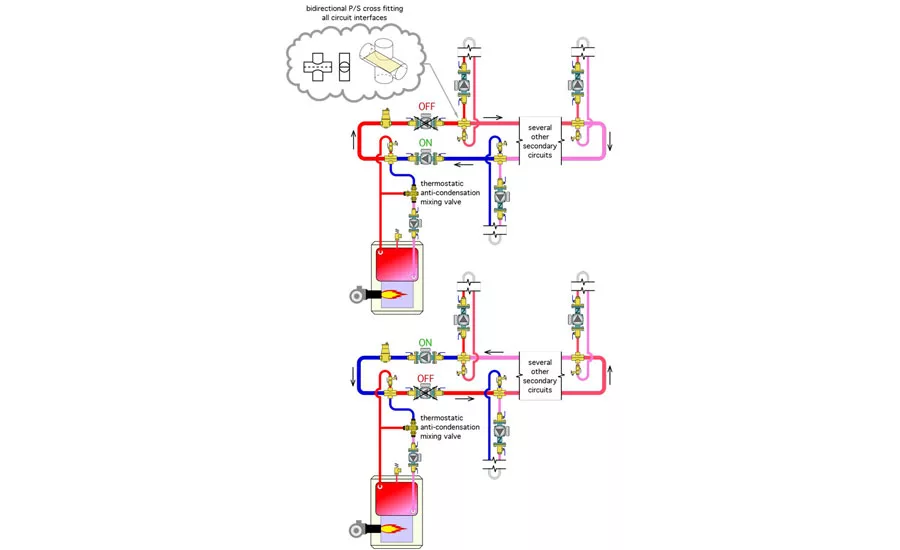
There are hydronic design concepts in which flow must pass backward through a nonoperating circulator, perhaps thousands of times over the life of the system. One example is periodic flow reversal through a circuit with several series-connected secondary loads as shown in Figure 1.

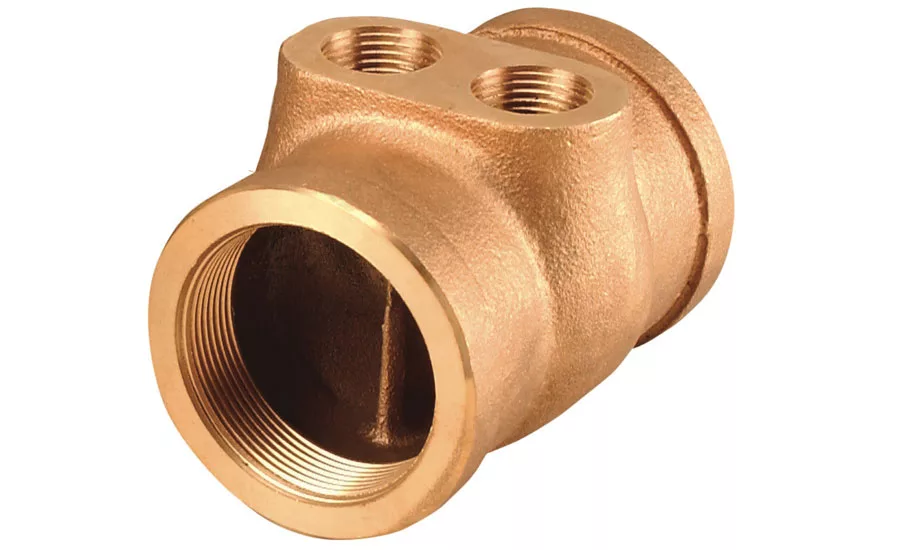
This system relies on a specific type of fitting where the secondary circuits, including the boiler circuit, connect to the primary loop. One such fitting, the “Twin-Tee,” is manufactured by Taco Inc. Figure 2 shows an example of this fitting.

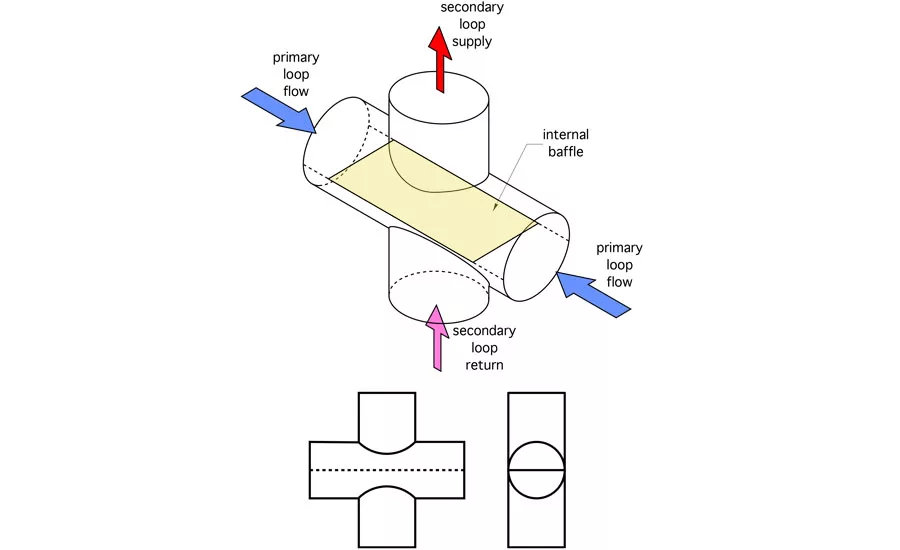
Another possibility would be to fabricate a fitting by brazing a baffle plate into a cross fitting as illustrated in Figure 3.

Primary flow can enter the run of these fittings from either direction. However, the flow direction through the secondary circuit will not change. The internal baffle prevents direct mixing between the supply and return sides of the secondary circuit. The supply and return ports for the secondary circuit are also located at the same pressure location along the primary circuit, which provides excellent hydraulic separation.

Looking for quick answers on air conditioning, heating and refrigeration topics? Try Ask ACHR NEWS, our new smart AI search tool. Ask ACHR NEWS →

Periodic flow reversal through the primary loop would, over time, provide the same average supply water temperature to each secondary circuit. This corrects for the inherent drawback of decreasing supply water temperature in circuits where multiple loads are connected in series. The greater the design temperature drop along the primary loop, with all circuits operating, the greater the benefit of periodic flow reversal.

The operating logic for the system shown in Figure 1 is simple: One primary loop circulator operates for a given time; it then shuts off, and the other primary circulator operates for the same elapsed time. A duplex circulator controller could be used to keep track of the running hours on each primary loop circulator and equalize them over time. Primary loop flow would always pass backward through the circulator that’s off.

UP, DOWN, UP, DOWN

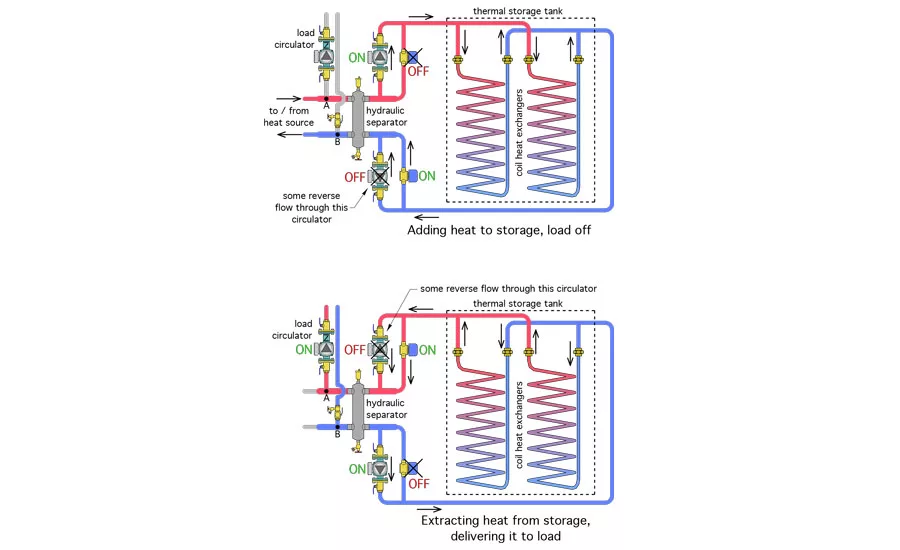
Another application where flow reversal is useful is when a coil heat exchanger within a thermal storage tank is used for both heat input and heat extraction. Flow reversal would be necessary to preserve temperature stratification within the tank and maximize the average temperature difference at which the heat exchanger operates. Figure 4 shows a possible piping configuration.

The upper piping assembly in Figure 4 shows heat being added to thermal storage. The load circulator could be on or off. If on, it draws hot water coming from the heat source at point A. Any flow not pulled to the load passes through the hydraulic separator and downward through the coil heat exchangers.

The tees where the load circuit connect to the system (e.g., points A and B in Figure 4) should be kept as close to the hydraulic separator as possible. To prevent mixing within the hydraulic separator, the flow rate from the heat source should always be equal to or greater than the flow rate created by the load circulator.

The lower piping assembly in Figure 4 shows heat being extracted from thermal storage and sent to the load. Flow is now passing from the bottom of the coils to the top, optimizing the temperature differential across the coils. If the heat source turns on, the flow would reverse.

Figure 4 also shows two electrically operated valves in parallel with the coil circulators. These could be zone valves or motorized ball valves. When one of these is turned on, it channels some flow from the coils around the adjacent circulator that’s off. This reduces the reverse flow through that circulator. These valves should have high Cv ratings to minimize pressure drop.

QUESTIONS REMAIN

The piping configurations  shown are rational solutions for accomplishing reverse flow, but there are still several questions that need answers. For example: Is it even necessary to have the two motorized valves shown in Figure 4? If they were eliminated, all flow from the coils would pass backward through the circulator that’s off. Eliminating these valves would obviously be simpler and less costly, but would routing all coil flow backward through the circulator create any problems? Another possibility would be to install check valves in both circulators to prevent any reverse flow and have all flow pass through the motorized valves. Which of these approaches is better?

To help answer such questions, we need to know more about reverse flow through the circulators. Here are a couple more questions in that regard: What is the head loss versus flow rate when flow is moving backward through a specific circulator? Could any conditions develop that would be harmful to a circulator when flow is passing backward through it? For example, is there any possibility an impeller that is treaded to the motor shaft could unscrew itself if subject to reverse flow over a long time? Another question: Could reverse flow through a circulator with an electronically commutated motor (ECM) cause the impeller to spin backward and thus spin the permanent magnet rotor within the stator poles, inducing an electrical generation effect?

These questions could be answered by installing a circulator in a test stand and forcing flow through it in reverse at different flow rates. Data for flow versus head loss could be captured and plotted. The resulting curve could then be used to assess the parasitic head loss characteristic of the circulator. This would help answer questions such as: Are the motorized valves shown in Figure 4 essential or just a waste of money and material?

Any potential electrical feedback could also be assessed during such a test.

A FINAL PLEA

Let me close the column by politely asking any circulator manufacturer who reads this to consider doing reverse-flow testing on some of their circulators and making specific recommendations based on the results of those tests.

Having this support would help refine designs for hydronic assemblies, such as those we’ve discussed. I would welcome further discussion on the subject.  

KEYWORDS: circulators hydronics

Share This Story

Looking for a reprint of this article?
From high-res PDFs to custom plaques, order your copy today!


John Siegenthaler, P.E.
Principal of Appropriate Designs
john@hydronicpros.com

The third edition of his book, Modern Hydronic Heating,
is now available. For details, visit www.hydronicpros.com.
 

Recommended Content

JOIN TODAY
To unlock your recommendations.

Already have an account? Sign In

  • HVAC-enrollment

    The Trades Are Back: HVACR Programs See Nearly 30% Enrollment Spike

    A new wave of future technicians is entering the pipeline.  
    Training and Education
    By: Matt Jachman
  • 2025 Top 40 Under 40

    2025 Top 40 Under 40 HVACR Professionals List

    The 11th annual Top 40 Under 40 list highlights those...
    HVAC Residential Market
    By: Hannah Belloli-Oster
  • LG Ductless Mini-Split Systems

    The 9 Types of Heat Pumps

    As the U.S. moves toward electrification, heat pumps are...
    Air Source Heat Pumps
    By: Joanna R. Turpin
Subscription Center
  • Create an Account
  • Start a Subscription
  • Manage My Account
  • Sign Up for Newsletters
  • Visit Customer Service
  • Update Preferences

More Videos

Sponsored Content

Sponsored Content is a special paid section where industry companies provide high quality, objective, non-commercial content around topics of interest to The News audience. All Sponsored Content is supplied by the advertising company and any opinions expressed in this article are those of the author and not necessarily reflect the views of The News or its parent company, BNP Media. Interested in participating in our Sponsored Content section? Contact your local rep!

close
  • Piggy Bank
    Sponsored byWatercress Financial

    Energy Prices, Inflation, and HVAC: What Today’s Homeowners Care About

  • Refrigerated Food
    Sponsored bySolstice Advanced Materials

    R-455A Refrigeration: A Cold Storage Solution for the Future

  • Airex Rooftop Units
    Sponsored byAirex Manufacturing Inc

    Consolidating Roof Penetrations: A Growing Trend in Multifamily HVAC Design

Popular Stories

HVAC-Price-Increase-graphic

HVAC Price Increase List: June 2026

Trump-Section-232.jpg

Trump Reduces Section 232 Tariffs on HVAC Equipment to 15%

R410A-Refrigerant-Cylinder.jpg

Refrigerant Recovery is a Revenue Opportunity

Heat-pump-cutaway.jpg

PFAS Rules and A2L Building Codes Continue to Evolve

Kroger.jpg

Kroger to Spend $100 Million to Reduce Refrigerant Leaks

View The ACHR NEWS
Centennial Anniversary Timeline

The ACHR News Timeline Chart
Submit a Letter
Submit a letter to our editors.

Events

November 6, 2025

Next-Gen Data Center Cooling: HVAC Innovation and Real-World Solutions

On Demand As AI workloads and high-density computing push traditional cooling methods to their limits, the data center industry is accelerating the adoption of next-generation HVAC technologies.

June 9, 2026

Before You Go All In on AI: Set Up Your Business to Actually Win

In this webinar, we'll walk you through exactly what to get in place before you add AI to your business. You'll leave with a clear picture of where you stand today and a practical action plan to set yourself up for real results.

View All Submit An Event

Poll

Summer Staff

Are you fully staffed for the summer season?
View Results Poll Archive

Products

BNI Mechanical/Electrical Square Foot Costbook, 2026 Edition

BNI Mechanical/Electrical Square Foot Costbook, 2026 Edition

See More Products
A2L Refrigerants - Free Webinar - May 21, 2026

Related Articles

  • The effects of retrofitting on an older display case

    See More
  • The Effects Of The Temporary Tax Cuts Of 2003

    See More
  • The Effects Of Sept. 11 On The Industry

    See More

Related Products

See More Products
  • Uncomplicating The Heat Pump: Refrigeration & Air Flow Systems DVD

  • EHEP002028.jpg

    Principles of Heating, Ventilation, and Air Conditioning in Buildings, 1st Edition

See More Products

Related Directories

  • CAST-X Circulation Heaters

    CAST-X Circulation Heaters can heat high-purity liquids and gases, high pressure gases, and flammable media. CAST-X Circulation Heaters are perfect for many industrial and consumer liquid & gas heating processes.
  • Applied Flow Technology (AFT) (Manufacturer)

    Founded in 1993, Applied Flow Technology is an international leader in the pipe flow modeling software market with a comprehensive line of products for the analysis and design of piping and ducting systems.
×

Sign Up. Stay Informed.

The #1 trusted source for the HVACR industry since 1926

SUBSCRIBE
  • RESOURCES
    • Advertise
    • Contact Us
    • Advisory Board
    • Classifieds
    • Submit a Letter
    • Directories
    • Store
  • ACCOUNT CENTER
    • Create an Account
    • Start a Subscription
    • Manage My Account
    • Sign Up for Newsletters
    • Visit Customer Service
    • Update Preferences
  • SERVICES
    • Marketing Services
    • Reprints
    • Market Research
    • List Rental
    • Survey/Respondent Access
  • STAY CONNECTED
    • LinkedIn
    • Facebook
    • Instagram
    • YouTube
    • X (Twitter)
  • PRIVACY
    • PRIVACY POLICY
    • TERMS & CONDITIONS
    • DO NOT SELL MY PERSONAL INFORMATION
    • PRIVACY REQUEST
    • ACCESSIBILITY

Copyright ©2026. All Rights Reserved BNP Media, Inc. and BNP Media II, LLC.

Design, CMS, Hosting & Web Development :: ePublishing