Supermarket Refrigeration Systems Are Constantly Evolving
A host of new technologies and refrigerants offer contractors numerous options
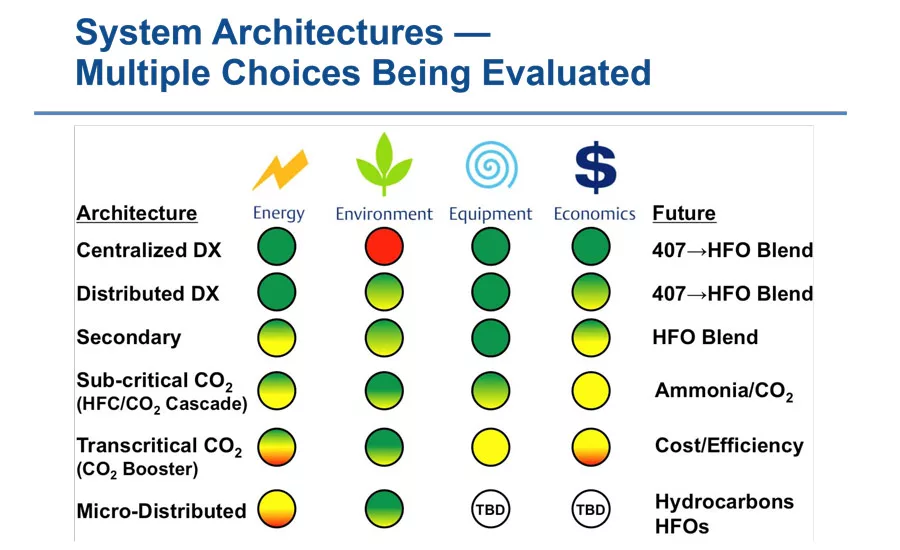
MANY FACTORS: While several architecture systems will comprise the supermarket refrigeration market of the future, specific choices will be made based on the needs of individual stores. Graphic courtesy of Emerson
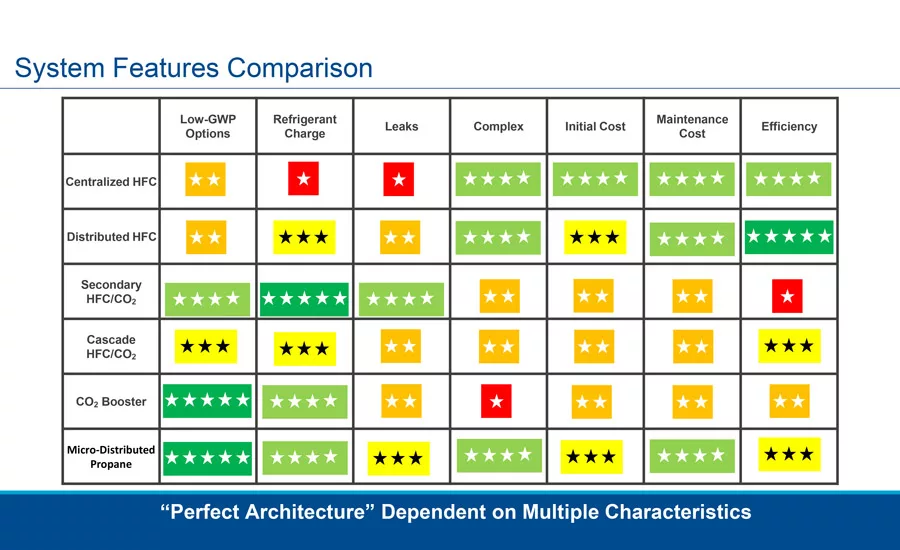
FEATURES COMPARISON: This comparison of system features shows how some of the current and emerging supermarket refrigeration system architectures stack up. Graphic courtesy of Emerson
When it comes to talking about emerging refrigeration system architectures for supermarkets, it’s good to start by taking a deep breath.
The days of centralized direct-expansion (DX) systems aren’t necessarily over, but those systems have been joined by a host of new technologies, including distributed systems in which smaller refrigeration units are located near the cases they serve; primary/secondary systems in which a small charge of refrigerant cools another heat transfer fluid (such as glycol) that is pumped out to the cases; subcritical and transcritical carbon dioxide (CO2) systems; microdistributed systems, which are similar to distributed systems that can be designed to send chilled water rather than refrigerant to the cases; and stand-alone cases. And, don’t forget the changing refrigerants: hydrofluorocarbons (HFCs) are on their way out, and naturals, hydrocarbons (HCs), and hydrofluoroolefins (HFOs) are on their way in. Finally, just to keep things interesting, keep in mind that more than one of these system architecture types can be used within the same supermarket.
What does this all mean for contractors?
To answer that question, Don Newlon, vice president and general manager, refrigeration marketing, Emerson’s Commercial and Residential Solutions business, advised stepping back and looking at the situation from supermarket clients’ point of view.
“Customers aren’t pursuing refrigeration architecture because of the architecture itself but because of the benefits they want to receive from it,” Newlon said. “Choosing a refrigeration system used to be all about energy efficiency, but many customers today have different things they’re trying to optimize. Energy efficiency is still important, but many customers also are seeking to reach environmental or sustainability goals — in fact, for some, that’s their primary motivation. So, be aware that there will be some segmentation of the end-user base depending on customers’ particular goals.”
Andre Patenaude, director, CO2 business development, Emerson’s Commercial and Residential Solutions business, noted that technological advances are coming fast and furious in commercial refrigeration, especially as newer systems benefit by having advanced electronic controls onboard.
“Taking advantage of the lower cost and greater capability of today’s electronics is a big deal,” Patenaude said.
Looking for quick answers on air conditioning, heating and refrigeration topics? Try Ask ACHR NEWS, our new smart AI search tool. Ask ACHR NEWS
He added that technological advances are helping CO2 systems operate at higher ambient temperatures, thus broadening their use into warmer climates. And, the advances flow back and forth from existing technology to emerging technology.
“Many of the strategies that are being used in CO2 systems today were taken from other types of architectures,” Patenaude noted. “And many of the energy-saving features on CO2 systems can actually be applied to current HFC systems if end users want to keep their old systems but reduce their energy footprints and maintenance costs. There are ways of significantly improving the systems they already have.”
Patenaude cited the example of a typical centralized HFC system that sends R-404A directly out to the medium- and low-temperature cases by direct expansion. Incorporating a plate heat exchanger into that system can allow it to pump glycol instead, which reduces the HFC charge by eliminating thousands of feet of copper lines filled with refrigerant running out to the cases.
That primary/secondary arrangement can also be used to pump CO2 out to the cases.
“CO2 is another refrigerant, but it has a global warming potential [GWP] of 1, and your pumping forces when used as a secondary fluid are about 10-times less than pumping glycol,” Patenaude said.
Propane is also poised for tremendous growth as a refrigerant in the U.S., and although it is generally thought of only for smaller, self-contained cases because of its charge limit of 150 grams per refrigeration circuit, Patenaude explained that integrated display cases that combine a number of circuits could make for easy plug-and-play operation.
Newlon and Patenaude agreed that some end users may not be comfortable with CO2 because of its higher operating pressures or propane because of its potential flammability. Those customers seeking the lowest GWP nonflammable refrigerants may find good options among the growing number of HFOs and HFO blends, such as R-448A and R-449A.
“We’re developing and will continue to develop HFO-relevant products as well as continuing our training courses on CO2 and other alternative refrigerants, because we think end users are looking at all their options,” Newlon said. “It’s not going to be any one thing that dominates the market in the future. Given that, we think the best advice for supermarket contractors is to discuss what their end users’ long-range plans are. Learn what’s important to them and then help them understand the system architectures that would be the best options for their stores.”
HURDLES TO NEW TECHNOLOGY
Matt Larison, regional manager, supermarket division, east/southeast territory, DEEM Mechanical and Electrical Co., Indianapolis, said he thinks the supermarket industry’s ultimately headed in the direction of direct-expansion CO2 systems. One thing holding back the move to CO2 is that it can’t be retrofitted into existing systems, which requires an investment in new equipment.
A larger problem, however, is one that is all too familiar at every level of the HVACR industry: a lack of qualified personnel to work on the systems.
“There’s a very serious shortage of technicians, and it’s getting worse all the time with more technicians leaving the industry each month than coming in,” Larison noted. “With a shift toward CO2 and fewer people coming into the business, it’s going to be even harder to work on those systems. Everybody is trying to get away from conventional refrigerants and move toward CO2 systems; the problem is nobody knows how to work on them.”
Along with the move toward CO2 systems, Larison added there is a push toward case controller systems, which is an older technology from Europe that is fairly new to the U.S.
“[Case controllers] offer tight control of product temperatures with fast recovery times after defrost, but, again, it’s an advance in technology that is pretty new to a lot of old-school refrigeration guys,” he said.
REFRIGERANT UNCERTAINTY PERSISTS
Despite — or, perhaps, because of — the recent court decision that ruled the U.S. Environmental Protection Agency (EPA) could not phase out HFCs because it was overstepping its authority under the Clean Air Act, uncertainty over refrigerants persists.
Pete Savage, head of the controls division at AAA Refrigeration in New York City, said he is seeing a large push for distributed systems as well as an increase in self-contained propane cases. Some smaller grocery stores are using chilled water loops around the stores to feed small, self-contained water-cooled units.
In larger stores, HFO-based refrigerants will play a role, particularly in systems retrofitted from HFCs. But, Savage said their chances of being the first-choice option in new construction projects may be hindered by uncertainty about where the EPA may set the GWP bar.
“It wasn’t that long ago that we started doing conversions from R-22 to R-407A, and now 407A is on the EPA’s list to be chopped,” he said. “It makes it difficult for contractors to help customers select what gas to use because we don’t know what the EPA might add to its list next.”
Uncertainty over refrigerant phaseouts also plays a role in the growth of distributed systems, Savage noted.
“One of the reasons distributed systems are on the increase is the idea of reducing the refrigerant charge,” he said. “It used to be that you reduced the charge just to be green. Now, we seek to reduce the charge because no one knows the next refrigerant the EPA may decide to phase out, and, obviously, the conversion on a smaller system is much less costly than it is on large central rack.”
In the long run, Savage sees transcritical CO2 as the direction most mainstream grocers will follow, especially as the technology improves with advancements, such as parallel compression and injector technology, that make it more suitable for use in all climates.
“The pros of a switch to transcritical CO2 are its energy efficiency and positive impact to the planet,” he said. “The biggest con — although it isn’t exactly related to the technology itself — is the qualified technician shortage. At AAA, we’ve always been committed to educating our employees, but, as of late, we’ve increased our focus on education with the help of our suppliers and manufacturers. Everyone is affected by the technician shortage, and making the refrigeration industry more appealing to the younger generation is something we need to figure out as an industry.”
Supermarket Technology Briefs
- Danfoss announced the opening of its new monitoring center in Baltimore. The center will provide 24/7 assistance to its food-retail customers utilizing Danfoss Enterprise Services, a cloud-based service delivery platform tailored to supermarket and other food-retail applications. Danfoss reps said the center is designed to allow the company to provide support, such as 24/7 alarm monitoring, issue diagnosis, and service dispatching as well as energy management and optimization techniques. For more information, visit http://bit.ly/DanfossMonitoringCenter.
- Embraco’s Plug N’ Cool is an R-290 pre-charged sealed system that provides a plug-and-play solution designed to offer greater flexibility for store layout. According to Embraco, the Plug N’ Cool can simplify the installation process and negate the need for a machine room. It is designed for top-mounted reach-in coolers in grocery stores, supermarkets, and professional kitchens. For more information, visit http://bit.ly/EmbracoPlugncool.
- Emerson introduced the ProAct Alerts mobile app for iOS, a mobile application that delivers facility alarm notifications for supermarkets, convenience stores, restaurants, and similar commercial environments. It is designed to work with the company’s ProAct™ Services, which assists retail facility managers, store managers, and contractors in quickly and effectively responding to critical HVAC, refrigeration, and building alerts. The app is available for download from the Apple App Store. For more information, visit http://bit.ly/EmersonProAct.
- Hillphoenix has installed a CO2 booster system with ejector technology at Sprouts Farmers Market in Woodstock, Georgia. According to Jeff Newel, director of refrigeration systems research and development for Hillphoenix, ejector technology combined with parallel compression can yield significant savings in warm ambient areas, such as those found in the southern U.S. For more information, visit www.hillphoenix.com.
- Honeywell Intl. Inc. announced that Tesco, one of the world’s largest supermarket chains, is converting more than 1,200 stores across the U.K. to Honeywell’s Solstice® N40 (R-448A) refrigerant. Tesco is switching away from R-404A, a hydrofluorocarbon (HFC) with a global warming potential (GWP) of 3,943. According to Honeywell, Solstice N40 is a near drop-in replacement for R-404A, is nonflammable, and has a GWP of 1,273. Sixty stores have already been converted; the full conversion will be completed over the next three years. For more information, visit http://bit.ly/HoneywellN40.
Publication date: 9/4/2017
Want more HVAC industry news and information? Join The NEWS on Facebook, Twitter, and LinkedIn today!
Looking for a reprint of this article?
From high-res PDFs to custom plaques, order your copy today!