The Renaissance of Retrocommissioning
Building owners reap the benefits of energy-saving improvements
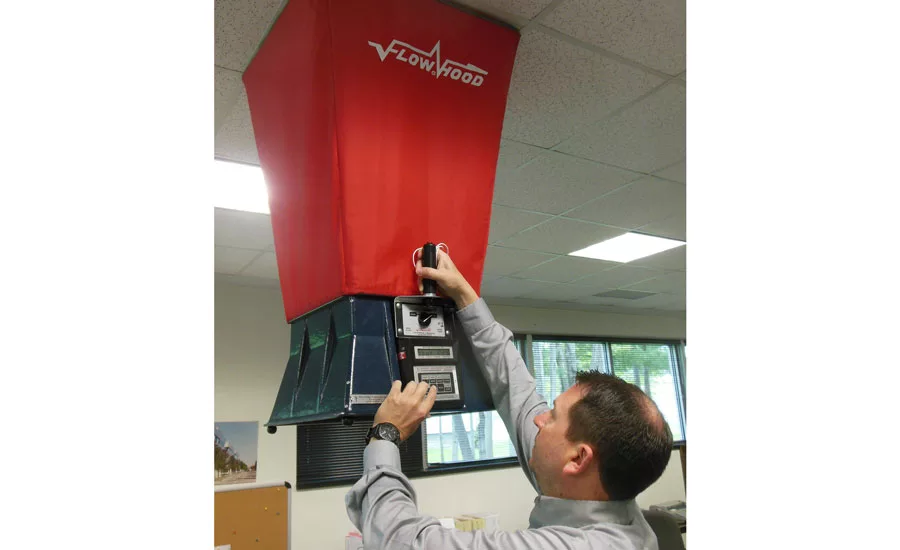
GO WITH THE FLOW: Nick Andrukat, service manager, Enterprise HVAC Service & Control, Twinsburg, Ohio, uses a flow hood during a retrocommissioning procedure.
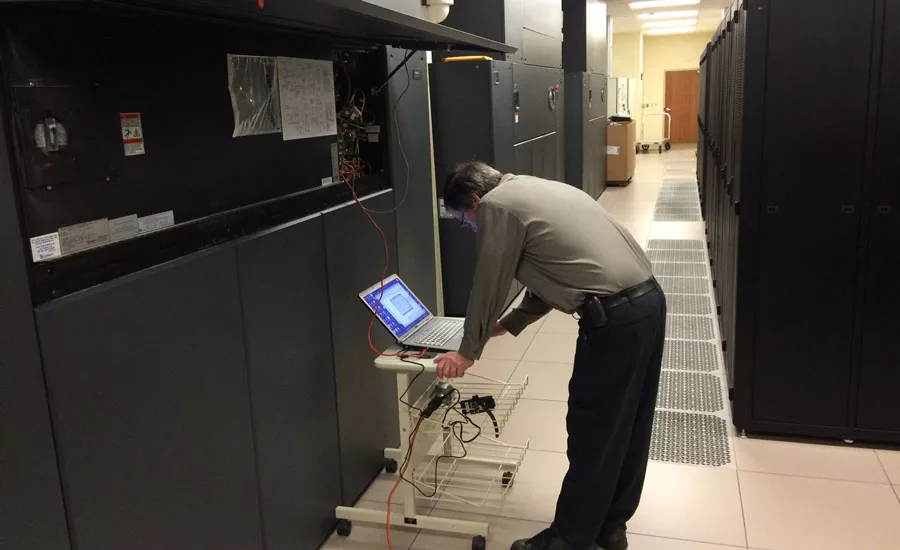
GOING RETRO: Andy Sabatini, HVAC service journeyman, Carnegie, Pennsylvania-based Ruthrauff Service, recommissions using a Liebert unit.
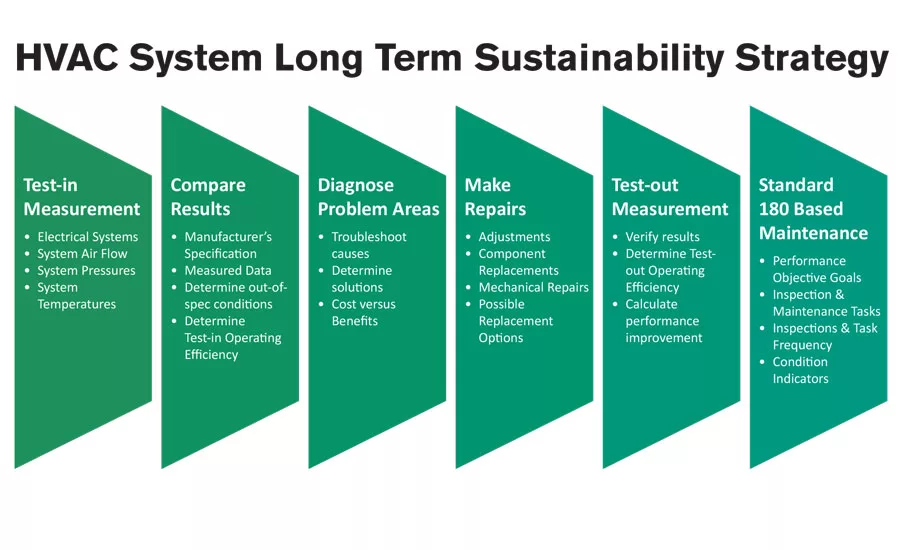
TESTING, TESTING: When performing retrocommissioning, it is necessary to test the equipment before and after the process. Illustration Courtesy of Aire Rite AirConditioning and Refrigeration.
Most in the HVAC industry know all about the commissioning process, which the National Environmental Balancing Bureau (NEBB) describes as “verifying and documenting that a facility and all of its systems, components, and assemblies are planned, designed, installed, tested, can be operated, and maintained to meet the owner’s project requirements.”
Properly commissioning an HVAC installation is a necessary process that ensures newly installed systems operate as intended.
An equally important process is retrocommissioning, which refers to identifying improvements that can increase the energy savings and performance of existing buildings. Considering that about half of all commercial buildings in the U.S. were constructed before 1980, it’s easy to see why there is a growing demand for contractors who offer retrocommissioning.
GOING RETRO
Many existing buildings are in poor shape, and through retrocommissioning, contractors are trained to identify problems and offer solutions.
Don Langston, president and CEO, Aire Rite Airconditioning and Refrigeration, Huntington Beach, California, and chairman of ACCA, often finds ductwork problems to be the biggest issue in existing buildings.
“Undersized return ductwork is the most common problem, followed by adapter curbs that leak both outside and between supply and return plenums and broken economizers,” he said.
During the retrocommissioning process, Langston often finds systems that are delivering only 50 percent of their rated capacity into the indoor conditioned space.
Looking for quick answers on air conditioning, heating and refrigeration topics? Try Ask ACHR NEWS, our new smart AI search tool. Ask ACHR NEWS
“Combine poor installation and service-related issues with inconsistent maintenance practices or, even worse, a run-to-fail scenario, and many systems operate far below the manufacturer’s AHRI [Air-Conditioning, Heating, and Refrigeration Institute] laboratory-rated efficiency.”
And even though building owners usually know they have a problem, Langston has found they tend to make repair decisions based on their level of pain and/or discomfort.
“Energy savings alone does not move very many customers to act,” he said. “Even in California, where electrical rates are second only to Hawaii, it is a lack of comfort or IAQ concerns that move them to spend money on repairs and improvements.”
Some of the problems that Richard Starr, president and CEO, Enterprise HVAC Service and Control, Twinsburg, Ohio, and former national chairman of Mechanical Service Contractors of America (MSCA), has uncovered during retrocommissioning include improper air pressures (zones that should be positive but are negative and vice versa), a lack of proper air changes per hour, and building controls that are not calibrated properly.
“For example, a global outside air sensor out of calibration by 10°F can result in systems trying to cool in heating season,” Starr said. “Sometimes, the biggest problem lies in the maintenance guy who runs the building. You may have to reduce the system’s complexity to his level of understanding.”
Retrocommissioning has been a part of Enterprise HVAC’s culture for more than 20 years as it goes hand in hand with the company’s HVAC service and building control business, said Starr.
“Retrocommissioning helps building owners and managers create environments that are conducive to productivity, safety, and good health,” he said. “As a result, the building operates more efficiently, there is less liability in terms of mold and IAQ problems, and there is the potential for higher rent revenues.”
Ongoing retrocommissioning is absolutely vital to the performance of a building, said Thom Brazel, general manager, Ruthrauff Service, Pittsburgh, and former national chairman of MSCA.
“Today’s buildings are extremely complex, and they live and breathe just like humans,” he said. “Thinking of them in those terms, over years of operation, our bodies operate differently. Our blood chemistry changes, our eyesight isn’t as good as it used to be, and our waistlines sometimes fall out of calibration. Buildings are very similar, in that some of the moving parts need to be repaired or adjusted, or they sometimes become obsolete.”
Brazel often finds older components that require adjustment, calibration, or replacement during retrocommissioning, and he considers those to be the easiest problems to correct. It gets challenging when the building use has changed considerably over its lifetime. For example, a building may have originally been constructed for manufacturing, but over time, it has been turned into office space.
“Besides the obvious differences in desired space conditions, you may discover challenges, such as code changes or building envelope deficiencies, that preclude the occupant from achieving the performance they want (or require),” Brazel said. “It’s not uncommon to find a building that simply can’t meet the required performance level without performing major surgery.”
THE PROCESS
At Enterprise HVAC, retrocommissioning services are directly related to HVAC, building controls, and system integration and usually involve one or more of these system problems: building pressure, lack of outside air, controls, air balance, water balance, zoning, humidity, design issues, lack of operator training, and excessive energy consumption.
“The process begins with a discovery period, where we conduct interviews with occupants,” said Starr. “This is followed by a problem analysis period, which leads to an estimate. The estimate determines the cost of the resolution, which may include design engineering and retrofits. The process can take anywhere from a couple of days to nine months, because we want to verify all system functions throughout the temperature extremes and changeover periods of the four seasons.”
Starr says the usual retrocommissioning process takes place as follows:
- Conduct a kick-off meeting;
- Develop the owner’s objectives;
- Field investigate and test existing systems;
- Develop an energy model of this building and compare it to similar buildings;
- Perform field repairs;
- Discuss any thoughts that might enhance building operation; and
- Give a final report and verbalize recommendations to the owner.
Once the building is recommissioned, Starr recommends a process be put in place to make sure it stays that way.
“It doesn’t take much for a system to fall out of alignment, because an operator chose to override an air-handling unit on a cold weekend when the building had a special function,” Starr said. “Forgetting to restore the schedule can result in 24/7/365 costly operation.”
Langston stresses the importance of testing existing systems before embarking on any repairs or replacements in order to assess the current system’s level of delivered efficiency.
“This allows us to identify defects in the installation and distribution system that, if corrected, will allow the delivered efficiency of the upgraded system to greatly improve.”
And once repairs are made, be sure to verify they work correctly.
“An efficient installation is our obligation to our customers,” Langston said. “We’ve been promising improved efficiency through higher EER requirements for years. No one else is more qualified or able to verify efficiency than we are as contractors. Airflow, temperature, and power consumption are invisible to the naked eye. Verification only occurs when you deploy protocols that measure its delivered efficiency.”
Ultimately, retrocommissioning benefits building owners, because equipment that is properly operated, maintained, adjusted, and calibrated is going to last longer, operate more efficiently, and allow for a healthier environment for its occupants, said Brazel. “Retrocommissioning also helps contractors stay in business. Most of what we do is provide solutions to problems, and problems change over time as buildings change. We’re helping our customers extend the life expectancy of their buildings by keeping them healthy.”
Publication date: 7/17/2017
Want more HVAC industry news and information? Join The NEWS on Facebook, Twitter, and LinkedIn today!
Looking for a reprint of this article?
From high-res PDFs to custom plaques, order your copy today!


