Optimizing Boiler Performance
Service, retrofits can keep systems running efficiently
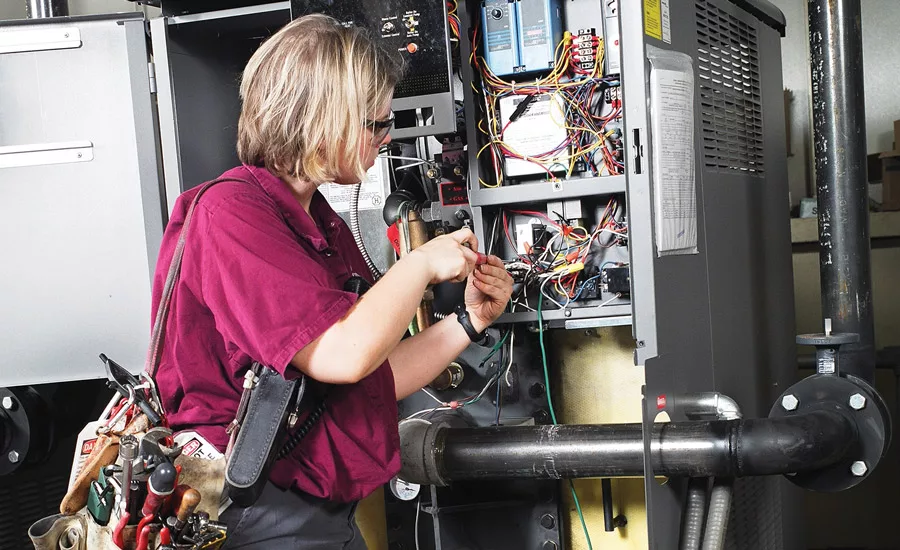
ALL WIRED UP: An electrician wires a boiler for connection to a building management system. PHOTO COURTESY OF LAARS HEATING SYSTEMS
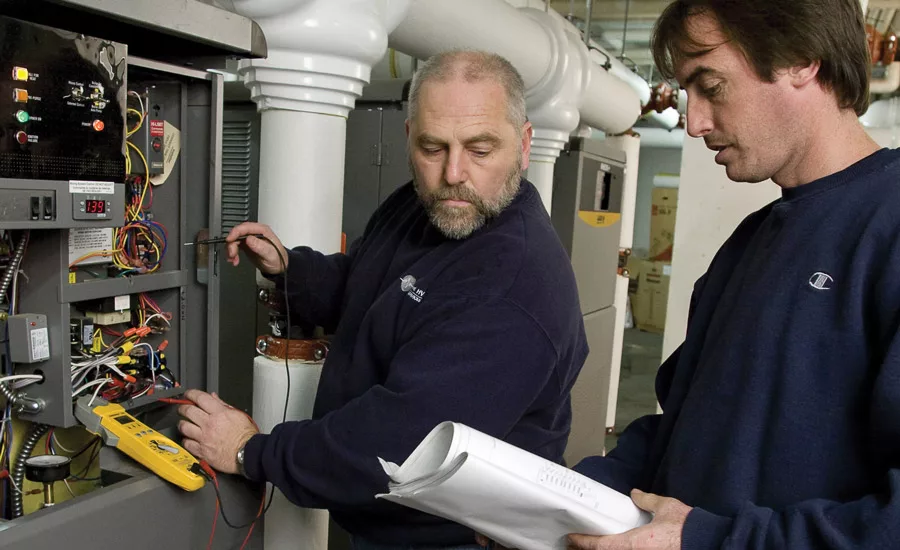
PROPER INSTALL: Ike Casey, president of Islip, New York-based Integrated HVAC Systems & Services, uses a voltmeter during installation of a Laars Rheos boiler/volume water heater.
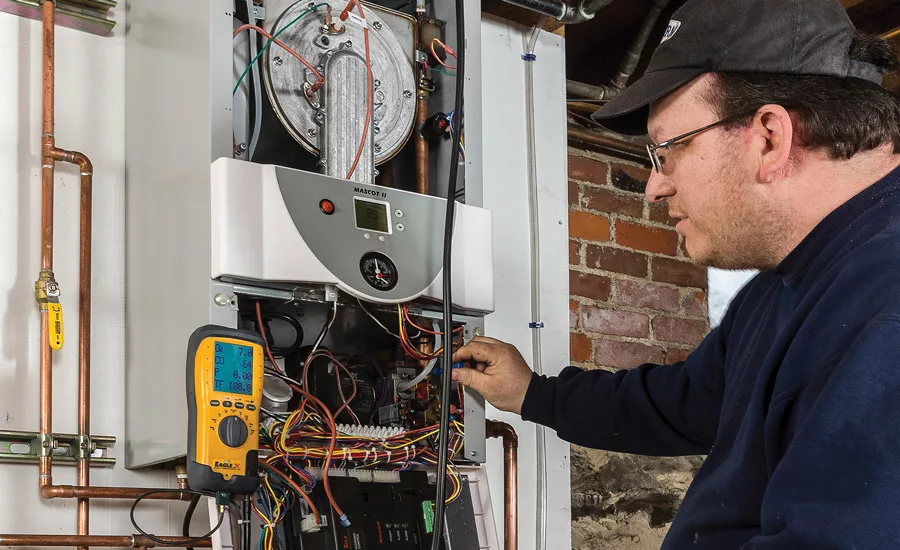
ANALYZE THIS: A technician adjusts a gas valve and measures CO2 during a combustion analysis for a Laars Mascot II boiler.
Most homeowners know they should have their boilers serviced at least once a year, but many do not realize just how profoundly the lack of regular maintenance can affect their equipment. If a boiler is not serviced regularly, products of combustion may build up on the heat exchanger, which may reduce heat transfer and result in lower energy efficiency and less comfort. In addition, safety, reliability, and longevity may be compromised if a boiler is not properly maintained.
Annual service not only helps keep boilers running efficiently, it gives contractors the ability to spot other potential problems, such as water leaks, piping problems, venting issues, and improperly functioning controls. Regular service also gives contractors the opportunity to suggest additional energy-saving measures, such as programmable thermostats, outdoor reset controls, and other smart retrofits.
REDUCED EFFICIENCY
So, just how much efficiency can be lost if a boiler is not properly maintained? That’s hard to say, but the ongoing buildup of combustion byproduct on a boiler’s heat exchanger can lead to a loss in efficiency of 5-10 percent or more, said Mark Hughes, national service manager, Laars Heating Systems Co. “And because these are mechanical systems, if settings and combustion performance drift out of the specific range for optimal burning, gas valve settings can move and efficiency will fall.”
Without proper care and regular maintenance, which includes cleaning the heat exchanger and monitoring water chemistry, the performance of a boiler will definitely decrease over time.
“Hard water can result in scale deposits, which lower the heat transfer rate and negatively effect boiler efficiency,” said Mike Boyd, product manager, Weil-McLain. “The insulating effect of deposits will cause the flue gas temperature to rise, which prevents condensation and, in turn, will decrease boiler efficiency at least 10 percent. As boiler efficiency decreases, homeowners may find their heating systems unable to maintain comfortable temperatures during extreme weather.”
The bottom line is that regular maintenance keeps boilers operating at their highest efficiencies by ensuring that the heat exchanger surfaces and burners are clean and combustion is optimized, said Don DeCarr, hydronic/warm air product manager, ECR Intl. “The byproducts of combustion can build up on the heat exchanger surfaces over time, insulating them and reducing their heat transfer capabilities. Dirty burners likewise do not perform to their designed efficiencies. Dirty heat exchangers and burners can also cause boilers to operate at higher temperatures due to the reduced transfer of heat. This can shorten a boiler’s life.”
Safety is another reason why regular boiler maintenance needs to occur.
Looking for quick answers on air conditioning, heating and refrigeration topics? Try Ask ACHR NEWS, our new smart AI search tool. Ask ACHR NEWS
“Yellow flames on gas burners and black soot on oil boilers indicate that the fuel is not burning properly. It’s good practice that all property owners with fuel-burning equipment install carbon monoxide detectors,” said Boyd. “When inspecting a boiler, contractors should also look for any signs of corrosion, overheating, or erosion as well as any leaks from the boiler or external piping. These items can be signs that the boiler is not working properly and should be repaired immediately.”
As part of a regular boiler inspection, Boyd suggests contractors check these items as well:
• Inspect the flame igniter and sensor for wear and/or replacement.
• Check the fresh-air intake and exhaust vents to be sure they are not obstructed by anything that could affect the boiler’s operation.
• Make sure the shut-off valves function properly. Check for water leakage.
• Check the refractory for integrity to ensure it is properly protecting critical portions of the boiler.
• Check for broken pieces or cracks and repair, if needed.
• Check the functioning of controls, safety devices, and indicators, including the low-water cutoff (LWCO) devices and regulators, pressure gauge, safety valves, and the pressure relief valve. Any that are not working properly puts the boiler at risk of major structural damage.
• Check the fuel-feed system and burners. They should be inspected and cleaned. Not doing so will result in inefficient combustion and heat transfer, which may result in higher fuel costs and less effective heating. Also, clean or replace any fuel filters so as to maintain effective fuel flow. Not doing so could cause damage to occur.
• Be sure to clean boiler heat transfer surfaces regularly to remove buildup. In the case of an oil-fired boiler, there may be soot residue. Soot can act as an insulator, which cuts down on the efficiency of the heat transfer between combustion gas and steam or hot water generation.
While regular maintenance is a necessity for all boilers, it becomes even more of a concern for certain types of high-efficiency boilers, said Hughes. “Modulating-condensing boilers are growing quickly within the HVAC industry, and, often times, they require more maintenance than mid-efficiency systems. The truth is, as the market has pushed the need for higher efficiency equipment, such as condensing-modulating systems, boilers, and burners may require multiple maintenance checks each year.”
RETROFIT OR REPLACE
As part of their regular maintenance process, contractors may want to suggest ways in which homeowners can save energy. “Existing boilers may benefit from outdoor reset controls — if they’re not already equipped — and programmable thermostats can also reduce energy consumption,” said DeCarr. “These two measures alone could shave 15-20 percent yearly from the fuel bill.”
Suggesting an outdoor reset control is a great idea, said Dan Rettig, product manager, Lochinvar LLC. “It would help save money, because it would change the temperature of the supply water as the outdoor temperature gets cooler or warmer. Evaluating the installation of more efficient pumps could potentially help with electrical consumption, as well, although the amount saved would depend on the application.”
One type of reset control that may help improve the energy performance of older, noncondensing, non-modulating on-off boilers is the FuelMizer from Taco Comfort Solutions. This outdoor reset switching relay is both a boiler reset control and switching relay and is designed to regulate the supply water temperature of a single boiler based on the outdoor temperature. With reduced supply water temperatures, substantial energy savings is achieved, said Dave Sweet, product manager at Taco.
“Typical energy savings is about 14 percent, though some customers have experienced up to 30 percent reductions in energy use once the FuelMizer is installed,” said Sweet. “The device is incredibly easy to install and set. Simply disconnect line voltage to the boiler, bring it into one side of the control, and bring it out the other side and back into the boiler. That’s it. Setup couldn’t be simpler — just dial it to the design temp, and that’s it. At design conditions, the default assumes the need for 180°F.”
Of course, there is a certain point at which boiler efficiency can no longer be sustained or improved and replacement becomes necessary — particularly if the boiler has not been maintained properly. “Poorly maintained boilers operated with very hard water can result in drastically reduced efficiency and performance due to hard water residue in a boiler heat exchanger and other components,” said George Woodcock, product manager, Rinnai America Corp. “Depending on the situation, it may be more cost-effective to replace the unit.”
And once that old boiler is replaced with a shiny, new, energy-efficient one, contractors have yet another opportunity to talk about the need for regular boiler maintenance. After spending thousands of dollars for a new unit, homeowners may be more willing to keep their investment working properly.
SIDEBAR: MOD-CON MAINTENANCE IN NINE STEPS
Residential boilers should be serviced annually, but if it is a modulating-condensing boiler, it may need to be checked more frequently. Mark Hughes, national service manager, Laars Heating Systems Co., suggests the following steps be followed when inspecting a modulating-condensing boiler:
1. When doing a routine inspection of the burner, first remove the burner itself. This will allow access to inspect the combustion chamber and see if any combustion byproducts have accumulated. Outside the burner chamber, check fans and blowers for buildup of dirt on the fins. If the boiler is equipped with filters on the makeup air, clean or replace them.
2. While checking all of the safeties and controls, be aware of the time it takes to light the boiler after each shutoff. Some boilers and controls require more time because of the post- and pre-purge and ignition timing.
3. With an atmospheric burner, it may be appropriate to allow the pilot to light but not to fire the main burners. Check the pilot flame and compare the inlet gas pressure to the factory recommendations.
4. Make sure all the electrical connections are secure. Check all wiring for overheating. Hardening or melting of wiring or connections is a sign of a more serious problem, such as chambers firing too hot.
5. Check the flue passages. These will indicate whether the boiler is burning properly. If there’s soot in the flue passage, the system may be running rich or have insufficient combustion air. If there’s moisture in the vent pipe, the system is running too cool.
6. Inspect the vent pipe. Look for any white, powdery residue that may be left behind from condensation taking place in the vent. Condensate is extremely acidic and can eat through the vent pipe material. Be sure to maintain stack temperatures above manufacturer minimums to prevent this.
7. Check all flame-sensing rods. Also, examine the spark rods to ensure they’re properly gapped. Always check the ceramic retainer that holds each of these to be sure there are no hairline fractures.
8. Check the condensate drain. Is the line free and is flow unobstructed? Is there sufficient acid neutralizer media in place?
9. When finished with the inspections and cleaning, make sure to fire the boiler and run through a proper combustion setup procedure. Is there proper combustion? Be sure to use a properly calibrated combustion analyzer to check the CO2 before leaving the job.
Publication date: 10/24/2016
Want more HVAC industry news and information? Join The NEWS on Facebook, Twitter, and LinkedIn today!
Looking for a reprint of this article?
From high-res PDFs to custom plaques, order your copy today!