New A/C Reporting Rules Coming
HVAC distributors, contractors must abide by new requirements as of Aug. 15
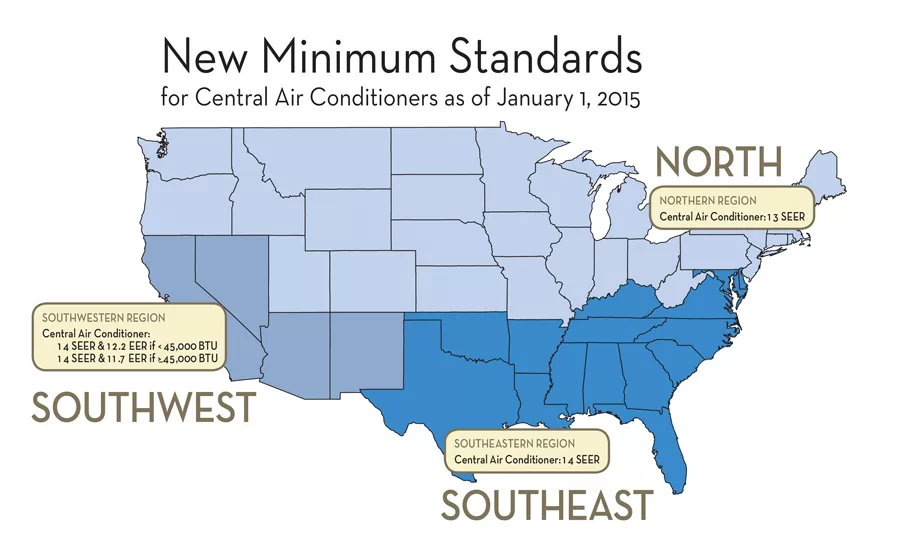
As of Jan. 1, 2015, minimum efficiency standards for residential split-system and single package central air conditioners are dependent on the region in which the equipment is installed.
On July 14, the U.S. Department of Energy (DOE) issued a final rule that officially puts new recordkeeping requirements in place as of Aug. 15 for the sale and installation of split-system and single package central air conditioners (see below for details). These new requirements will directly impact all distributors in the U.S. and all installers in the Southeast and Southwest regions of the country.
NO SURPRISES
From when the DOE’s latest regional energy conservation standards for split-system and single package central air conditioners went into effect at the beginning of 2015 up until last month, the industry operated with no formal enforcement guidance in place from the department. Many in the industry have been frustrated by this delay in the rulemaking process, especially since the department had been sitting on a negotiated rulemaking since October 2014. The DOE finally published a notice of proposed rulemaking (NOPR) last November that was largely unchanged from what industry stakeholders negotiated, yet it still took until July of this year to finalize that rule and publish it in the Federal Register.
The final rule, according to Chuck White, vice president, technical and code services, Plumbing-Heating-Cooling Contractors — National Association (PHCC), is more or less what the working group negotiated at the end of 2014. White was part of the Regional Standards Enforcement Working Group and represented contractors in the plumbing, heating, and cooling trades during negotiations.
“There are really no surprises in there,” he said, adding that many contractors have been recording the necessary information all along as part of their normal recordkeeping. But, for those who haven’t been as diligent in their recordkeeping, the rule will have an immediate impact.
“For some contractors, this is going to add an extra year of file retention for those products, and, most likely, they’re not going to sort out air conditioners from everything else,” White said. “There are also some contractors who, once the job is done, don’t keep anything. That’s rather rare, but there are some out there.”
Jon Melchi, vice president of government affairs and business development for Heating, Air-conditioning & Refrigeration Distributors International (HARDI), also said the leaders at HARDI “didn’t see anything that wasn’t expected” in the final rule, which is not to say its members wholeheartedly supported it. Like White, Melchi also participated in the working group to represent the interests of HVACR distributors across the country.
“We’ve communicated about this thing since the working group finalized its proposal in October of 2014,” Melchi said, adding that the DOE’s delay in the rulemaking has caused a great deal of confusion for HARDI’s members. “We’ve communicated it to folks since then, but there are still questions coming in from some of the best in the business.”
Looking for quick answers on air conditioning, heating and refrigeration topics? Try Ask ACHR NEWS, our new smart AI search tool. Ask ACHR NEWS
STILL A BURDEN
In addition to the confusion caused by an 18-month delay in the enforcement rulemaking, the new requirements themselves will likely cost contractors and distributors both time and money.
White said that while many contractors already keep records of all of the required information, they may have to tweak how that information is recorded and retained.
“In a typical residential service call or installation, they’re dealing with jobs one by one per technician,” he said. “So, they’re tracking all that information and maybe tracking it electronically, but they’re not segregating air conditioners from furnaces or motors or other components.”
The new recordkeeping requirements may also place a burden on contractors who do not typically store customer information for four years and/or who do not store their customers’ information electronically.
“If you want to segregate air conditioning from all your other business, that’s going to incur some cost because people are going to have to start tracking that differently,” White said. “If you’re not retaining records for four years, you’re going to incur some cost. You’re going to have to hang onto records longer, which may mean you need more storage, more time to scan things in electronically, or whatever that might entail. There’s also maybe more detail. The list of things they want, you may not have that in your current format. You may have recorded that you sold Mrs. Jones this unit with the serial number on this date, but you may not have the distributor information. You may have to add more data for each job.”
Barton James, senior vice president of government relations for ACCA, which also served as a member of the working group, agreed there will be a cost to comply for some contractors.
“It all depends on their business models,” he said. “Some only do installations and aren’t interested in service, and it will impact them. Any time you’re required to do something, it’s a burden.”
White added that, for those who perform installations in multifamily residential buildings, they will be forced to pay much closer attention to which units are installed where and ensure that they properly document that information, which may require additional man-hours to accomplish.
“For larger projects, where people might be doing a 200- or 300-unit apartment complex, lots of equipment is shipped to a single job site. If you have a couple hundred serial numbers, contractors and distributors are going to have to be more careful about knowing where things went. It’s a lot of work to double check all the serial numbers. On the bigger projects, people are going to be looking at needing more verification than perhaps they did before.”
To compound matters, the DOE finalized its rule during the busiest time of the year, which may make it harder for some contractors to comply with the new recordkeeping requirements.
“It’s the end of summer — this is the busiest time of the season for our members,” James said. “To add something to contractors’ plates that they’re supposed to now pay attention to, it’s not good timing, especially since enforcement is focused on the South, where it doesn’t get any busier than this time of year.”
“People are busy running their businesses,” Melchi agreed. “This is going to be a challenge for a lot of folks, and I fear that because of the vast delay the DOE has had in pushing out these regulations, it’s only going to make it harder to communicate these things throughout the channel. It’s an enormous task to make sure people are doing the right things. People who are busy running their businesses and taking care of their employees in the industry doing their jobs don’t have time to monitor all the rules and regulations that come from the federal government.”
In addition to the regulatory burden placed on contractors and distributors, James stressed that the individuals most affected by these regulations are the end users.
“These standards are forcing a tax on the consumer,” he said. “With any new regulation, the cost gets passed onto the consumers. So, when the contractor, distributor, or manufacturer has to comply [with a new regulation], that cost ends up being passed onto consumers, and it’s tougher on contractors to absorb those costs. It makes quality installations and the things that are important to consumers even more difficult.”
SPREADING THE WORD
It is a top priority for industry organizations to make sure distributors nationwide and contractors in the Southeast and Southwest are aware of — and complying with — the new recordkeeping requirements.
“I believe that, by and large, HARDI members have been good about communicating,” Melchi said. “But, we also have to recognize that there are a lot of folks distributing equipment that are not HARDI members — or maybe not primarily HVAC distributors — who are servicing customers. At that point, it’s up to manufacturers to communicate that. And it’s a challenge to make sure everyone has their I’s dotted and their T’s crossed.”
White said PHCC has also been working to inform its members of the new requirements. “The messaging has gone out through a lot of channels, but it’s hard to hit everybody,” he said. “Contractor organizations like PHCC and ACCA have been putting the word out, as have distributor and manufacturer chains. HARDI has been very proactive about trying to make people aware. Everybody who is installing air conditioners has to buy them somewhere, and the overall network has been trying to get the message out.”
“It’s going to be a process,” James said. “We’re doing the best we can with the marketing. For some of our contractors, this will catch them off guard, and it may take them a while to get up to speed keeping records in the way that’s now required.”
Meanwhile, the DOE has created a website as well as a brochure containing information about regional standards enforcement, though the website is not current, nor is it easy for the average contractor or distributor to find, which is a huge problem, Melchi said.
“The DOE committed to a public affairs campaign, but aside from a website where you have to know how to find it, I haven’t seen anything from the DOE that’s targeted at contractors or homeowners,” he said. “I understand there are scarce resources for efforts like this, but that’s maybe something that should’ve been considered before we went down this path.”
The reality, he added, is that the industry signed off on this in a negotiated rulemaking, and now it has to comply.
“From HARDI’s perspective, it was trying to make the best of a bad situation. We didn’t think, having heard some of the proposals, that this was the least invasive enforcement plan we could get consensus on, but it is still more aggressive than what we think is necessary. We believe it disproportionately impacts the small businesses that make up the contractor and distributor community. So, we think we’re ready, but this is something that’s never been tried in this or any other industry. We’ll all be watching to see how it goes.”
RECORDKEEPING REQUIREMENTS
All distributors must now maintain the following records for four and a half years after the date of sale.
Split-System Central Air Conditioner Condensing Unit
• Manufacturer;
• Model Number;
• Serial Number;
• Date unit was purchased;
• Contact information from whom the unit was purchased;
• Date the unit was sold;
• Contact information of the purchaser (name/address/phone number); and
• Delivery address (if applicable).
Single-package Central Air Conditioners
• Manufacturer;
• Model Number;
• Serial Number;
• Date unit was purchased;
• Contact information from whom the unit was purchased;
• Date the unit was sold;
• Contact information of the purchaser (name/ address/ phone number); and
• Delivery address (if applicable).
Installing contractors in the Southeast and Southwest must maintain all of the information above and the address of the installation location and name of the purchaser for split-system central air conditioner condensing units, split-system central air conditioner indoor units (not including uncased coils sold as replacement parts), and single-package central air conditioners. These records must be maintained for four years.
Source: DOE/HARDI
Publication date: 7/25/2016
Want more HVAC industry news and information? Join The NEWS on Facebook, Twitter, and LinkedIn today!
Looking for a reprint of this article?
From high-res PDFs to custom plaques, order your copy today!