It’s All About the BAS
Automation’s future is driven by convergence, security, and mobilization
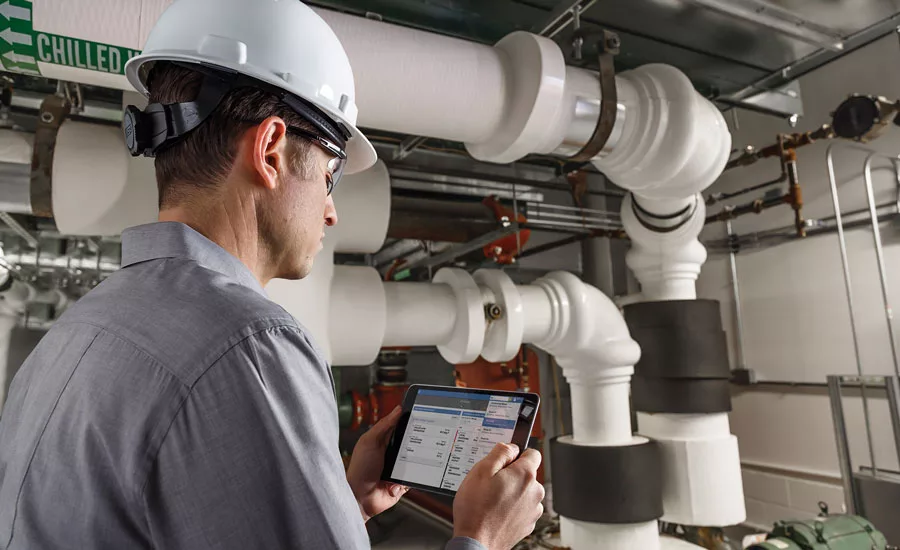
DATA DEPENDENT: A truly mobile building automation system user experience — one that is responsively designed and can be accessed from any device without downloading an app — is now more in demand than ever before. Photo Courtesy of Johnson Controls
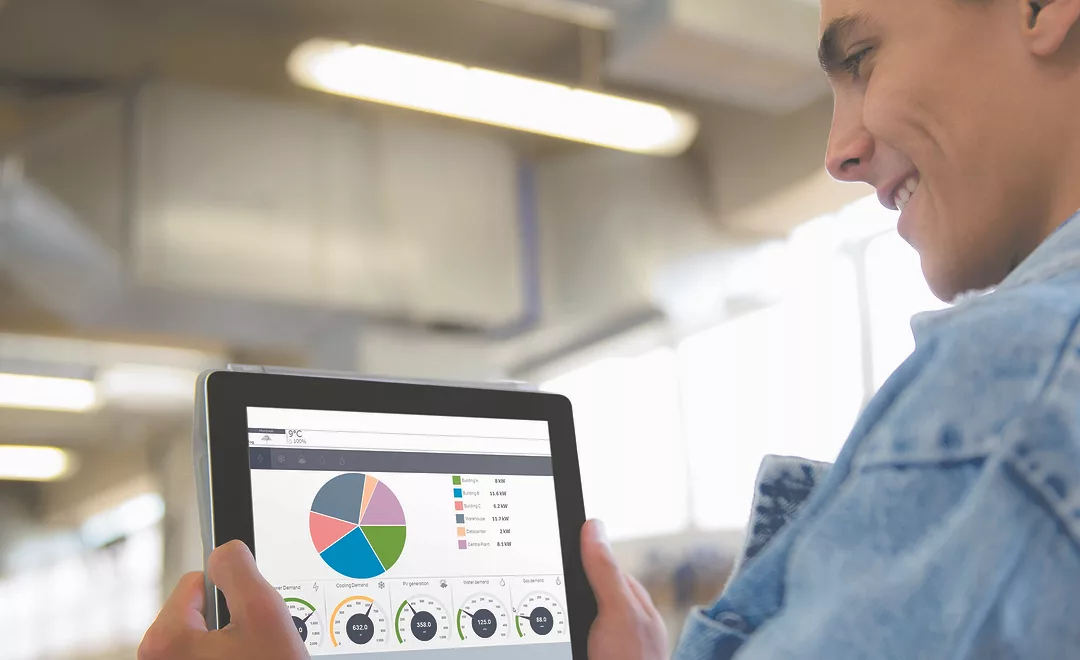
ON THE GO: Mobile technology continues to shape the BAS market with products like Distech Controls’ ENVYSION, a Web-based graphic design and visualization interface that enhances mobility.
The interest in building automation systems (BAS) continues to grow, with some reports forecasting the global market will reach $116.4 billion by 2020, up from $90.1 billion in 2014. There are many reasons for this predicted growth, including increased concern for cybersecurity, the move toward convergence and the Internet of Things (IoT), and the desire for a better mobile user experience.
As a result, building owners and managers are seeking experienced system integrators who can help guide them through the complex process of choosing a total BAS solution that goes well beyond just controlling the heating and cooling equipment. With consumer expectations soaring, the need will be strong for individuals who can solve integration issues, offer solutions that converge with a building’s information technology (IT) infrastructure, be well-versed in mechanical systems ranging from lighting to elevators to HVAC, and keep the systems updated and secure.
SAFETY FIRST
After the recent spate of high-profile cybersecurity breaches, it’s no wonder one of the biggest issues that concerns BAS users is cybersecurity. Companies are besieged by cyber threats that are becoming more frequent and sophisticated as hackers leverage unexpected entries into network infrastructures to steal companies’ data or disrupt their businesses, said Nazanin Hoglund, vice president of systems product management, Johnson Controls Inc. “This trend is driving customer demand for cyber-secure BAS products and installations.”
Vendors now need to build cyber-secure products with best-practice deployment and installation methods to ensure products are easily maintained and upgraded in the field, noted Hoglund. “BAS customers can no longer afford to purchase the initial BAS without a plan for keeping it current over the life cycle of their buildings. It’s imperative that both BAS vendors and the customers they serve stay current with product revisions and cybersecurity technologies to combat this dynamic and growing threat.”
Staying current with updates can be problematic, though, which is why cybersecurity is an issue that is far from being resolved, said Raphael Imhof, director of strategy, Siemens’ Building Technologies Division, and vice-chairman of the board, Continental Automated Buildings Association (CABA). “Anybody can make a network highly secure, but how do you make it economically secure so it can be maintained easily and offer the owner affordable upgrade paths? I think, in the classic BAS industry, we’ve had some road maps on how that could be solved, but with the IoT, we have more and more of these edge devices. It remains to be seen what the best solution is going to be.”
Imhof believes that with the advent of the IoT, there is the need for a standard that will provide affordable, reliable security measures that can easily be maintained. “There is so much innovation in the IoT space right now that a standard has to be coming, and it will be driven by IT companies. While the BAS industry expects BACnet to solve the problem of interoperable security, when it comes to IoT devices, we’re going to need innovation from IT companies to help us.”
IT companies definitely have a vested interest in providing help as the BAS industry is increasingly leveraging IT infrastructures to deliver total building management solutions. “By converging BAS with IT infrastructures onto a single backbone, we are able to minimize the impact on the building envelope, reduce installation costs, and offer truly connected real estate,” said Caroline Cadieux, global director of marketing and communications, Distech Controls Inc. “This empowers building owners and facility managers with the ability to improve occupant comfort and the user experience, which increases tenant satisfaction. Basically, the availability and adoption of IP [Internet protocol]-based control systems and Web services over IP [Internet protocols] networks has significantly contributed to making BAS part of building occupants’ everyday life.”
Looking for quick answers on air conditioning, heating and refrigeration topics? Try Ask ACHR NEWS, our new smart AI search tool. Ask ACHR NEWS
Convergence is, indeed, a huge trend, said Imhof, both in the technology space as well as the application space.
“There is a lot of convergence in network technology, because we are now bridging the gap between operation technology [OT] and IT organizations, where we not only use the same technology, but it is possible to be managed by the IT organization. I think that’s the next frontier. From an application standpoint, there is convergence between disciplines, such as lights, classic HVAC building controls, and even fire and security. These applications are coming together with common user interfaces to manage a building, which requires tighter integration of controls, even at the room level.”
GOING MOBILE
As more people are starting to interact primarily with mobile devices for online and digital needs, there is greater demand for mobilization in the BAS industry, said Robert Hemmerdinger, director of business development, Schneider Electric. “We’re seeing this trend in the way buildings are managed as facility managers look for mobile solutions to interact with building systems.”
Offering a mobile BAS user experience might sound obvious at first, but the shift to a mobile workplace is still happening, said Hoglund. “A truly mobile BAS user experience — one that is responsively designed and can be accessed from any device without downloading an app — is more important than ever. BAS users expect to be able to replicate what they do with their mobile applications in their personal lives while on the job. If contractors and engineers aren’t able to design and service the most intuitive, secure, and comprehensive BAS, they will lose jobs.”
That’s because end users today expect their BAS to be as simple to access, use, and maintain as possible, and they want to be able to access their BAS software from any device without installing software so they can ultimately be in control, even when they’re on the go, noted Hoglund. “Once they’ve accessed their BAS, they want to be able to quickly perform fundamental tasks including troubleshooting issues and maintaining operational efficiency. They also want the ability to summarize all of their equipment into a single view, so they can quickly conduct comparisons between similar equipment.”
Mobile technology is also shaping the BAS market in that it can complement and even replace sensors, devices, and occupancy detection, said Cadieux. “It also provides an opportunity for the industry to further offer solutions related to positioning and security. Bluetooth technology also holds a lot of potential for the BAS market, providing additional solutions for occupant engagement.”
In order to support the increasing number of mobile devices, many BAS are incorporating cloud technology, which can provide interesting insights, especially with the advent of the IoT, said Hemmerdinger. “Taking the data collected from these connected devices and bringing it up to the cloud infrastructure can have a meaningful impact on what is happening in a building. Consider outside air temperature sensors — nearly every BAS has them, and in any given city, there may be thousands. If nonproprietary data from all these systems are collected and compiled, we could learn a great deal about temperature patterns within a city. Today, we are only scratching the surface of what we can do with connected devices, and it will be interesting to see what we can learn from light, power, humidity, and temperature data collected over time.”
This data collection will become even more important as the BAS industry increasingly leverages IP-based technology, said Cadieux, because end users will demand that the increased data and connectivity be used to influence the performance of buildings. “They will expect their BAS providers to be able to analyze outside data, such as weather, as part of an overall intelligent system.”
Of course, to reap the benefits of better cybersecurity and mobile access, end users typically will have to upgrade their BAS, which can be a costly proposition. “We still see customers with dial-up modems,” said Imhof. “It can be expensive for customers to upgrade, which is why it’s important to stress the value proposition to them. For example, start with energy efficiency and IAQ — it’s much more difficult to analyze buildings with old technology, because you don’t have the bandwidth to trend. This might lead to a discussion about how it’s possible to make a building more efficient through analytics, but in order to really make this happen, it might be necessary to upgrade the building.”
As for cybersecurity, in many cases, the end users’ devices may no longer be supported, so their systems are not safe and secure. “There is a demand for companies like us to come in and help customers understand their risk exposure,” said Imhof. “A lot of customers don’t even know exactly what they have in the walls and ceilings. They need to know their risk exposure, but they don’t know all the devices they have for HVAC, the elevators, the lights, and who knows what else.”
With issues like these to be solved, there is going to be a huge demand for upgraded systems in the coming years. As Hemmerdinger noted: “BAS are the backbones and digital hubs of buildings, and as buildings become more intelligent, customers are going to demand more from their BAS. We don’t know all the future demands, but our goal is to build flexible architecture that can adapt as the market changes.”
Publication date: 5/9/2016
Want more HVAC industry news and information? Join The NEWS on Facebook, Twitter, and LinkedIn today!
Looking for a reprint of this article?
From high-res PDFs to custom plaques, order your copy today!